Free trial
A 7-day free trial applies to every paid plan. The initial conversation is free without a credit card.
Learn moreAn AI thought companion that remembers your story and matches you with a therapist
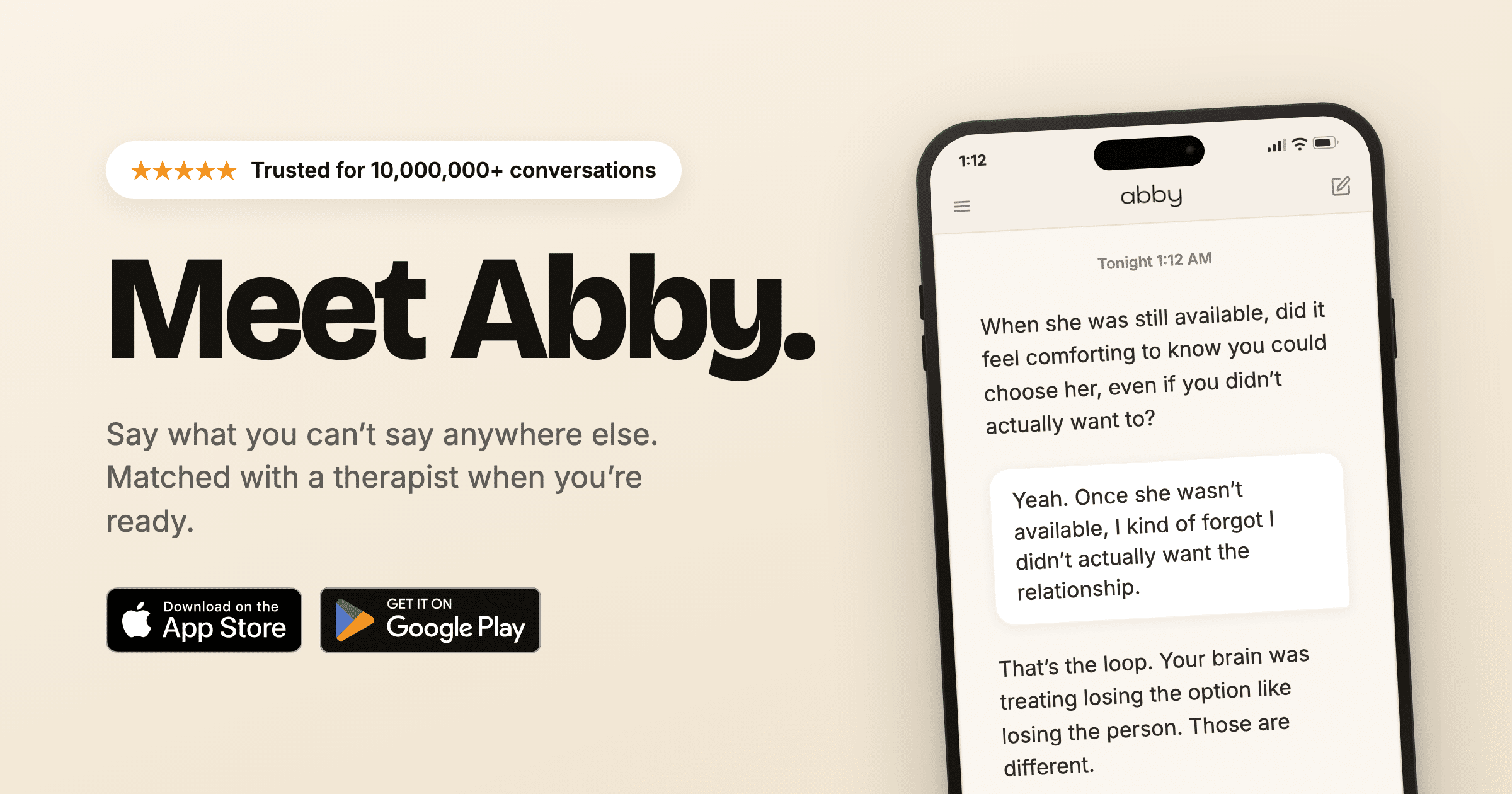
Abby is an AI thought companion for everyday mental health struggles. It remembers prior conversations, adapts its personality and tone to your preferences, speaks 88 languages, and offers free matching to licensed therapists when you want clinical care. It does not diagnose or treat.
Abby is an AI mental health companion built around memory. Where a general chatbot answers the message in front of it, Abby tracks what you have shared over time, stores the details, and links a new remark to something you said months earlier. The stated goal is to surface the pattern beneath the immediate complaint and ask the question that moves you forward, rather than to sound clever. It is available around the clock on iOS, Android and the web, and the company reports more than 10,000,000 conversations to date. The product leans hard on personalization. You choose the personality Abby adopts (professional and evidence based, an empathetic friend, a tough coach, or one of several other presets), how much she says, her tone, whether she pushes back gently or calls you out, and how often she checks in. She can also switch languages mid sentence across 88 supported languages while keeping the same memory of your history. Voice input is offered for nights when typing feels like too much. Therapist matching is the second half of the offer. When you decide you want clinical care, Abby draws on what you have already discussed to suggest licensed therapists with a fit rationale, such as a specific specialty, a preferred communication style, and available evening video slots. The matching service is free and the network is described as vetted, with thousands of licensed therapists. An enterprise and EAP tier covers companies, universities and healthcare systems, with the promise that employee conversations are never shared with employers. Abby is explicit that it is not therapy. It does not diagnose or treat, and the site positions it as the conversation before therapy: overthinking, a text you keep rereading, a decision you circle at 2am. It fits best as a low friction way to untangle thoughts between sessions or before committing to a therapist. People in crisis are directed to 988 or 911, so it is not a crisis service.
A 7-day free trial applies to every paid plan. The initial conversation is free without a credit card.
Learn moreThe first conversation is free with no credit card or appointment. Continued use requires a paid plan, and every plan starts with a 7-day free trial. The homepage does not state plan prices or tiers.
Learn moreEnterprise and EAP deployments can route people to in-network providers already covered by their plan. No third party app integrations are described on the homepage.
Learn morePersistent memory of your story, user-selected personality and tone, pushback level, daily or event-based check-ins, voice input, and 88 languages with mid sentence switching. Free matching to licensed therapists with fit rationale and availability. Enterprise deployment for companies, universities and healthcare systems with conversation privacy from employers.
 AI Angels400+ customizable AI girlfriends for NSFW chat, voice calls, and roleplay
 Candy AIExperience the future of companionship with AI friends who chat, role-play, and connect with you on a human level.
 ourdream.aiA vast AI roleplay platform with millions of characters for chat, images, video and voiceAI Angels400+ customizable AI girlfriends for NSFW chat, voice calls, and roleplayCandy AIExperience the future of companionship with AI friends who chat, role-play, and connect with you on a human level.ourdream.aiA vast AI roleplay platform with millions of characters for chat, images, video and voice