Integrations
Agents connect to CRM, ERP and custom applications through API integrations without coding, and reach customers over WhatsApp, Facebook Messenger, MS Teams, Telegram, web chat, voice, SMS and email.
Build and orchestrate specialized LLM agents without writing code
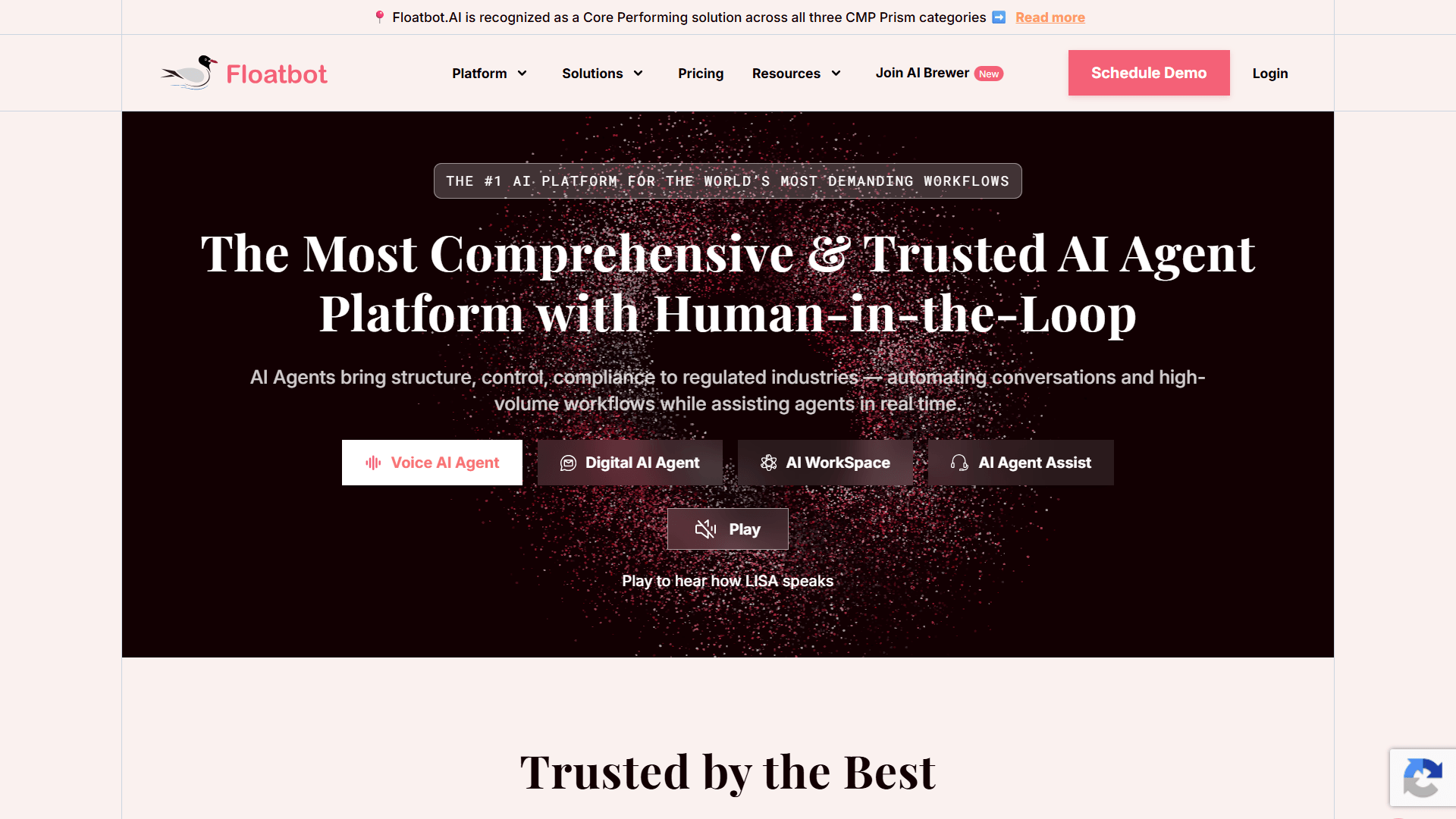
Agent M is an AI chat bot tool that builds and orchestrate specialized LLM agents without writing code. Agent M is Floatbot's no-code agentic framework for building multi-agent LLM assistants that chat, call APIs, search internal data and deploy across 15+ channels.
Agent M is Floatbot's agentic AI framework for building, training and running specialized LLM-driven agents. A master agent acts as a manager, coordinating smaller agents that each own a single process such as answering FAQs, pulling CRM records, booking meetings or completing a sales quote. The framework handles session management, long running memory and the routing between agents, so a conversation can move across several tasks without the user restarting. In practice, teams use the no-code studio to attach skills. Pre-defined skills cover common support and sales work (orders, tickets, calendars, CRM lookups), and custom skills can be assembled for narrower jobs like freight calculation or travel planning. Agents are grounded with uploaded documents and internal knowledgebases through RAG cognitive search, and they reach business systems through API integrations with CRM, ERP or custom applications. Guardrails include PII redaction and a verification layer aimed at reducing hallucination. Everything can be tested in a service terminal with live logs before it goes live. The model layer is deliberately open. Agent M runs on FloatGPT or on GPT, Claude, Gemini, Llama or a custom enterprise LLM, and deployment spans chat, voice, SMS, email plus channels such as WhatsApp, Messenger, MS Teams, Telegram and the web. Compliance claims include SOC 2, HIPAA and GDPR, with sensitive data excluded from model training. The tool suits contact centers, support and sales operations, and product teams embedding an assistant into their own application. It is closest to general agent frameworks such as LangChain, but it trades library-level flexibility for a managed, channel-ready product. Buyers should note that the homepage publishes no pricing, and that the breadth of the feature set means real value depends on how much of the integration and orchestration layer a team actually uses.
Agents connect to CRM, ERP and custom applications through API integrations without coding, and reach customers over WhatsApp, Facebook Messenger, MS Teams, Telegram, web chat, voice, SMS and email.
Multi-agent orchestration under a master agent, pre-defined and custom no-code skills, long-conversation memory and session management, RAG cognitive search over uploaded documents, API connections to CRM and ERP, PII redaction and hallucination guardrails, omni-channel deployment, a service terminal for testing with live logs, and support for FloatGPT plus third-party LLMs.
 AI Angels400+ customizable AI girlfriends for NSFW chat, voice calls, and roleplay
 Candy AIExperience the future of companionship with AI friends who chat, role-play, and connect with you on a human level.
 ourdream.aiA vast AI roleplay platform with millions of characters for chat, images, video and voiceAI Angels400+ customizable AI girlfriends for NSFW chat, voice calls, and roleplayCandy AIExperience the future of companionship with AI friends who chat, role-play, and connect with you on a human level.ourdream.aiA vast AI roleplay platform with millions of characters for chat, images, video and voice