Support
A contact page is available for enquiries, but no help centre, documentation or support tiers are described on the homepage.
Learn moreSee how leading AI models rank your company against rivals
Own AI Visibility Rank? Verify ownership to get a dofollow link

AI Visibility Rank is a prank AI tool. AI Visibility Rank tests how a company places when leading AI models are asked category questions. It runs prompts across GPT, Claude, Gemini, Grok, Llama, Sonar, Nova and DeepSeek, then reports comparative rankings plus AEO insights, with public trending lists for research.
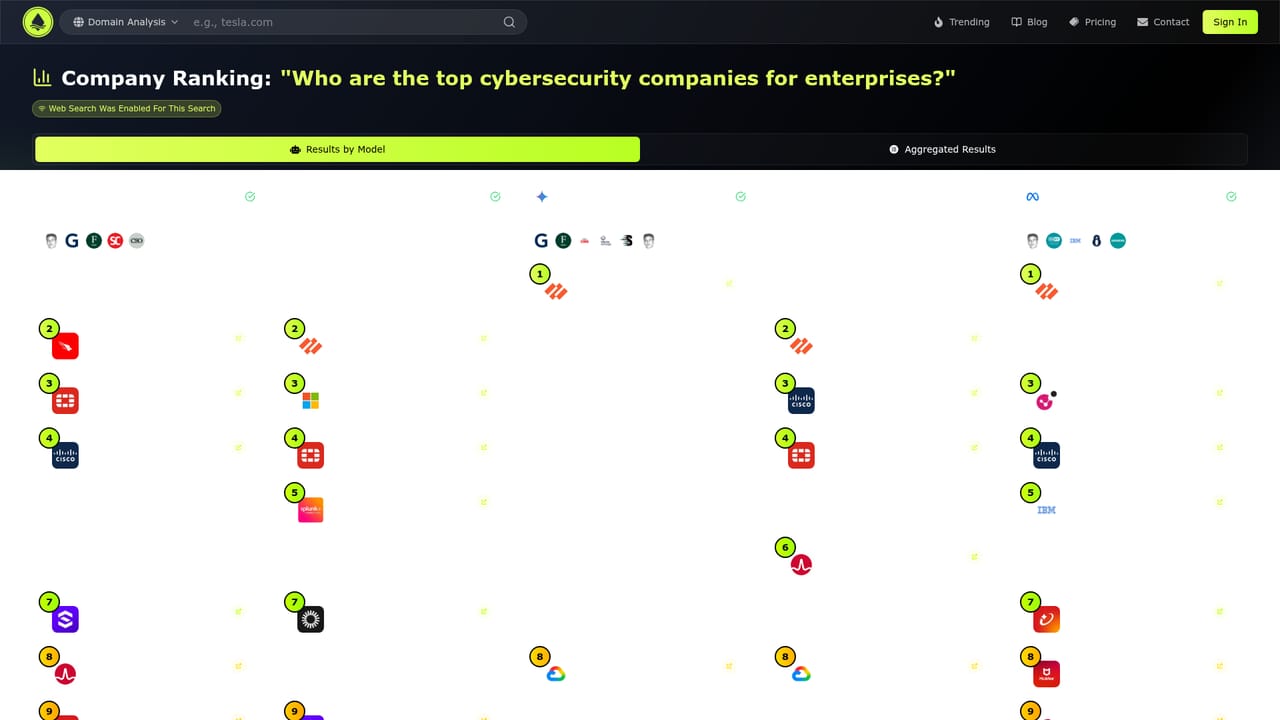
AI Visibility Rank is a market research tool built around a single question: when someone asks a leading AI model which companies lead in a category, where does your brand land? You submit a company domain and a question prompt, and the platform runs that prompt across a panel of models, then reports how your company and its competitors place in the answers. The model panel covers GPT 4.1, Claude 3, Gemini 2.5, Grok 3, Llama 4, Sonar, Nova Lite and DeepSeek, so results reflect a spread of vendors rather than one engine's opinion. The public side of the site doubles as a browsing layer for competitive research. Trending company rankings collect prompts such as who leads in enterprise cybersecurity, open banking APIs, industrial robotics, MLOps or EV charging networks, and list the companies that surface most often in AI answers for each theme. Each company entry carries a short profile, a category label and a count of the prompts it appeared in, which makes it easy to scan a vertical and see which names the models treat as default answers. In practice the tool suits marketers, SEO and AEO specialists, and competitive intelligence teams who need evidence for how their brand is represented in generated answers. It is less about traditional keyword rankings and more about share of voice inside AI responses, a measurement layer that classic rank trackers do not cover. Compared with broad SEO suites, AI Visibility Rank is narrow and research oriented, and it works best as a complement to a conventional search analytics stack. The site also markets an ExpertRanking module, and reports running totals for companies scanned, prompts analyzed and insights generated. Setup appears to be a form driven flow: enter a domain, enter the question you want tested, then choose whether web search is on and which models to include. Output is presented as comparative rankings rather than a single score. Buyers should treat it as a diagnostic, since the underlying answers from model providers shift between versions and over time.
A contact page is available for enquiries, but no help centre, documentation or support tiers are described on the homepage.
Learn moreThe core feature is multi-model ranking: one domain and one prompt are tested across GPT 4.1, Claude 3, Gemini 2.5, Grok 3, Llama 4, Sonar, Nova Lite and DeepSeek, with an optional web search toggle. Public trending company rankings group prompts by industry and show how many prompts each company appeared in. The site also markets an ExpertRanking module and tracks running totals of companies scanned and prompts analyzed.
 AI Angels400+ customizable AI girlfriends for NSFW chat, voice calls, and roleplay
 Candy AIExperience the future of companionship with AI friends who chat, role-play, and connect with you on a human level.
 ourdream.aiA vast AI roleplay platform with millions of characters for chat, images, video and voiceAI Angels400+ customizable AI girlfriends for NSFW chat, voice calls, and roleplayCandy AIExperience the future of companionship with AI friends who chat, role-play, and connect with you on a human level.ourdream.aiA vast AI roleplay platform with millions of characters for chat, images, video and voice


