AutoContent API

One REST API turns a single source into podcasts, videos, slides and quizzes

Advanced API
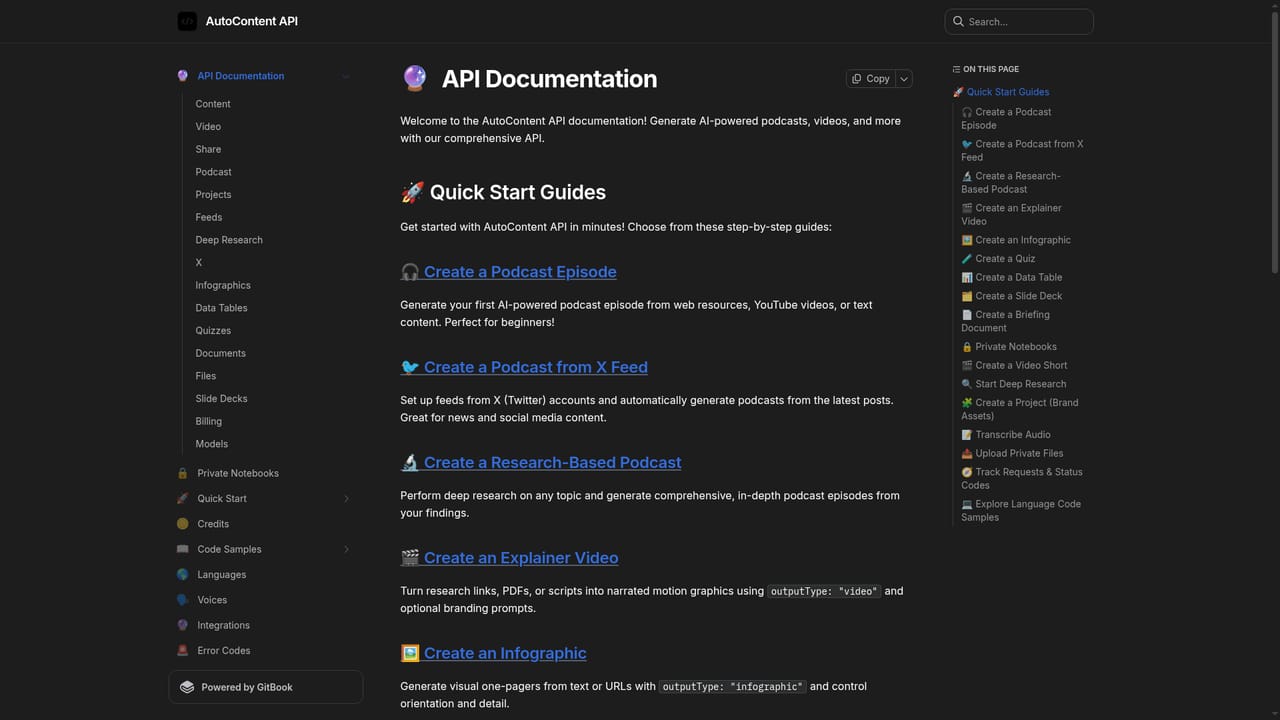
Screenshot of AutoContent API, One REST API turns a single source into podcasts, videos, slides and quizzes

What is AutoContent API?

AutoContent API is a content tool. A REST API that converts PDFs, URLs, YouTube videos, documents or text into podcasts, videos, infographics, slide decks, research reports and quizzes, with webhooks, multi language output, custom voices and podcast distribution built in.

AutoContent API is a developer facing REST service that converts one input into many finished content formats. A PDF, a URL, a YouTube video, a document or a block of raw text goes in through a JSON request to the /Content/Create endpoint, and the platform returns publishable assets: audio podcasts, video, explainer shorts, avatar shorts, infographics, slide decks, deep research reports and quizzes. Status polling and webhooks handle long running jobs, and output can be produced in more than 50 languages with custom branding applied. The product is aimed at teams that need volume and repeatability rather than a single polished artifact. Marketing departments, media companies, sales teams and learning groups use it to turn existing material into weekly shows, onboarding explainers or social clips without adding production staff. The platform layer on top of the API adds a dashboard for managing multiple podcasts, autopilot scheduling on daily or weekly cadences, custom cloned voices for hosts, and distribution that pushes episodes to Spotify, Apple Podcasts, YouTube Music and a long list of other platforms with metadata and artwork handled automatically. A separate notebook product keeps persistent source libraries, with 200 notebooks per license and 100 sources per notebook. In practice the workflow is programmatic. A request is submitted with a source and a desired output type; the service generates the asset, and a webhook notifies the caller when it is ready. Live social feeds from X and Reddit can also act as sources, which means recurring shows can be built from ongoing conversation rather than a fixed document. The API is the natural pick for engineering teams that want a single media pipeline. Buyers who only want a finished podcast occasionally, with no code, will find the request and webhook model heavier than a consumer app, and the two product lines are billed separately.

How do you use AutoContent API?

  1. 1Get an API key and open the docs
    Create an account through the app, generate a key, and read the reference for the content endpoints before building anything.
    AutoContent API — Get an API key and open the docs
  2. 2Choose a starting source
    Decide whether input will be a URL, PDF, YouTube video, document or raw text, since the request payload differs by source type.
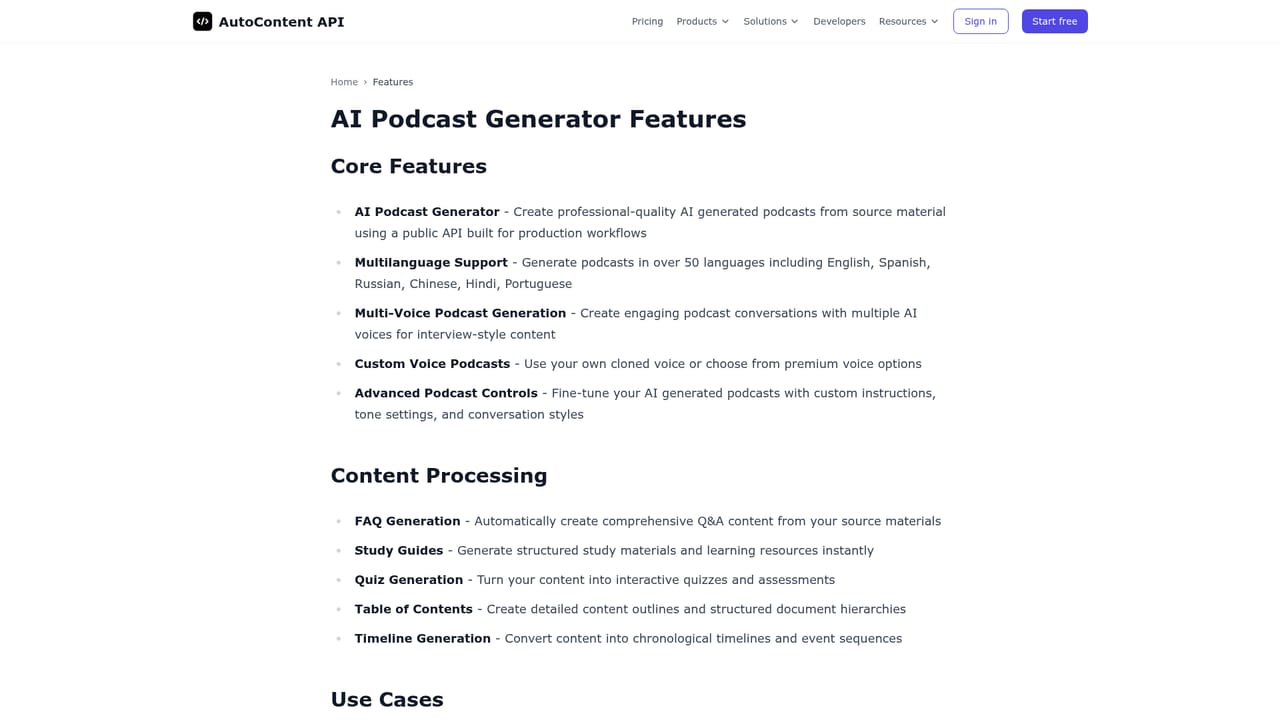
    AutoContent API — Choose a starting source
  3. 3Submit a content request
    Send a JSON payload to the create endpoint with the source and the output format you want, such as podcast, infographic, slides or quizzes.
  4. 4Handle completion with webhooks
    Register a webhook or poll the job status, then collect the returned asset URL when generation finishes.
  5. 5Review examples per format
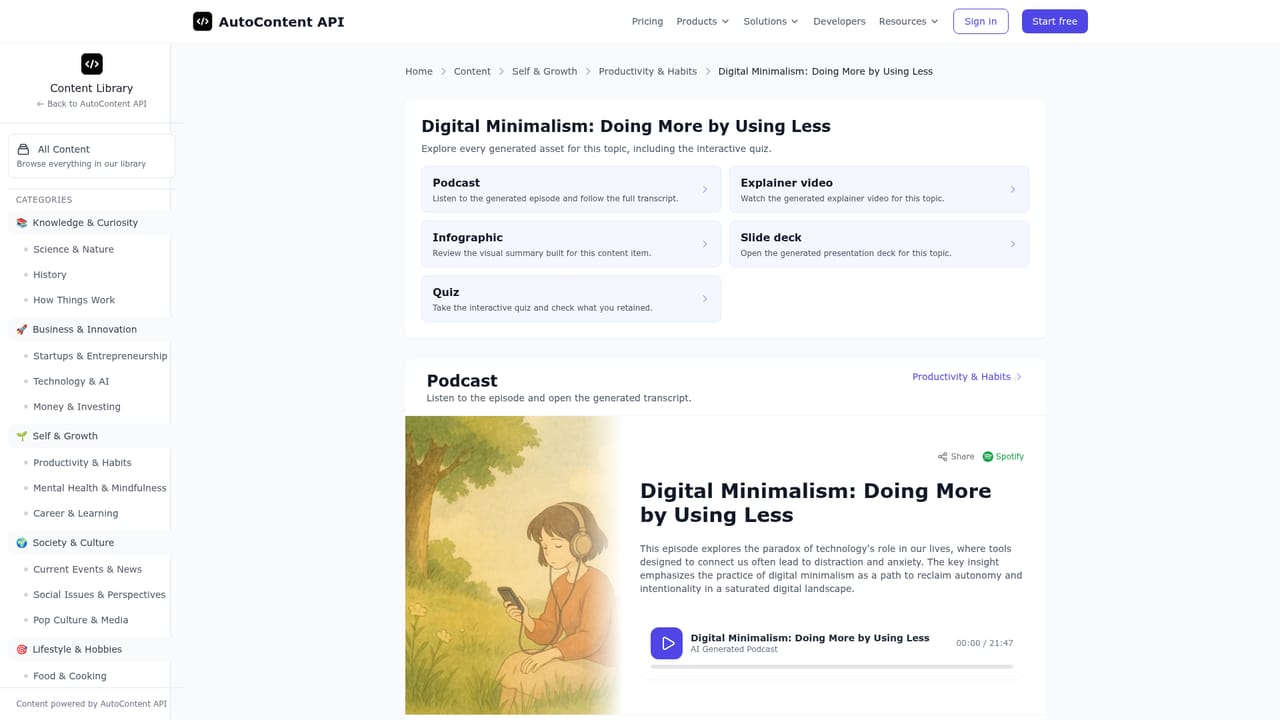
    Study the published samples for podcasts, explainer shorts, avatar shorts and infographics to calibrate tone and structure before scaling up.
    AutoContent API — Review examples per format
  6. 6Automate publishing and scheduling
    Connect the dashboard to set publishing cadence, manage multiple shows and route finished episodes to distribution platforms.

Pros and cons

Pros

  • Single endpoint converts one source into podcasts, video, shorts, slides, infographics, quizzes and research reportsAI
  • Webhook and status polling design fits automated, high volume content pipelines and scheduled jobsAI
  • Output is available in more than 50 languages with custom branding and cloned host voicesAI
  • Podcast distribution to Spotify, Apple Podcasts, YouTube Music and 20 or more other platforms is handled automaticallyAI
  • Live X and Reddit feed monitoring supports recurring shows built from current conversationAI

Cons

  • The API first model assumes engineering resources, so non technical teams face a real setup costAI
  • Content generation and private notebooks are separate plans and credits, which complicates budgetingAI
  • Homepage does not publish rate limits, per request quotas or output length capsAI
  • Sample testimonials are the main evidence shown, with no independent benchmarks on audio qualityAI
  • Social feed sourcing is limited to X and Reddit at the time of writingAI

How much does AutoContent API cost?

Pricing

Paid plans start at EUR 29 per month for finished content generation through the API. Private Notebooks are a separate EUR 99 per month license covering one dedicated workspace with 200 notebooks, 100 sources per notebook and 200 grounded questions per rolling 24 hours. The two workflows can be bought alone or combined.

Learn more

Integrations

Distributes podcasts to Spotify, Apple Podcasts, YouTube Music, Google Podcasts, Stitcher, Overcast, Pocket Casts and more than 15 other platforms, and ingests live feeds from X and Reddit.

Learn more

Features

Content creation from URLs, PDFs, YouTube videos, documents and text, with outputs including podcasts, video, explainer and avatar shorts, infographics, slide decks, deep research and quizzes. Also includes status polling and webhooks, 50 or more languages, custom branding, AI avatars, cloned host voices, multi podcast management, autopilot scheduling, automated distribution and live X and Reddit feed sourcing.

Learn more

Frequently asked questions about AutoContent API

  • How much does AutoContent API cost?
    Paid plans start at EUR 29 per month for finished content generation through the API. Private Notebooks are a separate EUR 99 per month license covering one dedicated workspace with 200 notebooks, 100 sources per notebook and 200 grounded questions per rolling 24 hours. The two workflows can be bought alone or combined.
  • Does AutoContent API have an API?
    Yes, AutoContent API offers an API.
  • How do you use AutoContent API?
    The walkthrough on this page covers 6 steps: 1. Get an API key and open the docs 2. Choose a starting source 3. Submit a content request 4. Handle completion with webhooks 5. Review examples per format 6. Automate publishing and scheduling.
  • What platforms does AutoContent API support?
    AutoContent API is available on Web App.
  • What does AutoContent API integrate with?
    Distributes podcasts to Spotify, Apple Podcasts, YouTube Music, Google Podcasts, Stitcher, Overcast, Pocket Casts and more than 15 other platforms, and ingests live feeds from X and Reddit.
  • What are the limitations of AutoContent API?
    The API first model assumes engineering resources, so non technical teams face a real setup cost. Content generation and private notebooks are separate plans and credits, which complicates budgeting. Homepage does not publish rate limits, per request quotas or output length caps.

Status

StatusActive
Views0
Outbound clicks0
Added10/21/2026

Platforms

Web App

Pricing

PaidSubscription