What these tools do
AIs debating each other means putting a question to more than one model and letting them argue it out: one side proposes, another pushes back, a third weighs in, and the exchange surfaces the assumptions a single answer would have hidden. The reader gets a transcript of positions rather than one confident paragraph.
This is for people stuck on a decision that does not have a clean answer. A founder weighing a pivot, a team lead choosing between two hires, someone working through an ethical tangle. It replaces the usual loop of asking one chatbot, getting a flat answer and asking again with a different prompt. The debate formalises that loop and gives the disagreement a shape you can read.
How to choose one
Start with the number of voices. A two-model setup gives you a clean for and against, which is easy to follow and good for binary questions. A larger council, four to six advisors, produces more angles but also more noise, and you have to read the whole transcript to find the useful objection.
Next, check whether the models are allowed to disagree with each other or only with your premise. A real debate includes rebuttal, not just three separate opinions stapled together. Then think about the output: a verdict with reasoning is easier to act on, a pure transcript is better when you want to think rather than be told.
Cost matters less here because several of these are free or trial based, so try two and compare how they handle a question you already know the answer to. A tool that misses the obvious objection on familiar ground will miss it on unfamiliar ground too.
Notable tools
Kvorum runs a five-advisor AI board aimed at business decisions, with a subscription and a free trial. The framing is closer to a leadership meeting than a chat: several advisors, one question, a structured exchange.
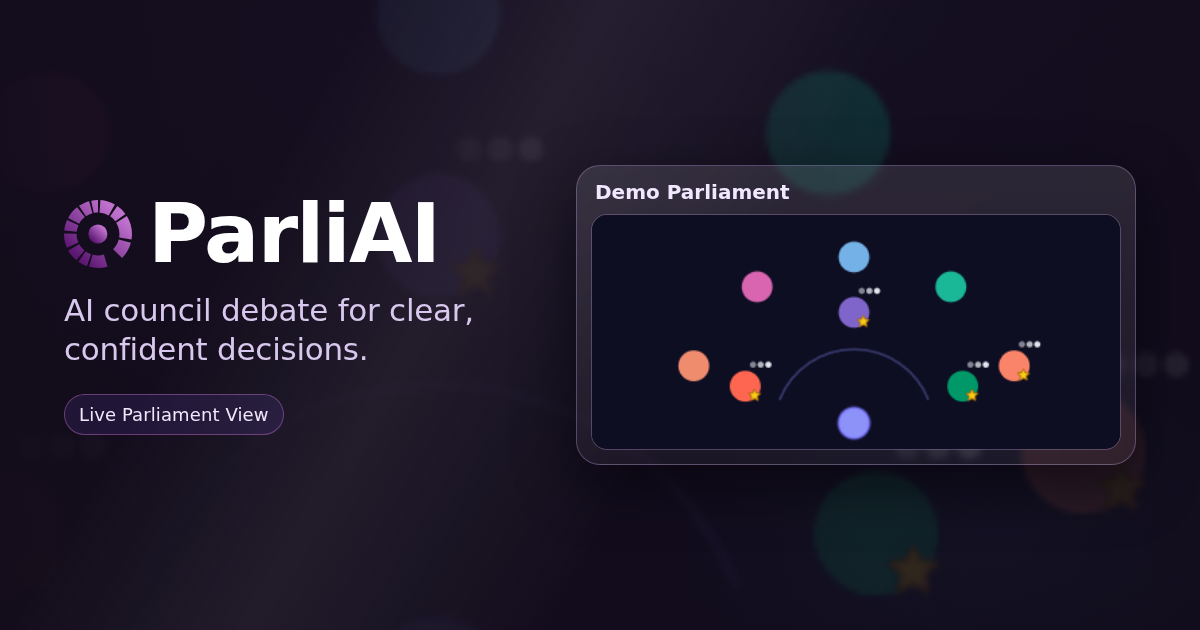
ParliAI is a multi-model council that compares answers and debates the tougher calls. It is free and web based, so it works well as a first stop when you want to see how a multi-model debate actually reads.
Arcanon takes a different angle, with six AI philosophers debating your dilemma to surface blind spots. It suits ethical or personal questions more than operational ones, where the point is noticing what you did not consider.
Common questions
Can two AIs debate each other?
Yes, and that is the basic version of this format. One model argues a position, a second argues against it, and you read the exchange. Some tools run both sides on the same underlying model with different instructions, others pair separate models so their blind spots differ. The second setup usually produces the more interesting disagreement.
What is the point of two AIs debating with each other?
The value is in the friction. A single model tends to agree with how you framed the question, so you get an answer that inherits your assumptions. A debate forces at least one voice to attack the premise, which is where the genuinely new objection tends to come from. Read the rebuttals first if you are short on time.
Do these tools decide for me?
No, they produce arguments. Kvorum, ParliAI and Arcanon all hand back a discussion or a recommendation with reasoning attached, and the judgement stays with you. Treat the output as a list of objections to test, not a verdict to follow.
When to look elsewhere
If the appeal is absurd arguments rather than useful ones, the Prank Calls category is the closer match. If you want the material itself turned into something shareable, Meme Translator takes a message or exchange and rewrites it for a different audience, which is a different job from arguing a decision through.