ParliAI

A multi-model council that compares answers and debates your tough calls

Intermediate
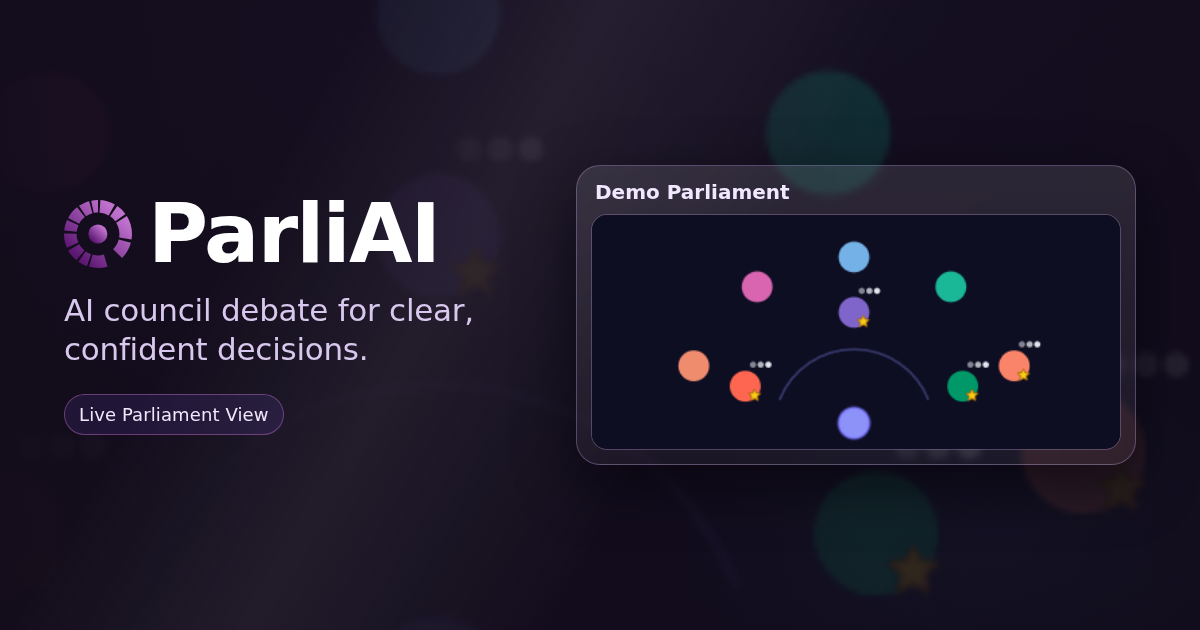
Screenshot of ParliAI, A multi-model council that compares answers and debates your tough calls

What is ParliAI?

ParliAI is an AI aggregators tool. ParliAI was a multi-provider AI council that mixed models from Anthropic, OpenAI, Gemini and Grok into custom groups, then ran one-on-one answers, comparisons or multi-round debates with a full reasoning trail, scores and vote justifications.

ParliAI was a multi-provider AI council built for people who could not settle important questions with a single chatbot reply. The premise was simple: one model gives you an answer, several models give you a decision you can inspect. Users assembled a council from providers such as Anthropic, OpenAI, Gemini and Grok, then put a business or strategy question to the group and watched the models argue it out. The project is now archived and the service has closed, so what remains is a documented design and fictional sample conversations rather than a live product. The tool worked across three depth settings. One-on-one returned a single direct answer. Compare added answers from the other models in the council plus a curator pass that weighed them. Debate went further, repeating answers across rounds so each model could read the others and revise its position, at a much higher token cost. A curator model, optionally Grok, sat over the top of the council and produced scores, vote justifications and proposal diffs. Transparency was the central design claim. Every recommendation came with a full reasoning trail, so a user could follow how a conclusion formed, see which model pushed which argument and check the scoring rather than trusting an opaque verdict. The intended audience was decision makers, product teams and analysts who were already cross-checking prompts between tabs and paying for several subscriptions, and wanted that workflow consolidated under one plan. ParliAI sat in the same space as multi-model chat aggregators and AI debate or ensemble research tools, but leaned toward structured deliberation and auditability instead of fast single answers. With the service closed, it is best treated as a reference point for how multi-model consensus products were framed, not as a tool to evaluate for adoption. The examples on the archive are fictional and do not represent live output.

How do you use ParliAI?

  1. 1Open the archive
    The live product is closed. Visiting the archive page shows the project notice and the fictional example deliberation, which is the only remaining way to inspect how the interface was laid out.
  2. 2Pick a deliberation depth
    In the original workflow, the first choice was one-on-one for a single direct answer, compare to add other council answers and a curator pass, or debate for repeated revision rounds.
  3. 3Assemble the council
    Users selected models from providers such as Anthropic, OpenAI, Gemini and Grok, with an optional curator model layered on top, and could adjust the mix on each question.
  4. 4Write and submit the question
    The question could be drafted at any point, and nothing ran until it was explicitly submitted, so setup could be prepared without spending tokens.
  5. 5Review the reasoning trail
    After a run, the council output included model proposals, scores, vote justifications and proposal diffs, letting the user trace how the recommendation was formed.

Pros and cons

Pros

  • Council members can be mixed from several providers in one custom groupAI
  • Three depth modes (one-on-one, compare, debate) let users match effort to the stakesAI
  • Curator pass produces scores, vote justifications and proposal diffsAI
  • Reasoning trail makes each recommendation auditable rather than opaqueAI
  • Consolidates cross-checking between separate model subscriptions into one planAI

Cons

  • The service has closed and the site is an archive, so it cannot be usedAI
  • Debate mode consumes far more tokens than a single answer, which raises costAI
  • Only four providers are named (Anthropic, OpenAI, Gemini, Grok), limiting the model poolAI
  • No published pricing, API or support details survive on the archived pageAI
  • Sample conversations are fictional, so real output quality cannot be judgedAI

How much does ParliAI cost?

Features

Custom councils assembled from Anthropic, OpenAI, Gemini and Grok models, with an optional curator. Three depth modes: one-on-one, compare (extra answers plus a curator pass) and debate (repeated rounds where models revise after reading each other). Outputs include a full reasoning trail, scores, vote justifications and proposal diffs. Questions only run on explicit submission.

Frequently asked questions about ParliAI

  • How do you use ParliAI?
    The walkthrough on this page covers 5 steps: 1. Open the archive 2. Pick a deliberation depth 3. Assemble the council 4. Write and submit the question 5. Review the reasoning trail.
  • What platforms does ParliAI support?
    ParliAI is available on Web App.
  • What are the limitations of ParliAI?
    The service has closed and the site is an archive, so it cannot be used. Debate mode consumes far more tokens than a single answer, which raises cost. Only four providers are named (Anthropic, OpenAI, Gemini, Grok), limiting the model pool.

Status

StatusActive
Views0
Outbound clicks0
Added10/21/2026

Platforms

Web App

Pricing

Free