Pricing
The site states that using the estimation tool costs nothing for residents, and that moving companies can add a rebranded version to their own websites. No public price list for mover plans appears on the homepage.
Learn morePhoto-based moving estimates that movers and AI agents can trust

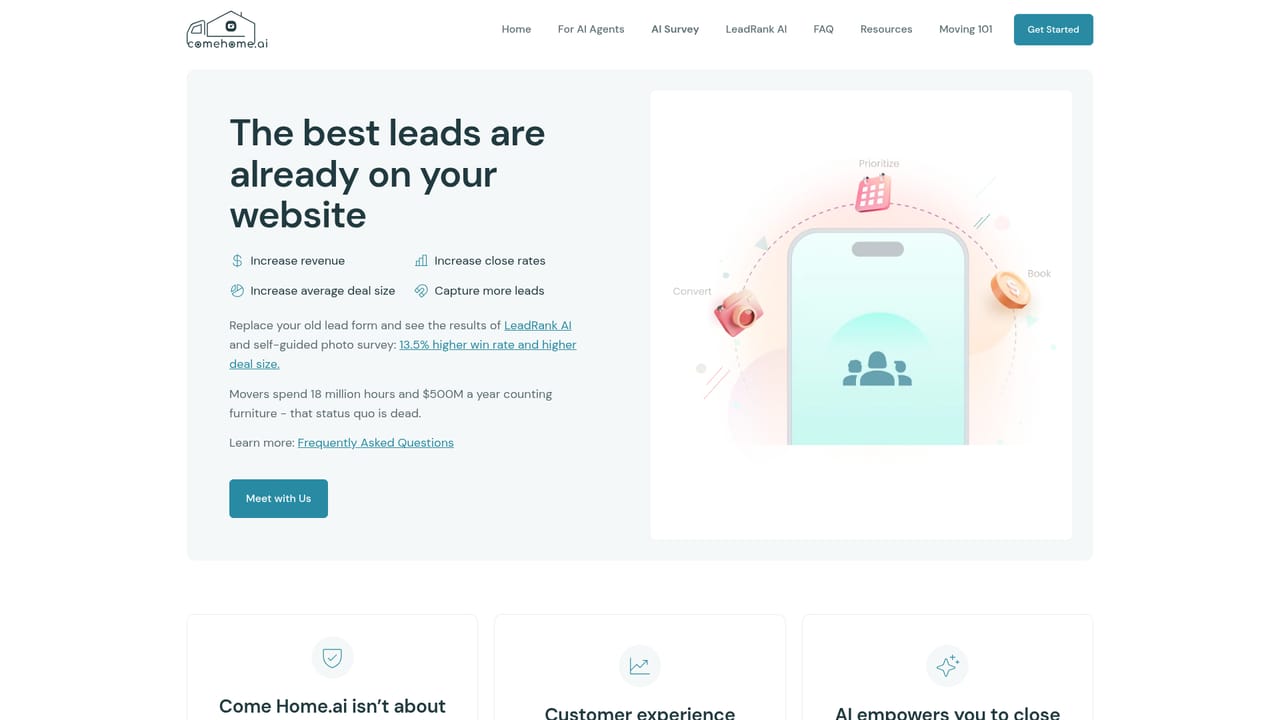
ComeHome turns photos of household belongings into moving estimates with cost ranges, weight, volume and an itemized inventory. Moving companies embed it to capture and rank leads, while AI agents query its MCP server to answer moving cost questions with structured data instead of rough guesses.
ComeHome is a moving cost estimation platform built around photographs of household belongings. A resident uploads pictures of their home contents, and the system returns estimated cost ranges, total weight in pounds, volume in cubic feet, and an itemized inventory sorted into industry-standard categories such as furniture, boxes and appliances, along with a confidence score. The underlying models were trained on three years of data from large moving companies and are combined with property databases covering details like bedroom counts and square footage, so the output resembles a professional survey rather than a rough guess. The product serves two distinct audiences. For moving companies, ComeHome is a lead capture and qualification layer: a rebranded survey sits on the mover's site, and the LeadRank AI component flags which enquiries look most profitable so sales reps can prioritize. For AI assistants and agents, ComeHome exposes an MCP server that answers questions like how much a move will cost with structured estimates instead of generic figures. If the resident wants to proceed, the inventory and photos can be passed to a vetted mover for a real quote, with an opt-in step. The pitch rests on a familiar industry problem: movers lowball initial quotes and raise prices once belongings are loaded. Photo documentation gives the resident a defensible record and gives the mover a more honest starting point. ComeHome reports its AI inventory at 85 percent or better accuracy, while acknowledging that residents often forget items or photograph them twice, so sales teams still need to ask follow-up questions. Analytics today are limited to monthly breakdowns of form-only versus photo submissions, with richer reporting described as roadmap work. The platform competes less with consumer moving calculators and more with manual virtual surveys and phone-based inventory calls, which the company says consume 36 million hours a year across the industry. Buyers should treat it as a workflow tool for lead quality and quote accuracy rather than a booking marketplace.

The site states that using the estimation tool costs nothing for residents, and that moving companies can add a rebranded version to their own websites. No public price list for mover plans appears on the homepage.
Learn moreQuestions go to support@comehome.ai, and the team offers 30 minute meetings booked through Calendly. An FAQ covers accuracy, analytics and agent use.
Learn moreThe homepage names SmartMoving and Supermove lead APIs, with redundant email delivery if SmartMoving goes down, plus an MCP server for AI agents and PostHog used for product analytics.
Photo-based furniture detection feeds cost, weight and volume estimates plus an itemized inventory with a confidence score. Moving companies get an embeddable AI survey, LeadRank AI lead scoring, and lead delivery into SmartMoving and Supermove. An MCP server serves AI agents, and analytics currently cover monthly form versus photo submission counts.
Learn more AI Angels400+ customizable AI girlfriends for NSFW chat, voice calls, and roleplay
 Candy AIExperience the future of companionship with AI friends who chat, role-play, and connect with you on a human level.
 ourdream.aiA vast AI roleplay platform with millions of characters for chat, images, video and voiceAI Angels400+ customizable AI girlfriends for NSFW chat, voice calls, and roleplayCandy AIExperience the future of companionship with AI friends who chat, role-play, and connect with you on a human level.ourdream.aiA vast AI roleplay platform with millions of characters for chat, images, video and voice


