Cresh

Score a startup idea across 33 validation metrics before you build.

Beginner
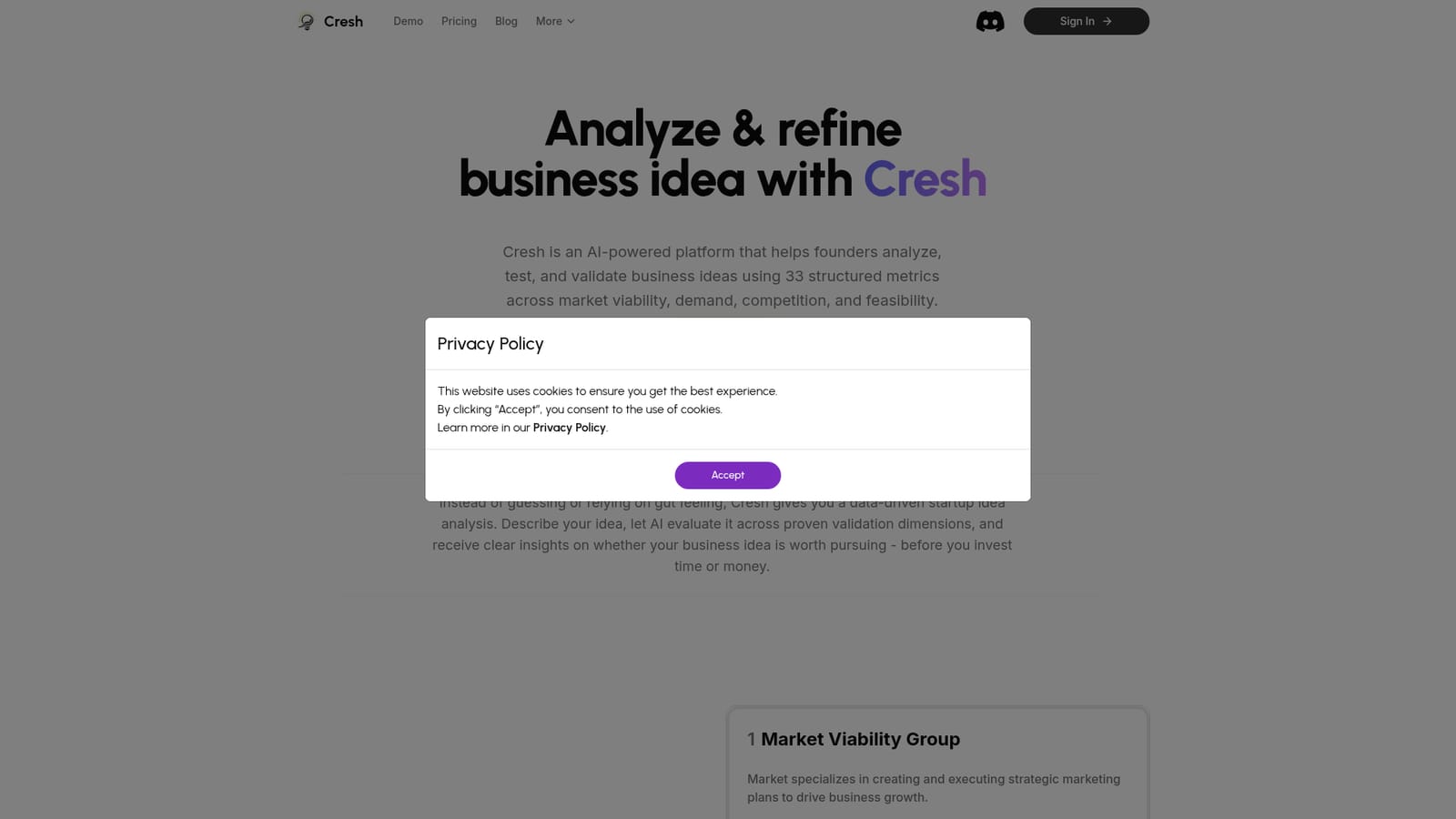
Screenshot of Cresh, Score a startup idea across 33 validation metrics before you build

What is Cresh?

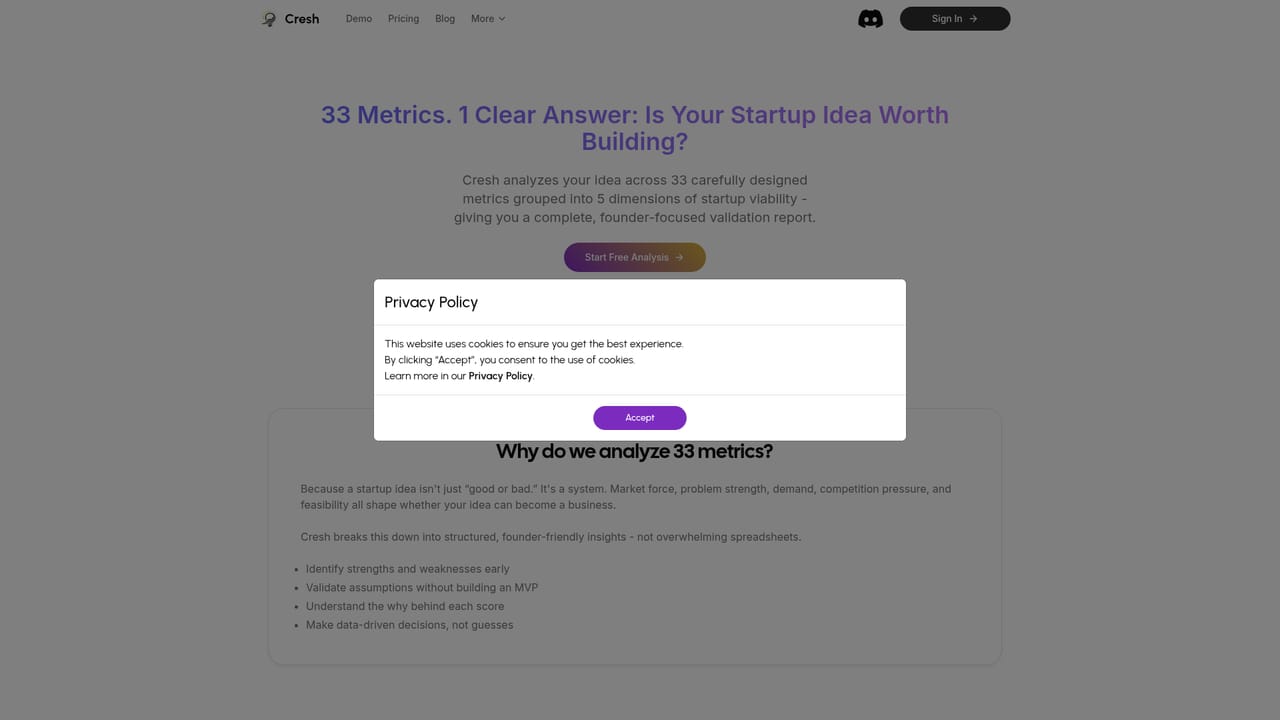
Cresh is an AI project builder tool. Cresh scores a startup idea against 33 validation metrics grouped into market viability, problem strength, demand signals, competition and technical feasibility. A guided wizard collects the idea, AI agents generate a scored report in about ten minutes, and results export to PDF.

Cresh is an AI validation workspace for founders who want a structured verdict on a business idea before committing time or money to it. The premise is simple: most early ventures fail because nobody checked whether the market, the problem and the demand were real, and Cresh turns that check into a repeatable scoring exercise rather than a gut call. The mechanics are organised around five validation groups: market viability, problem strength, user demand signals, competition pressure and technical viability. Those groups expand into 33 individual metrics, and an AI agent reasons over each one using web and market data. You feed it the idea through a guided wizard that asks for the problem, the target users and the proposed solution, then wait roughly ten minutes for a report that scores the concept, explains each score and suggests what to improve. Results can be exported as a PDF, which makes them easy to circulate to cofounders, mentors or an accelerator reviewer. Two analysis depths exist. A Fast run covers six key metrics pulled from across the evaluation groups and suits a quick sanity test on a throwaway idea. A Full run scores all 33 and is the version to use when an idea is serious enough to plan around. The company positions the product against general chat assistants, arguing that a purpose-built metric framework produces more consistent comparisons than freeform prompting. It also pitches itself as faster than manual desk research, compressing weeks of market digging into a single session. The audience is founders, indie hackers and early-stage entrepreneurs, particularly solo builders who lack a research team. Anyone weighing several concepts at once can buy a coin bundle and run multiple reports for comparison. It sits somewhere between a market research consultant and a brainstorming chatbot, cheaper and faster than the former, more disciplined than the latter.

How do you use Cresh?

  1. 1Read a sample report first
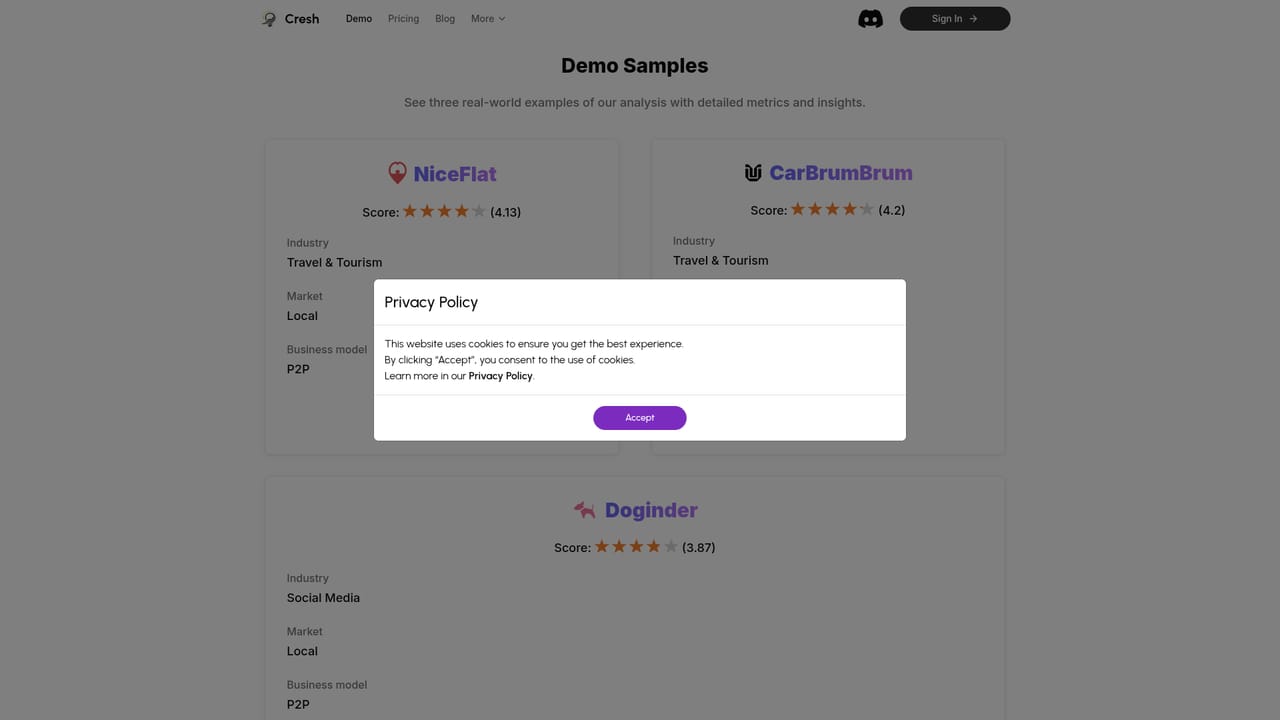
    Open the examples page to see how a finished analysis is structured and scored before spending a coin on your own idea.
    Cresh — Read a sample report first
  2. 2Describe your idea in the wizard
    Start an analysis from the homepage and answer the guided prompts covering the problem, your target users and the solution you plan to offer.
    Cresh — Describe your idea in the wizard
  3. 3Pick Fast or Full depth
    Use a Fast analysis for a six metric sanity check, or spend more coins on a Full run that scores all 33 metrics.
  4. 4Review the scored report
    After roughly ten minutes, read the scores, the explanations behind each metric and the suggested improvements across the five validation groups.
  5. 5Export and compare
    Download the PDF, then run further ideas and compare reports side by side to decide which concept deserves build effort.
    Cresh — Export and compare

Pros and cons

Pros

  • Splits validation into 33 named metrics across five groups, so scores are comparable rather than ad hocAI
  • Guided wizard collects problem, audience and solution, which reduces vague inputs and weak outputsAI
  • Fast mode covers six key metrics and makes cheap triage of several ideas practicalAI
  • Reports ship as PDF exports, useful for sharing with cofounders, mentors or acceleratorsAI
  • Roughly ten minute turnaround is far quicker than manual market researchAI

Cons

  • Report quality depends heavily on how clearly the founder describes the idea in the wizardAI
  • No integrations with market data providers or analytics tools are described, so analysis stays self-containedAI
  • Output is advisory scoring, not verified primary research such as customer interviews or surveysAI
  • Single-run costs are low but there is no stated subscription, so heavy users must keep buying coin bundlesAI
  • The homepage does not document accuracy benchmarks or how metric weights are setAI

How much does Cresh cost?

Pricing

Pricing runs on Cresh Coins bought in bundles: $6 for one coin (a Fast analysis), $9 for two coins (one Full or two Fast), $18 for six coins (three Full or six Fast) and $25 for ten coins (five Full or ten Fast). Every tier lists full 33 metric analysis and PDF reports among its inclusions.

Learn more

Support

Support is handled through the site's FAQ, which answers questions on how validation works, whether a free analysis is enough, cost and how Cresh differs from general AI chat tools. No live chat or email channel is stated on the homepage.

Learn more

Features

Cresh evaluates an idea across 33 metrics organised into five groups: market viability, problem strength, user demand signals, competition pressure and technical viability. A guided wizard captures the problem, audience and solution, AI agents reason over web and market data, and a scored report with explanations and improvement suggestions arrives in about ten minutes. Reports export to PDF.

Learn more

Frequently asked questions about Cresh

  • How much does Cresh cost?
    Pricing runs on Cresh Coins bought in bundles: $6 for one coin (a Fast analysis), $9 for two coins (one Full or two Fast), $18 for six coins (three Full or six Fast) and $25 for ten coins (five Full or ten Fast). Every tier lists full 33 metric analysis and PDF reports among its inclusions.
  • How do you use Cresh?
    The walkthrough on this page covers 5 steps: 1. Read a sample report first 2. Describe your idea in the wizard 3. Pick Fast or Full depth 4. Review the scored report 5. Export and compare.
  • What platforms does Cresh support?
    Cresh is available on Web App.
  • What are the limitations of Cresh?
    Report quality depends heavily on how clearly the founder describes the idea in the wizard. No integrations with market data providers or analytics tools are described, so analysis stays self-contained. Output is advisory scoring, not verified primary research such as customer interviews or surveys.

Status

StatusActive
Views0
Outbound clicks0
Added10/22/2026

Platforms

Web App

Pricing

Paid