Support
Support runs through the contact form on the site. No help centre, documentation portal or public support tier is linked from the homepage.
Learn moreAsk your database questions in plain language and get answers fast

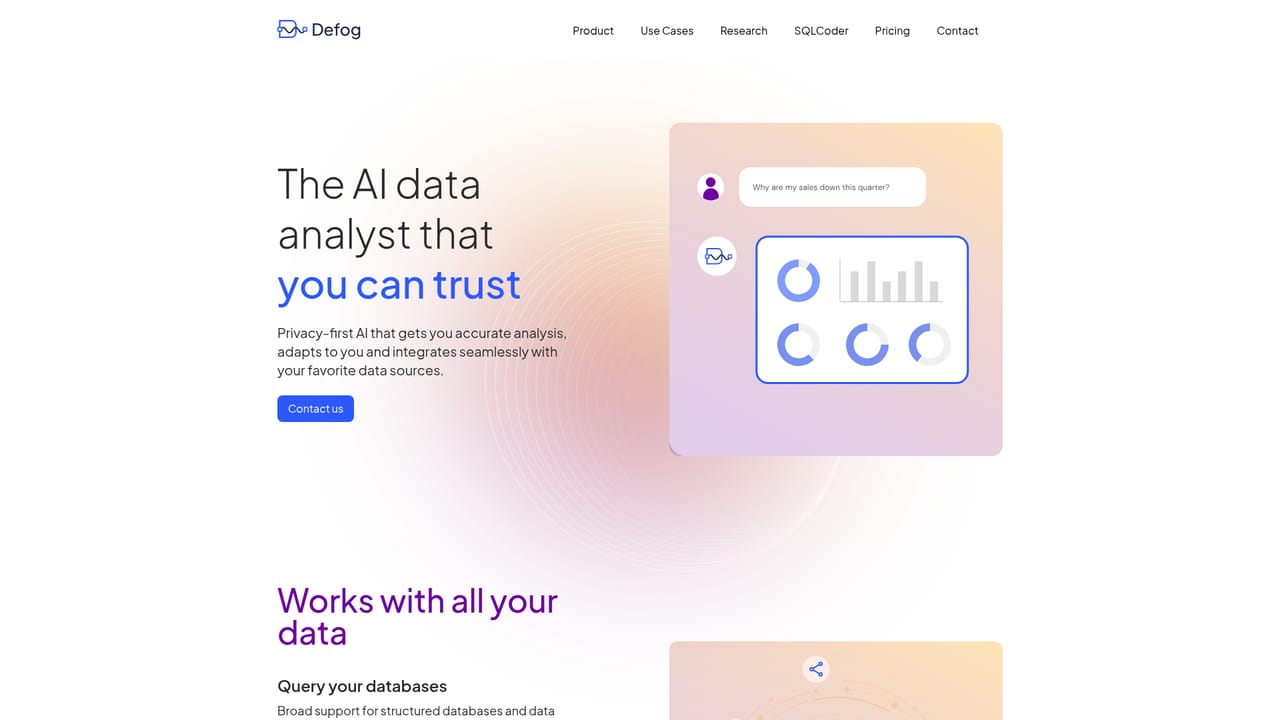
Defog is an AI data analyst that turns natural language questions into queries against your database, connectors or CSV files. It runs on SQLCoder, the company's open text-to-SQL model, and targets enterprise data teams that want answers without waiting on an analyst queue.
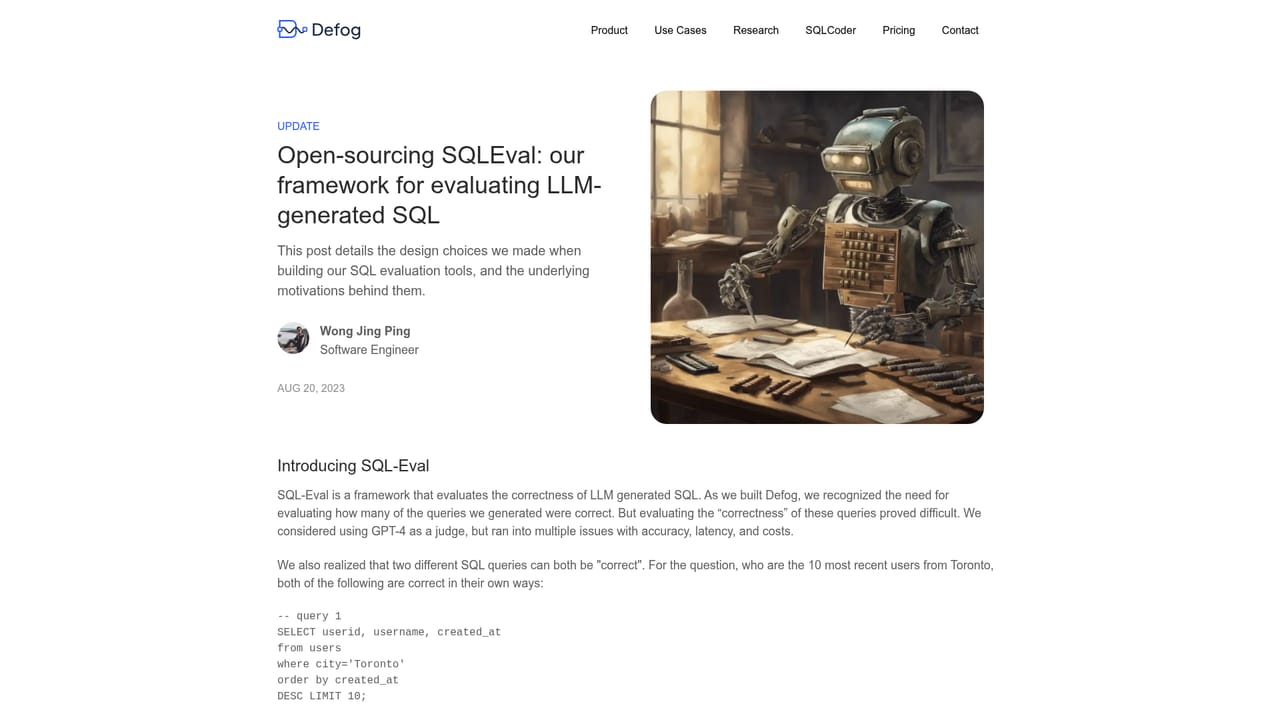
Defog is an AI data analyst built for enterprise teams that need answers from their own data without waiting on a specialist. The core idea is straightforward: pose a question in natural language, and Defog translates it into a query against your structured data and returns the result. The company's positioning is speed, framed around removing the queue that forms when analysts are the only people who can reach a warehouse. The product leans on SQLCoder, a text-to-SQL model Defog developed and released in 2023. It is the engine behind query generation, and the company reports more than 300,000 downloads of the open models. SQLEval, an open-source evaluation framework, exists to measure how accurate those models are on query tasks. Beyond querying, Defog advertises drill-down into specifics without stacking filters in a dashboard, exploration of open-ended hypotheses, and follow-up questions in the same session so users can iterate instead of restarting. In practice, Defog connects to structured databases including Postgres and Snowflake, to other tools through connectors, and directly to CSV files for teams without a warehouse in place. The company states that customer data is never shared with anyone, including its AI model, which addresses a common objection from regulated industries. It also claims the system adapts to individual feedback and preferences over time. Defog fits between a BI dashboard and a human analyst. It is aimed at data teams in larger organizations, evidenced by customers such as Toyota, Alliance Bernstein, Macmillan and Genmab, rather than at casual users. The model lineage has credibility in the ML community, with endorsements from Hugging Face, AWS and JLL cited on the site. Pricing is not published, and the commercial path runs through a contact form, so expect a sales conversation before you see a number.
Support runs through the contact form on the site. No help centre, documentation portal or public support tier is linked from the homepage.
Learn moreDefog connects to databases such as Postgres and Snowflake, to other platforms through connectors, and accepts CSV uploads. The site does not list named connector partners.
Learn moreDefog converts natural language questions into queries against structured databases (Postgres, Snowflake), data from other tools via connectors, and CSV files. It supports drill-down into specifics, exploration of broad hypotheses, and follow-up questions in the same session. Underneath sits SQLCoder, Defog's text-to-SQL model, with SQLEval as an open framework for measuring query accuracy.
Learn more AI Angels400+ customizable AI girlfriends for NSFW chat, voice calls, and roleplay
 Candy AIExperience the future of companionship with AI friends who chat, role-play, and connect with you on a human level.
 ourdream.aiA vast AI roleplay platform with millions of characters for chat, images, video and voiceAI Angels400+ customizable AI girlfriends for NSFW chat, voice calls, and roleplayCandy AIExperience the future of companionship with AI friends who chat, role-play, and connect with you on a human level.ourdream.aiA vast AI roleplay platform with millions of characters for chat, images, video and voice