Free trial
The site links to a Start free entry point on ai-hub.upsolve.ai, but it does not state trial length or what the free tier includes.
Learn moreAnalytics agents that answer from your own business context
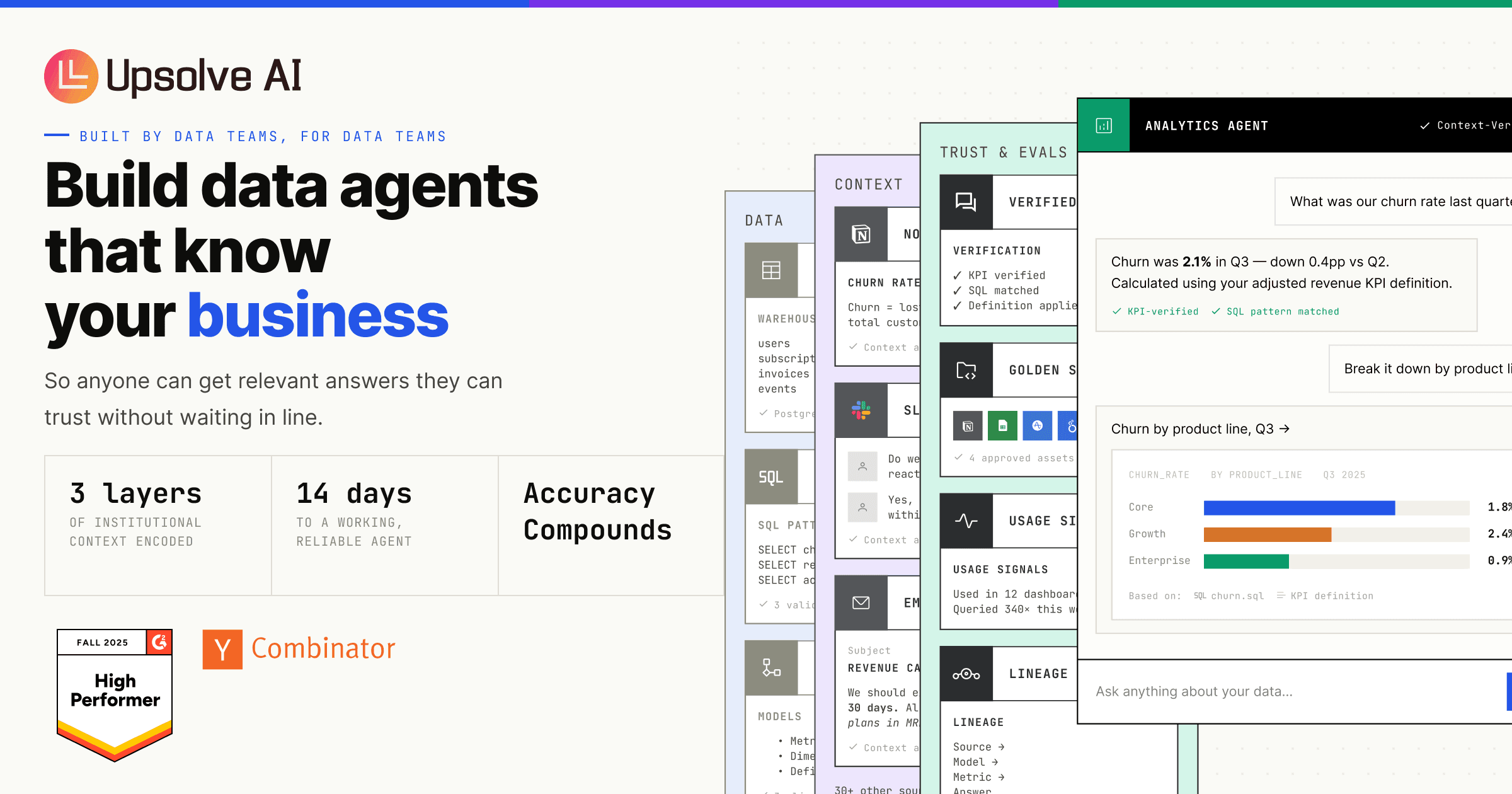
Upsolve AI builds governed analytics agents from your warehouse tables, SQL patterns and business definitions, so colleagues can ask their own data questions and get answers with verification and lineage attached.
Upsolve AI is a platform for building analytics agents that answer business questions using your own definitions, SQL patterns and documentation rather than generic model guesses. The product is aimed at data teams, meaning analytics engineers and data leads who field a constant queue of repeat requests from sales, finance, ops and product. The pitch is straightforward: encode how your company defines things once, then let colleagues ask their own questions and get answers that match your approved logic. The build process centers on three layers of context. Structure covers warehouse tables and validated SQL patterns; semantic models hold metrics, dimensions and definitions; meaning pulls from documents, chat threads and email where things like churn calculation rules actually get decided. Upsolve advertises 30+ SQL database connectors out of the box (Snowflake, BigQuery and Redshift are shown) and says an existing dbt project can be brought in, though a pre-built semantic layer is not required to start. A working agent is positioned at roughly 30 minutes of setup, and the platform claims accuracy compounds as more conversations and corrections are folded back in. On the consumption side, end users get an agent that responds in natural language with supporting evidence: KPI verification, matched SQL, the definition applied, usage signals and lineage from source table through model and metric to the final answer. Dashboards and BI canvases sit alongside the chat interface. A harness and observability layer let builders evaluate agent behavior before and after deployment, and row-level security governs who can see which rows. Upsolve sits in the emerging agentic analytics category, competing less with classic BI tools than with the general-purpose chatbot approach to warehouse data. Teams that already have a clean dbt project and documented metrics will get further faster; teams without either should expect the context engineering work to be the real project, not the agent itself.
The site links to a Start free entry point on ai-hub.upsolve.ai, but it does not state trial length or what the free tier includes.
Learn moreThe homepage names Snowflake, BigQuery and Redshift among 30+ SQL connectors, plus dbt projects, MCP servers and sources such as Notion, Slack, Linear, Fireflies and spreadsheets.
Learn moreCore features include a data plane with 30+ SQL connectors, MCP connections, semantic data models, row-level security, an evaluation harness, observability, BI canvases and a dedicated MCP integration for Claude. Answers are backed by KPI verification, golden sources, usage signals and end-to-end lineage from source table to metric.
Learn more AI Angels400+ customizable AI girlfriends for NSFW chat, voice calls, and roleplay
 Candy AIExperience the future of companionship with AI friends who chat, role-play, and connect with you on a human level.
 ourdream.aiA vast AI roleplay platform with millions of characters for chat, images, video and voiceAI Angels400+ customizable AI girlfriends for NSFW chat, voice calls, and roleplayCandy AIExperience the future of companionship with AI friends who chat, role-play, and connect with you on a human level.ourdream.aiA vast AI roleplay platform with millions of characters for chat, images, video and voice