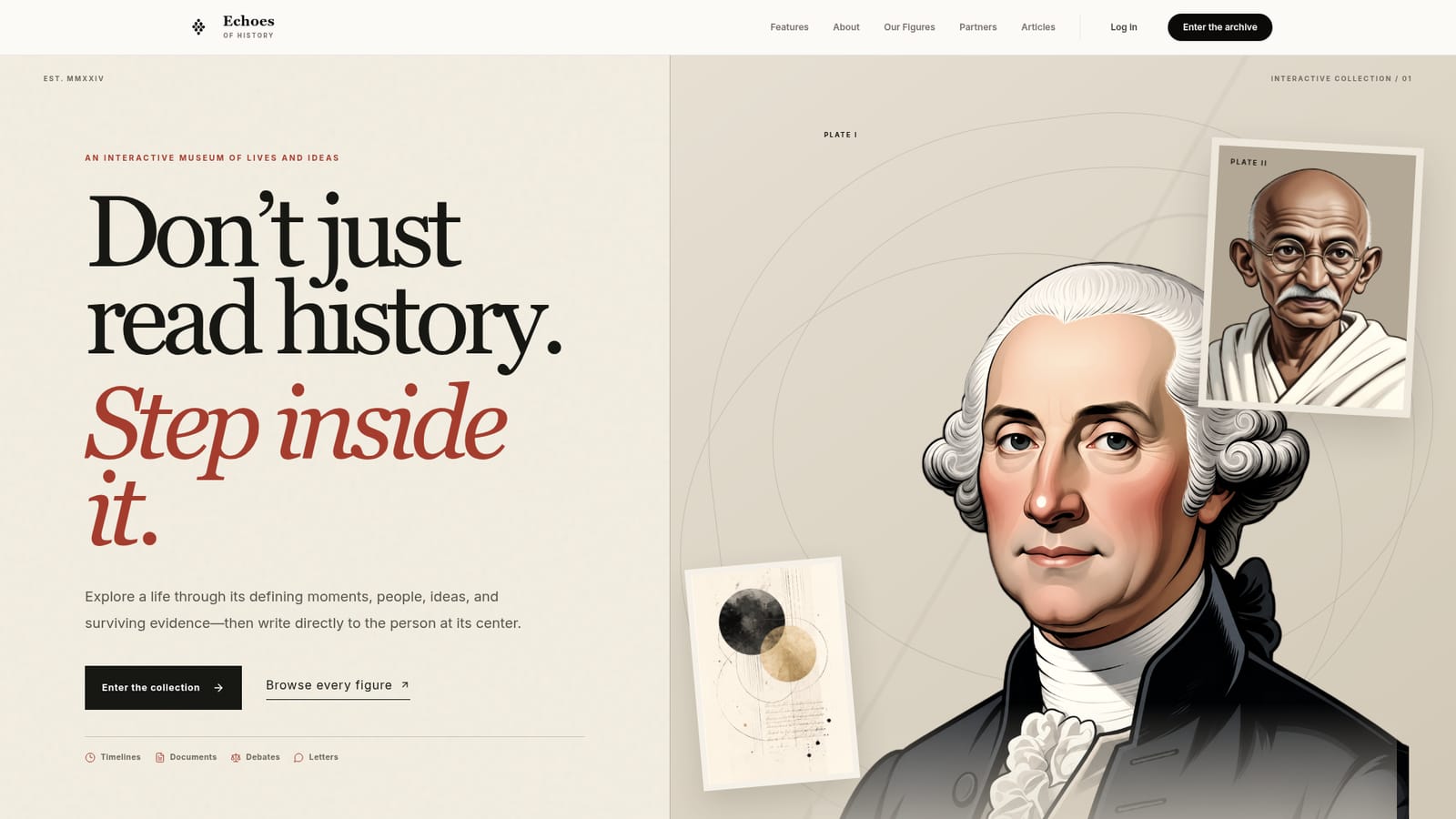
Echoes of History AI is a celebrity chat tool that writes letters to historical figures inside guided life timelines. Echoes of History AI is a web-based interactive museum where users explore the lives of historical figures through timelines, documents, debates and letters, then write directly to the person at the center.
Echoes of History AI is an interactive web collection that lets visitors explore the lives of historical figures and then write directly to them. Each figure opens into a guided world made up of a life story, chronological moments, relationships, surviving evidence, debates and documents. The homepage showcases figures such as Mahatma Gandhi, George Washington, Charles Darwin, Genghis Khan, Socrates and Aristotle, each with an "Enter conversation" entry point.
The site is aimed at curious readers, students and teachers who want more context than a plain biography offers. Instead of a dashboard, it offers several starting points with no required order: a timeline, a document, an idea or a person. A sample timeline for George Washington walks through 17 moments in chronological order, such as the end of the Siege of Boston in March 1776, and each moment can be opened for the story behind its date.
In practice, a visit follows three loose stages. The visitor first gets a portrait of the person, their era and the forces shaping their choices. Next, they open a moment, idea, relationship, debate or document, and the experience adapts to the records available for that figure. Finally, they turn something they found into a focused letter, asking the figure for a defense, an explanation, a memory or a perspective. A separate reading room adds essays on people, events, evidence and the complicated ideas they left behind.
Among alternatives, it sits closer to a museum-style learning product than to a general character chatbot. General companion and roleplay apps let users talk to a persona with little grounding, while this tool ties each conversation to biography, chronology and evidence. The homepage does not describe pricing, accounts, apps or an API, so buyers should confirm access terms on the site. The editorial design and limited roster make it better suited to focused study and casual exploration than to broad research across thousands of historical people.