FlickBloom

Governed marketing AI agents for mid-market and enterprise growth teams

Advanced
Screenshot of FlickBloom, Governed marketing AI agents for mid-market and enterprise growth teams

What is FlickBloom?

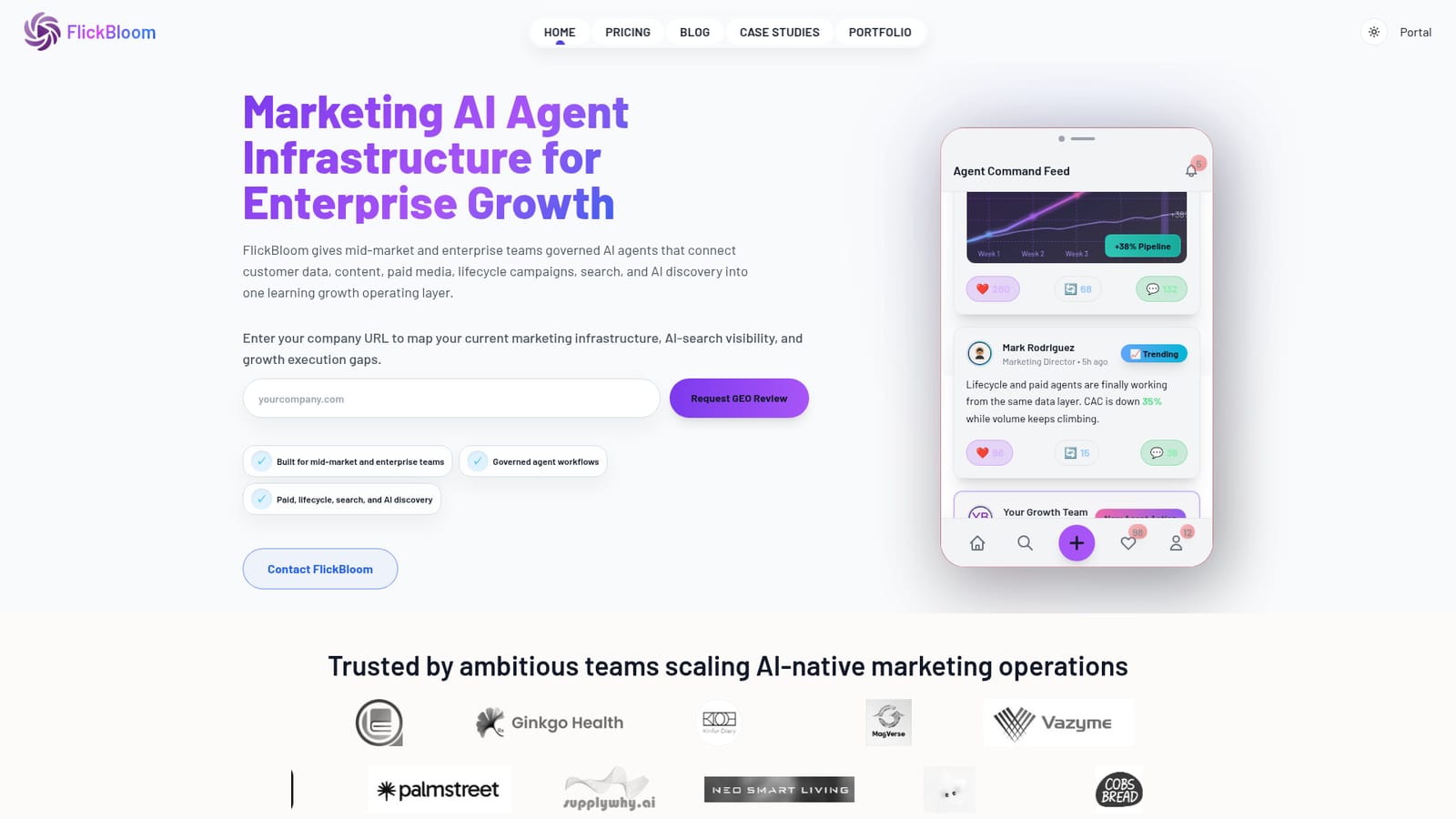
FlickBloom is a content tool. FlickBloom runs governed marketing AI agents across paid media, lifecycle, SEO and AI search for mid-market and enterprise teams, all working from a unified customer and campaign data layer with human review built in.

FlickBloom is an agent infrastructure layer for marketing organizations, aimed at mid-market and enterprise teams that run paid media, lifecycle, SEO and content as separate programs with separate data. The platform connects customer behavior, conversion paths, campaign history and brand knowledge into a shared operating context, so agents working on different channels start from the same signals instead of their own channel assumptions. The product is organized in two layers. An intelligence layer unifies performance data, search demand and AI discovery signals, watches competitive and audience shifts for gaps, and models which audiences, messages and channels are most likely to convert. A governed agent layer sits on top, with specialized content, paid media, lifecycle, SEO and AEO/GEO agents that draft, recommend, launch or escalate work depending on channel risk, brand sensitivity and team policy. Human review routing is part of the design rather than an afterthought, which matters for regulated or brand-sensitive enterprises. In practice, a marketing team points FlickBloom at its existing data and approved brand context, then lets agents propose and execute work across channels while every result feeds a feedback loop built on CAC, pipeline, conversions, retention and AI search visibility. Agents can reallocate spend and adapt journeys as those signals strengthen. The homepage also offers a URL-based review that maps current marketing infrastructure, AI search visibility and execution gaps, which is the natural first step before a scoped engagement. FlickBloom sits closer to a growth operating layer than to a single-purpose copy or image tool. It competes with stitched-together stacks of channel-specific AI point tools and with agency retainers, and its pitch is orchestration plus governance at a lower cost than an in-house growth team. Buyers should expect an enterprise-style onboarding and treat it as infrastructure, not a self-serve utility.

How do you use FlickBloom?

  1. 1Request a growth and GEO review
    Start on the homepage and submit your company URL. FlickBloom maps your current marketing infrastructure, AI search visibility and execution gaps as a first diagnostic.
    FlickBloom — Request a growth and GEO review
  2. 2Talk to the team about scope
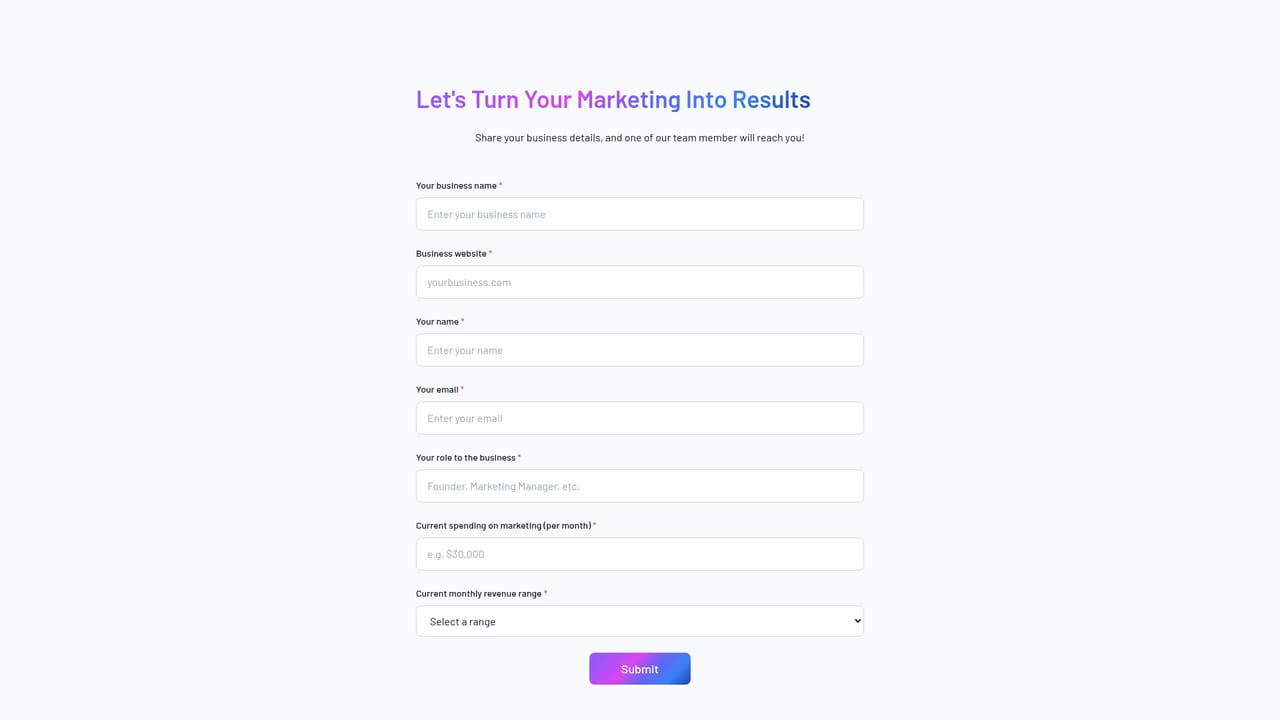
    Use the contact page to discuss your channels, data sources and review requirements. This is where engagement scope is set, since the homepage publishes no self-serve signup.
    FlickBloom — Talk to the team about scope
  3. 3Connect your data and brand context
    During onboarding, customer behavior, conversion paths, campaign history and approved brand knowledge are mapped into the shared operating context the agents work from.
  4. 4Deploy and configure agents
    Assign content, paid media, lifecycle, SEO and AEO/GEO agents to shared objectives, then set the review policy that decides which actions need human approval before launch.
  5. 5Review outcomes and reallocate
    Track CAC, pipeline, conversions, retention and AI discovery performance in the feedback loop, and let agents shift spend and adapt journeys as the signals get stronger.
  6. 6Read the case studies and blog
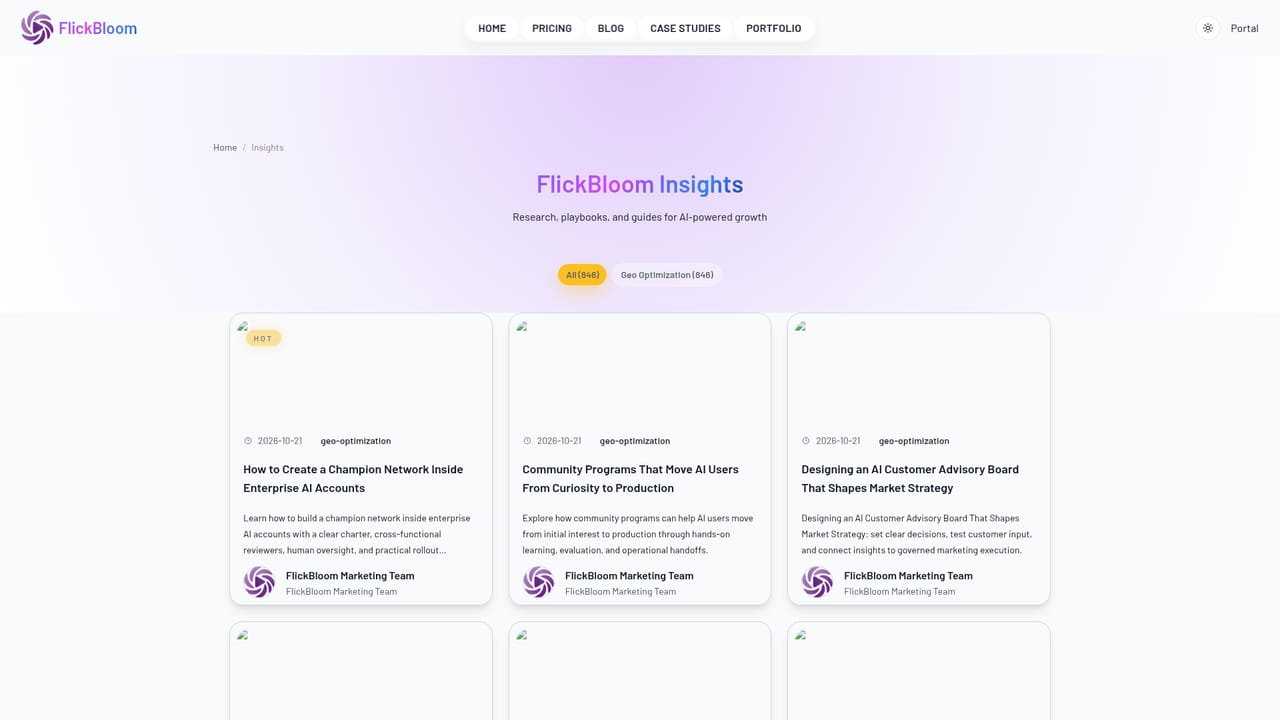
    Review published case studies and articles to benchmark what similar teams changed and which channels moved first.
    FlickBloom — Read the case studies and blog

Pros and cons

Pros

  • Connects paid, lifecycle, search and AI discovery work to one shared data layer instead of isolated channel toolsAI
  • Human review routing lets agents draft, launch or escalate based on channel risk and brand sensitivityAI
  • Brand positioning, product facts and schema stay aligned so content and AI answer engines read the brand consistentlyAI
  • Performance feedback loop ties agent actions to CAC, pipeline, conversions and AI search visibilityAI
  • Built specifically for mid-market and enterprise operations rather than solo creatorsAI

Cons

  • No public pricing, plan tiers or feature breakdown are published on the homepageAI
  • Pricing and onboarding appear to run through sales contact, so there is no self-serve trial path describedAI
  • Success stories are customer testimonials rather than independently verifiable benchmark dataAI
  • Value depends on connecting real customer and campaign data, which raises setup and governance effortAI
  • Little detail on which specific data sources, ad platforms or CRMs are supportedAI

How much does FlickBloom cost?

Features

A shared intelligence layer unifies customer, campaign and discovery signals and monitors competitive gaps and audience shifts. Specialized content, paid media, lifecycle, SEO and AEO/GEO agents coordinate from shared objectives, with review routing, machine-readable brand knowledge, performance-validated creative and a feedback loop on CAC, pipeline and AI discovery.

Frequently asked questions about FlickBloom

  • How do you use FlickBloom?
    The walkthrough on this page covers 6 steps: 1. Request a growth and GEO review 2. Talk to the team about scope 3. Connect your data and brand context 4. Deploy and configure agents 5. Review outcomes and reallocate 6. Read the case studies and blog.
  • What platforms does FlickBloom support?
    FlickBloom is available on Web App.
  • What are the limitations of FlickBloom?
    No public pricing, plan tiers or feature breakdown are published on the homepage. Pricing and onboarding appear to run through sales contact, so there is no self-serve trial path described. Success stories are customer testimonials rather than independently verifiable benchmark data.

Status

StatusActive
Views0
Outbound clicks0
Added10/21/2026

Platforms

Web App

Pricing

PaidSubscription