Free trial
The homepage invites users to start free with no credit card required. It does not state how long the free access lasts or which features it includes.
Learn moreWrite a spec in plain English, ship a tested production agent

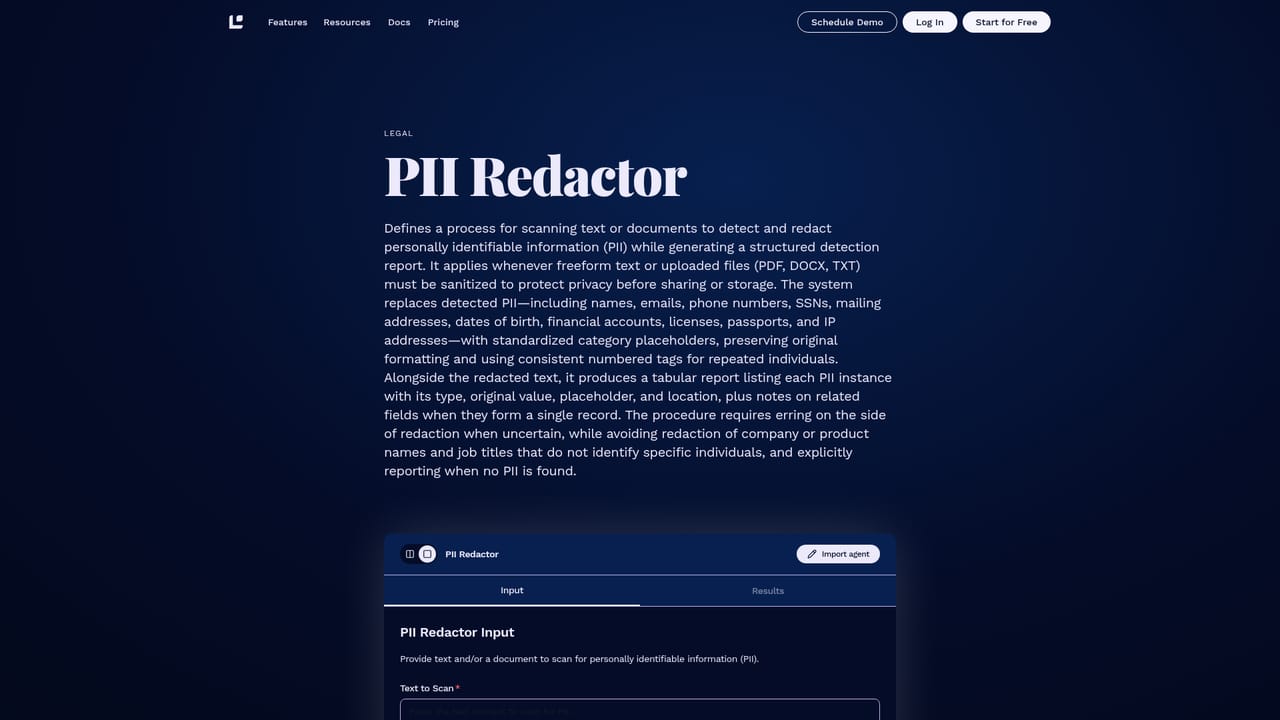
Logic.inc is an AI project builder tool that writes a spec in plain English, ship a tested production agent. Logic turns a plain English agent spec into a typed, versioned REST API in under a minute, with built-in testing, automatic model routing across OpenAI, Anthropic, Google and Perplexity, deployment docs and full execution logging.
Logic is a spec-driven platform for building and running AI agents. Instead of wiring together frameworks, SDKs and orchestration code, a team writes a natural language spec that defines what the agent does, what it accepts as input and what it returns. Logic turns that spec into a typed, versioned REST endpoint that can be called from anywhere. The company positions the product around the infrastructure most teams build before their first AI feature ships: schema validation, model routing, retries, testing, versioning and execution logging. In practice the workflow is short. A user picks one of the published templates (contract clause analysis, invoice and PO extraction, PII redaction, resume scoring, ticket triage, listing moderation and others) or writes a custom spec from scratch. Saving the spec produces an API endpoint, auto-generated documentation, an input form and a shareable web UI. Requests are routed automatically across OpenAI, Anthropic, Google and Perplexity, with faster models handling simple work and frontier models reserved for harder reasoning, plus failover if a provider errors out. Every execution is logged with inputs, outputs, reasoning, latency and error detail, so a broken agent can be traced to a specific version. The platform suits two distinct audiences. Engineers get stable API contracts, a test harness that runs expected-output checks on every save, and batch processing over a CSV. Operations, legal and support teams get approval workflows and version pinning, so non-technical editors can adjust decision rules without redeploying code. Published customers include Garmentory, which scaled product moderation from 1,000 to 5,000+ listings per day, and DroneSense, which cut complex purchase order handling from about thirty minutes to two. Alternatives tend to solve one slice of the problem. Prompt management tools, eval frameworks and routing layers each cover a piece, and teams can assemble them into a stack. Logic's argument is consolidation with typed APIs and rollback built in. The tradeoff is dependence on a managed abstraction: model choice is handled for you rather than picked by hand, and the spec-first style is less suited to agents that need fine-grained custom code or unusual tool chains.
The homepage invites users to start free with no credit card required. It does not state how long the free access lasts or which features it includes.
Learn moreAn MCP server connects agents to Claude, Cursor and ChatGPT. Requests route automatically across OpenAI, Anthropic, Google and Perplexity, and a REST API plus CI/CD hooks let agents plug into existing pipelines.
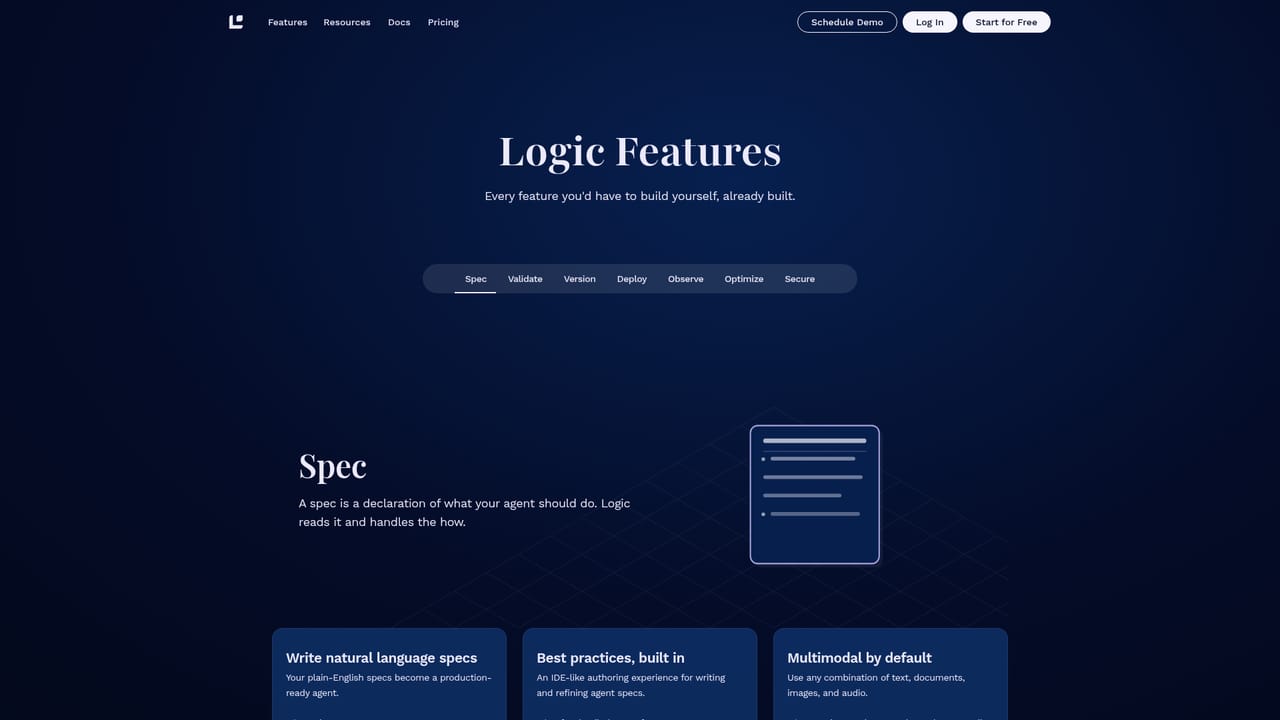
Learn moreCore capabilities include a plain English spec editor that generates typed REST APIs, a built-in test harness with regression detection, versioning with diffs and rollback, auto-generated API docs and shareable web UI, an MCP server for use in Claude, Cursor and ChatGPT, CSV batch runs, automatic routing and failover across OpenAI, Anthropic, Google and Perplexity, execution caching, and full per-call logging with latency and error detail.
Learn more AI Angels400+ customizable AI girlfriends for NSFW chat, voice calls, and roleplay
 Candy AIExperience the future of companionship with AI friends who chat, role-play, and connect with you on a human level.
 ourdream.aiA vast AI roleplay platform with millions of characters for chat, images, video and voiceAI Angels400+ customizable AI girlfriends for NSFW chat, voice calls, and roleplayCandy AIExperience the future of companionship with AI friends who chat, role-play, and connect with you on a human level.ourdream.aiA vast AI roleplay platform with millions of characters for chat, images, video and voice


