Free trial
A 30-day free trial is offered, with signup handled on a dedicated trial page. The homepage states no training period is needed and that content is returned as soon as products are uploaded.
Learn moreProduct images in, publish-ready listings out, in 40+ languages

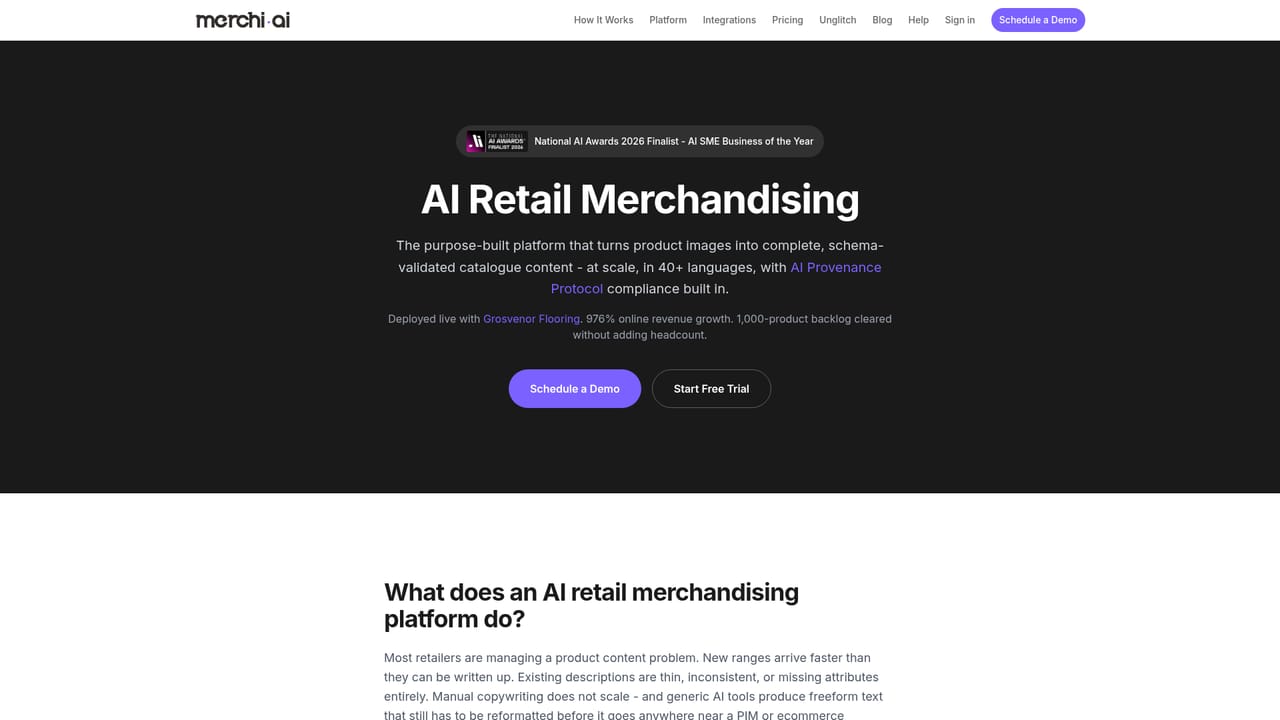
merchi.ai generates titles, descriptions, attributes and taxonomy from product images across entire retail catalogues, with native content in 40+ languages, brand voice controls, review workflows and marketplace or PIM integrations.
merchi.ai is a product content engine built for retailers and brands whose catalogues have outgrown their copywriting workflow. A seller uploads product imagery (single files, a ZIP of hundreds, a spreadsheet of image URLs, or an API feed) and multimodal AI examines each photo to write the listing: titles, descriptions, key features, styling and care notes, meta titles and descriptions, image alt text and FAQs. The platform positions this as roughly 30 seconds per product, with the claim that a thousand products can clear in a day. The strongest differentiator is how language is handled. Content is generated natively in each of 40+ supported languages rather than translated from a master version, so each market gets copy written independently for cultural and search relevance. Alongside the prose, merchi.ai assigns attributes and taxonomy against recognised standards (ETIM, GS1, Google Product Taxonomy, Shopify) or a custom taxonomy tree, and identifies visual attributes from the image itself. Brand voice is controlled through uploaded tone of voice documents, stop word lists, golden examples and category-specific tone profiles, while a flexible schema layer defines which content blocks appear and what rules each field follows. Day to day, the work is a review queue rather than a blank page. Merchandisers approve or reject generated copy, or refine it with plain language instructions such as asking for a more casual register or a stronger emphasis on a particular feature. Finished content exports as CSV, fires through a webhook, or syncs to an e-commerce or PIM system. The integration list spans marketplaces and commerce platforms (Amazon, eBay, Walmart, Zalando, Rakuten, Shopify, WooCommerce, Salesforce, SAP) plus PIM, DAM and cloud storage tools such as Akeneo, Salsify, inRiver, Plytix, Pimcore, Bynder, Canto, Brandfolder, Adobe and AWS. Buyers with compliance obligations get a notable amount of governance built in: an AI provenance trail recording which model produced each block and whether a human reviewed it, tenant isolation, encryption in transit and at rest, GDPR alignment and a verification API. The obvious comparison is general-purpose writing assistants, which handle one listing at a time and have no taxonomy or catalogue ingestion story; merchi.ai is aimed squarely at teams managing hundreds to thousands of SKUs who need volume, structure and auditability together.

A 30-day free trial is offered, with signup handled on a dedicated trial page. The homepage states no training period is needed and that content is returned as soon as products are uploaded.
Learn moreSupport runs through a contact form and demo scheduling with a 30-minute walkthrough using your own product images. Enterprise documentation covers the AI Provenance Protocol, GDPR data processing agreements and a public verification API.
Connectors and sync targets include Amazon, eBay, Walmart, Zalando, Rakuten, Shopify, WooCommerce, Salesforce and SAP, plus PIM and DAM tools such as Akeneo, Salsify, inRiver, Plytix, Pimcore, Bynder, Canto and Brandfolder, with cloud storage on AWS, Azure and Google Cloud.
Core capabilities cover AI-generated titles, descriptions, key features, styling advice, care instructions, meta fields, alt text and FAQs from product images; attribute extraction and taxonomy assignment against ETIM, GS1, Google Product Taxonomy, Shopify or custom trees; native generation in 40+ languages; brand voice and schema controls; and bulk intake via ZIP, spreadsheet or API with CSV, webhook and platform export.
Learn more AI Angels400+ customizable AI girlfriends for NSFW chat, voice calls, and roleplay
 Candy AIExperience the future of companionship with AI friends who chat, role-play, and connect with you on a human level.
 ourdream.aiA vast AI roleplay platform with millions of characters for chat, images, video and voiceAI Angels400+ customizable AI girlfriends for NSFW chat, voice calls, and roleplayCandy AIExperience the future of companionship with AI friends who chat, role-play, and connect with you on a human level.ourdream.aiA vast AI roleplay platform with millions of characters for chat, images, video and voice


