Free trial
Public signup creates an account at no charge, and a paid plan is only needed once you are ready to run a venture. The site does not state a time-limited free trial.
Learn moreAn AI executive team that runs your departments on a schedule.

Organ is a content tool. Organ gives founders and small agencies a scheduled AI team of executive agents that write code, draft content and run operations, with merges, outbound email and publishing held behind your approval. Plans start at $39 per month with included compute credits, and model tokens are billed separately on your own key or Organ's.
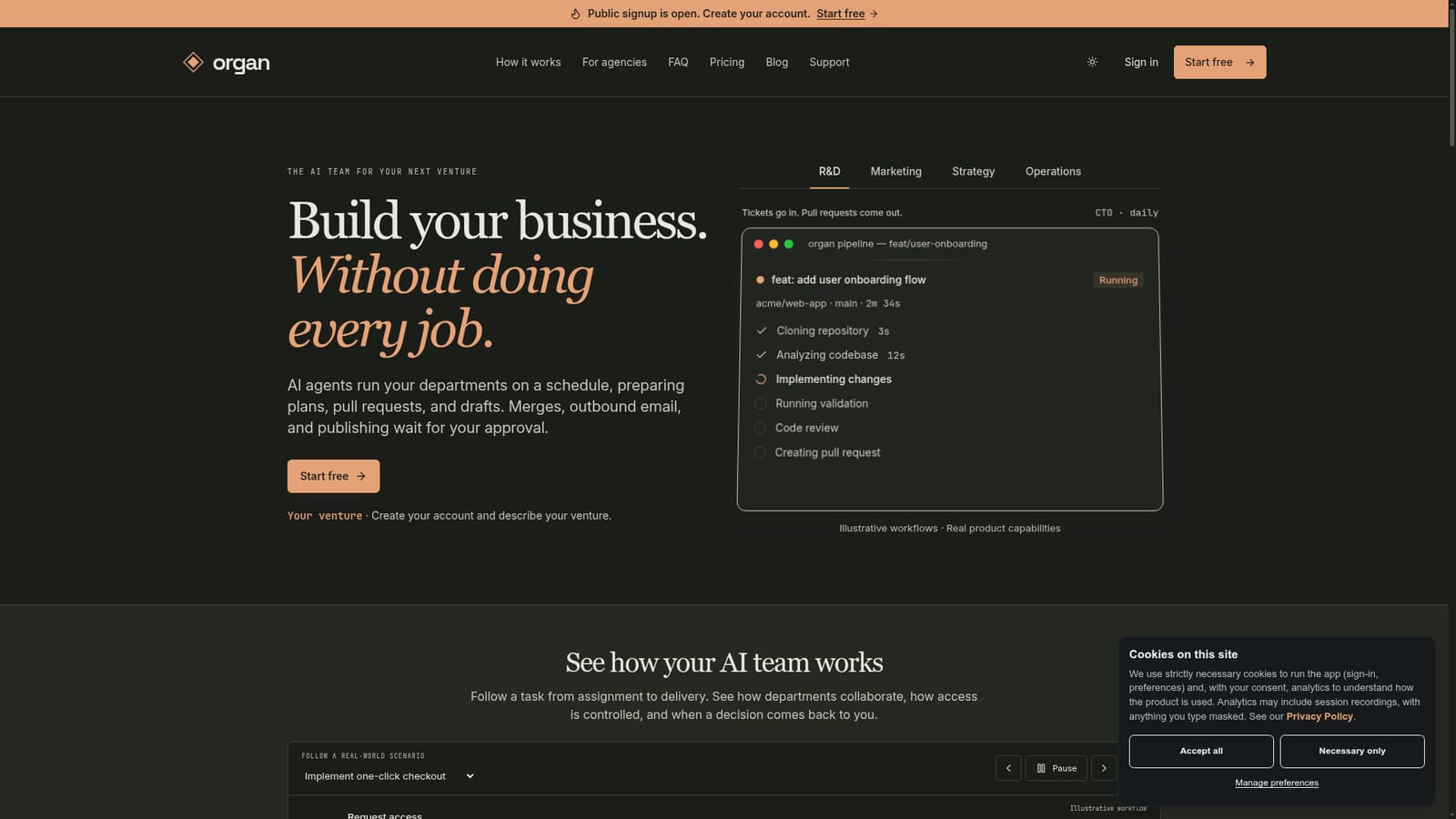
Organ is a web app that assembles a virtual executive team for a small business or solo founder. After a short conversation with Maya, the onboarding assistant, you describe what you want to build and Organ spins up departments for strategy, marketing, product, research and development, and operations. Each department is staffed by named agents (a CTO, a CMO, a COO, a CEO and specialists beneath them) that run on a schedule: strategy cadence is weekly, while marketing, operations, product and R&D run daily. The output is tangible work rather than chat text: goal updates, tickets, code branches and pull requests, blog drafts, and operational health checks. The design principle is that agents prepare and you decide. Merges, outbound email and publishing sit behind an approval gate, so pull requests open but do not merge unless you approve them or set an automatic approval rule yourself. Anything an agent cannot resolve escalates into an approvals inbox, tagged by severity, instead of being pushed through. Executives review finished work before it moves on, and a Security Officer agent scopes which resources each working agent can touch, covering repositories, databases, hosting, DNS, email and API keys. A shared memory layer, called the Brain, records observations from every agent and synthesizes them into a versioned institutional record. A decision made in marketing on Tuesday can inform an engineering build on Thursday, and context carries across sessions rather than resetting each time. Organ is aimed at founders and small agencies who want departmental coverage without hiring for every role, and who are comfortable reviewing a queue of decisions daily. Cost is split between a flat monthly fee that includes compute credits and model tokens billed separately, either on your own Anthropic, OpenAI or OpenRouter key or on Organ's key at metered rates. Repositories connect through GitHub, GitLab or platform-hosted repos in beta, and Linear is the supported tracker, so teams on other stacks should check fit before committing. Organ says its own company runs on the product, with agents opening pull requests against its codebase and drafting its blog posts.
Public signup creates an account at no charge, and a paid plan is only needed once you are ready to run a venture. The site does not state a time-limited free trial.
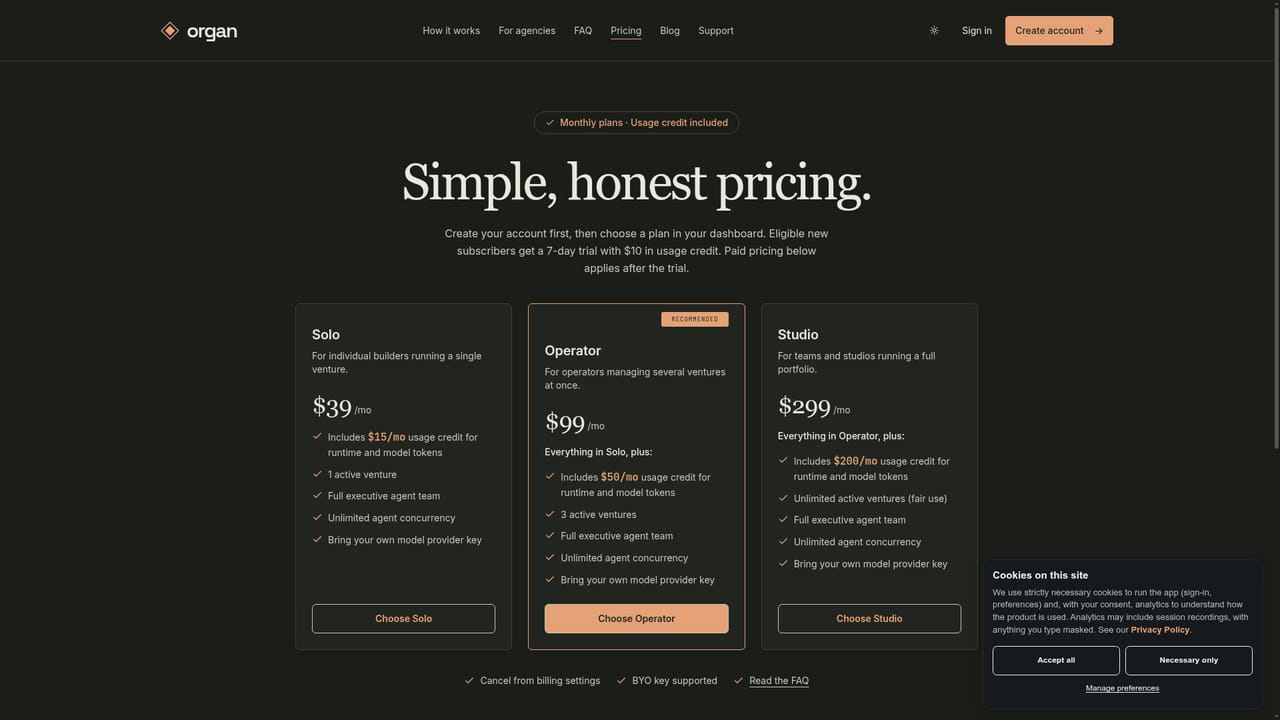
Learn moreThree paid tiers: Solo at $39 per month for one venture with $15 in monthly compute credits, Operator at $99 for several ventures with $50 in credits, and Studio at $299 for a portfolio with $200 in credits. Model tokens are billed separately, either through your own provider key or Organ's metered rates.
Learn moreRepositories on GitHub, GitLab and platform-hosted repositories (beta), plus Linear for issue tracking. Resource scoping also covers databases, hosting, DNS and TLS, the venture inbox and model or vendor API keys.
Scheduled departmental agents for strategy, marketing, product, R&D and operations; approval gates on merges, outbound email and publishing; a severity-tagged escalations inbox; executive review of finished work; a shared versioned memory layer called the Brain; a Security Officer that scopes resource access; and a spend dashboard with caps for compute credits and model tokens.
 AI Angels400+ customizable AI girlfriends for NSFW chat, voice calls, and roleplay
 Candy AIExperience the future of companionship with AI friends who chat, role-play, and connect with you on a human level.
 ourdream.aiA vast AI roleplay platform with millions of characters for chat, images, video and voiceAI Angels400+ customizable AI girlfriends for NSFW chat, voice calls, and roleplayCandy AIExperience the future of companionship with AI friends who chat, role-play, and connect with you on a human level.ourdream.aiA vast AI roleplay platform with millions of characters for chat, images, video and voice


