Respan

One router for every model, with tracing, evals and spend control built in

Advanced API
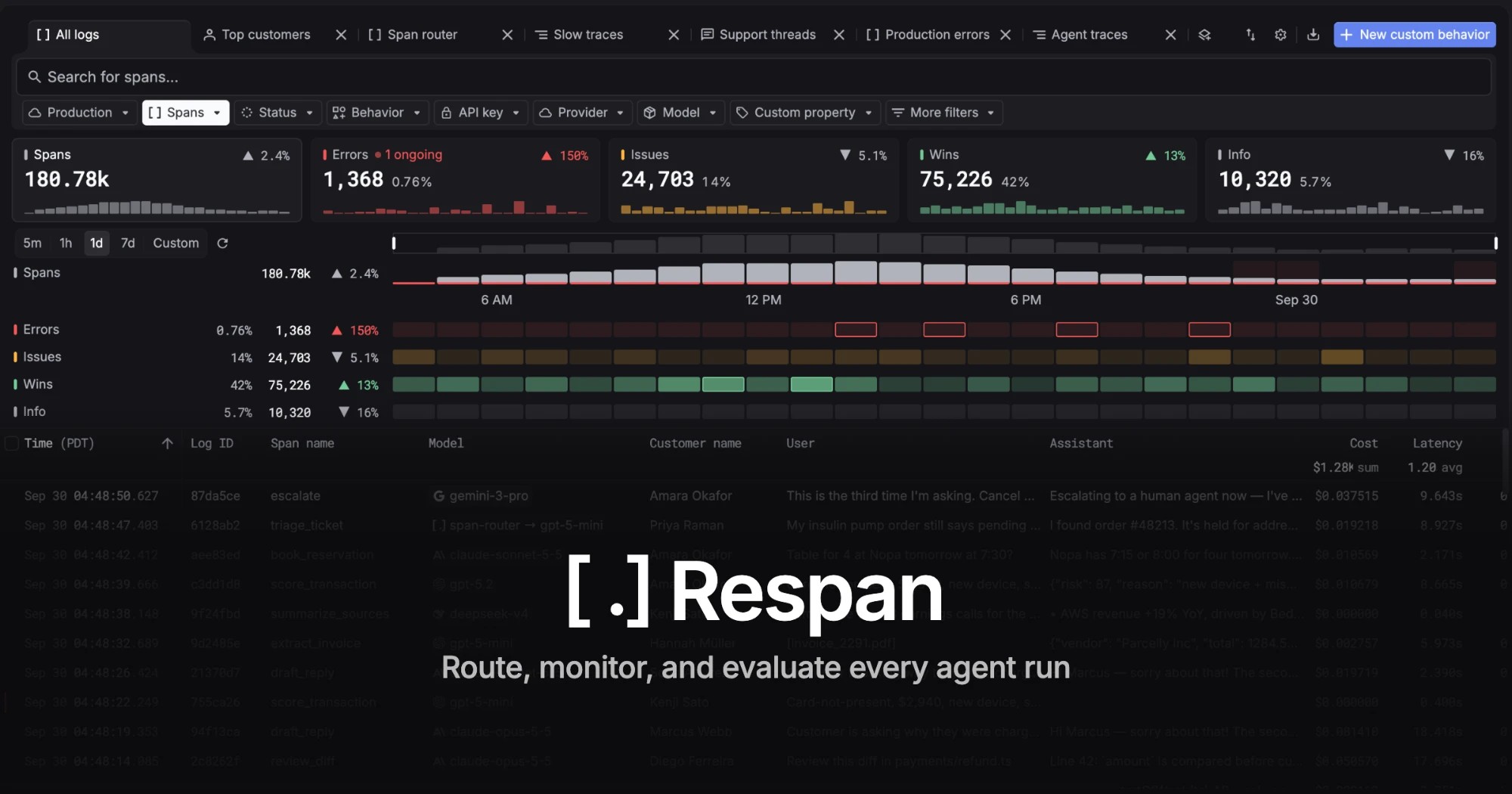
Screenshot of Respan, One router for every model, with tracing, evals and spend control built in

What is Respan?

Respan is an AI engineering problem solver tool. An AI gateway and observability platform: route requests to 1,000+ models through one endpoint with fallbacks, caching and budgets, then trace, monitor and evaluate every agent run. Built for engineering teams running agents in production.

Respan is a routing and observability layer for teams running AI agents and LLM-powered products. Instead of wiring separate credentials and endpoints for each provider, you point your existing SDK at one Respan endpoint and reach more than 1,000 models across the major providers. Switching models becomes a one-word change in the request. The gateway also handles the operational chores that usually get bolted on later: fallback lists that move to the next model when one errors or rate-limits, response caching for repeat calls, and budget or rate limits scoped to a key, a customer or the whole organization. The observability side is where Respan differs from a plain model proxy. Every LLM call, tool run, retrieval and agent turn is captured as a span inside a single trace, with input, output, latency, cost and token counts attached. A monitoring dashboard rolls requests, errors, cost, latency and tokens into one view, sliced by model, key or user, and alerts push to Slack, email or a webhook when a metric crosses a threshold you set. Evaluators combine an LLM judge, deterministic code checks and human review into one score, and the same evaluator can run against a test set or sample live production traffic at a chosen rate. The practical workflow is comparison-driven. You pull real requests from logs by filter and sampling rate (or upload a CSV), run a prompt or model against that dataset, and compare score distributions before shipping. The homepage cites teams scaling to hundreds of millions of API calls monthly, which explains the emphasis on debugging speed and reliability over prompt authoring. Respan suits engineering and platform teams already past the prototype stage: agent builders, voice and memory startups, and product groups that need cost governance and regression detection alongside model access. It is infrastructure, so non-technical users will find little here. Against tracing-first tools such as LangSmith, the pitch is one integrated stack (gateway plus tracing plus evals) and simpler setup, though teams deep in a single vendor ecosystem may prefer native tooling.

How do you use Respan?

  1. 1Create an account and get an API key
    Sign up on the Respan platform and generate a key. That key authenticates both gateway traffic and the tracing and monitoring attached to it.
  2. 2Point your SDK at the Respan endpoint
    Keep the SDK you already use and change the base URL and key so requests flow through the gateway. Follow the integration docs for your framework.
  3. 3Pick models and set fallbacks
    Choose a primary model from the catalog, compare input and output pricing, and list backup models so errors or rate limits roll over automatically.
  4. 4Add budgets, limits and alerts
    Set spend and rate limits per key, per customer or org-wide, then route threshold alerts to Slack, email or a webhook.
  5. 5Build an evaluator and a dataset
    Compose an evaluator from an LLM judge, a code check or human review, then sample production requests or upload a CSV to form the test set.
  6. 6Compare versions and monitor live traffic
    Run prompts or models against the dataset, compare score distributions side by side, and deploy the winning evaluator on sampled production spans.

Pros and cons

Pros

  • One endpoint replaces per-provider integrations, and model switching is a single-word changeAI
  • Automatic fallbacks address provider outages and rate limits without extra codeAI
  • Tracing captures each LLM call, tool run and retrieval as a span with cost and latencyAI
  • Evaluators blend LLM judges, code checks and human review, and can score sampled production trafficAI
  • Budget, rate limits and alerts are scoped per key, customer or organization, which keeps spend visibleAI

Cons

  • No public pricing tiers are listed on the homepage, so cost planning requires a demo or sales conversationAI
  • The product is infrastructure-grade: no visual agent builder, and setup assumes working code and SDK knowledgeAI
  • Its value depends on sending traffic through Respan, which means a meaningful migration for existing stacksAI
  • Evaluator quality still depends on the judges and rubrics you configure, so scoring needs ongoing tuningAI
  • Feature depth is spread across gateway, tracing and evals, and smaller teams may only need one of the threeAI

How much does Respan cost?

Pricing

The homepage does not publish plan tiers or subscription prices. It does show per-model token rates, for example DeepSeek V4.1 Flash at $0.06 input and $0.35 output per 1M tokens, alongside list prices shown crossed out with discounts from 20% to 75%.

Learn more

Support

No support channels such as email, chat or a help centre are described on the homepage. A demo booking link is offered, and docs pages are linked from the site for integrations.

Integrations

Documented integrations cover LangChain, LlamaIndex, Vercel AI SDK, Mastra, Haystack, LiteLLM, Cursor, Mem0, Cognee, PostHog, AssemblyAI and Linkup, plus gateway providers including Anthropic, OpenAI-compatible vendors, xAI, Groq, Together, Fireworks, DeepSeek and OpenRouter.

Learn more

Features

Gateway routing to 1,000+ models through one API with automatic fallbacks, response caching and scoped budgets or rate limits. Tracing turns every LLM call, tool run, retrieval and agent turn into a span with input, output, latency, cost and tokens. Monitoring tracks requests, errors, cost, latency and tokens with threshold alerts. Evaluators combine LLM judges, code checks and human review, run on test sets or sampled production traffic.

Frequently asked questions about Respan

  • How much does Respan cost?
    The homepage does not publish plan tiers or subscription prices. It does show per-model token rates, for example DeepSeek V4.1 Flash at $0.06 input and $0.35 output per 1M tokens, alongside list prices shown crossed out with discounts from 20% to 75%.
  • Does Respan have an API?
    Yes, Respan offers an API.
  • How do you use Respan?
    The walkthrough on this page covers 6 steps: 1. Create an account and get an API key 2. Point your SDK at the Respan endpoint 3. Pick models and set fallbacks 4. Add budgets, limits and alerts 5. Build an evaluator and a dataset 6. Compare versions and monitor live traffic.
  • What platforms does Respan support?
    Respan is available on Web App.
  • What does Respan integrate with?
    Documented integrations cover LangChain, LlamaIndex, Vercel AI SDK, Mastra, Haystack, LiteLLM, Cursor, Mem0, Cognee, PostHog, AssemblyAI and Linkup, plus gateway providers including Anthropic, OpenAI-compatible vendors, xAI, Groq, Together, Fireworks, DeepSeek and OpenRouter.
  • What are the limitations of Respan?
    No public pricing tiers are listed on the homepage, so cost planning requires a demo or sales conversation. The product is infrastructure-grade: no visual agent builder, and setup assumes working code and SDK knowledge. Its value depends on sending traffic through Respan, which means a meaningful migration for existing stacks.

Status

StatusActive
Views0
Outbound clicks0
Added10/21/2026

Platforms

Web App

Pricing

FreemiumSubscription