Free trial
A free scan is offered through the browser upload tool with no account mentioned. App Store and Google Play listings handle the paid app separately.
Learn morePhoto-first rock, mineral and gem identification with hardness clues
Own Rock Identifier.io? Verify ownership to get a dofollow link
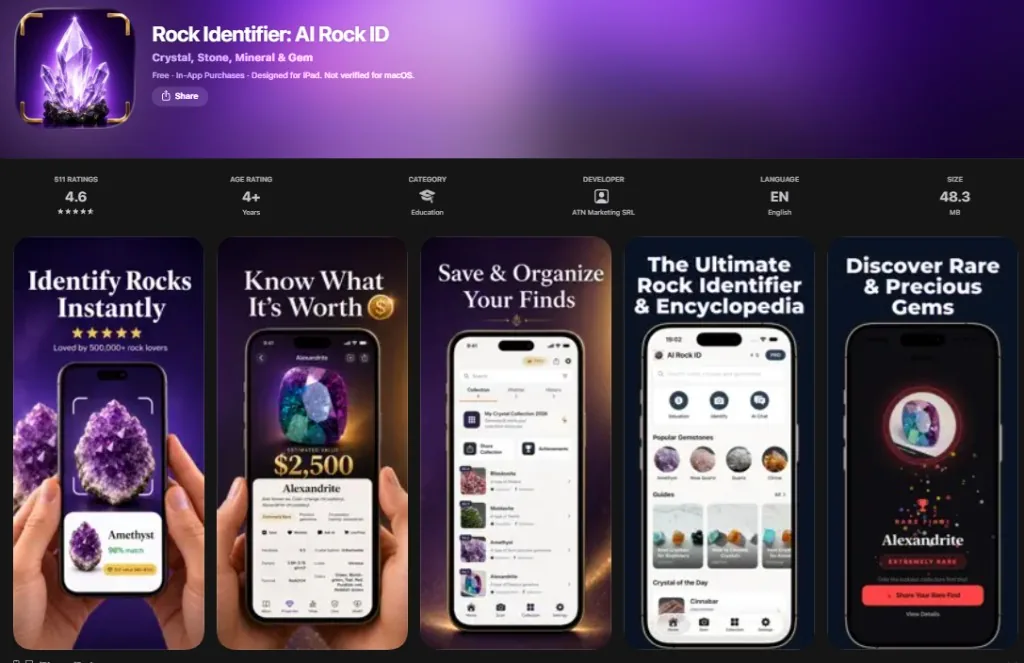
Rock Identifier.io is an image analysis tool. A photo-based identification tool for rocks, minerals, crystals, gemstones and fossils. Upload an image in the browser or use the mobile app to get a likely name, rock class, Mohs hardness clues, visual traits and a rough value range, plus targeted scanners for specific specimen types.
Rock Identifier.io is a browser-based lookup tool that names an unknown rock, mineral, crystal, gemstone or fossil from a single photo. Users upload an image or take one directly in the page, and the scanner returns a ranked likely identification with supporting evidence: rock class, visible mineral properties, Mohs hardness clues, common varieties and a rough value range. The site also ships dedicated scanners for narrower specimen types, covering crystal, gemstone, fossil, geode, meteorite, gold, diamond and obsidian among others, plus lookalike-focused tools for hallmark checks, jewelry and metal. The model is built to look past color, which the site openly calls misleading (purple may be amethyst, fluorite, lepidolite or dyed quartz). Instead it weighs texture, luster, grain size, cleavage, fracture, transparency, banding, vesicles and crystal habit. That makes the output closer to a geology student's sorting-table reasoning than a generic image search, and the site is candid about the ceiling: results are a first opinion, not a lab certificate or a certified appraisal. In practice the tool fits field and classroom use. Hikers, beach and river collectors, crystal hobbyists and students can point a phone camera at a find and get a candidate list within seconds, then narrow it with simple checks the site recommends, such as streak, magnetism, heft or a dilute acid test. Uploading a second photo from another angle is the suggested fix when the first result comes back broad. Steps like cleaning the surface and shooting in overcast daylight matter more here than with general-purpose vision tools. Its position among alternatives is clear. Google Lens matches a photo to similar web images and often returns jewelry listings or decor pages; ChatGPT explains geology well but is not built for specimen matching. Rock Identifier sits between them as a camera-first tool with mineral vocabulary attached, and the site recommends pairing it with a general assistant for interpretation rather than replacing one with the other. The iPhone and Android app adds unlimited scans, saved collections and extra field tools for people who identify rocks regularly.
A free scan is offered through the browser upload tool with no account mentioned. App Store and Google Play listings handle the paid app separately.
Learn moreThe homepage advertises a free photo scan in the browser and points to a paid iPhone and Android app that adds unlimited scans, saved collections and extra field tools. No subscription prices or tier details are stated on the page.
Learn morePhoto upload or in-page camera capture, ranked identifications with rock class and visible mineral properties, Mohs hardness clues, common lookalike warnings and a rough value range. Dedicated scanners cover crystals, minerals, stones, gemstones, fossils, diamonds, gold, geodes, quartz, agate, obsidian, shark teeth, hallmarks, jewelry and organic finds.
 AI Angels400+ customizable AI girlfriends for NSFW chat, voice calls, and roleplay
 Candy AIExperience the future of companionship with AI friends who chat, role-play, and connect with you on a human level.
 ourdream.aiA vast AI roleplay platform with millions of characters for chat, images, video and voiceAI Angels400+ customizable AI girlfriends for NSFW chat, voice calls, and roleplayCandy AIExperience the future of companionship with AI friends who chat, role-play, and connect with you on a human level.ourdream.aiA vast AI roleplay platform with millions of characters for chat, images, video and voice