Support
A single contact route is published: an email address, support@tanka.ai. No help center, documentation portal or live chat is listed on the homepage.
An operating base that turns human intent into computable work for AI-native teams

Tanka is an early-access operating base for AI-native companies. It focuses on capturing high-density human intent, encoding roles for digital twins, and building intelligent memory so AI agents can carry out work without constant human coordination.
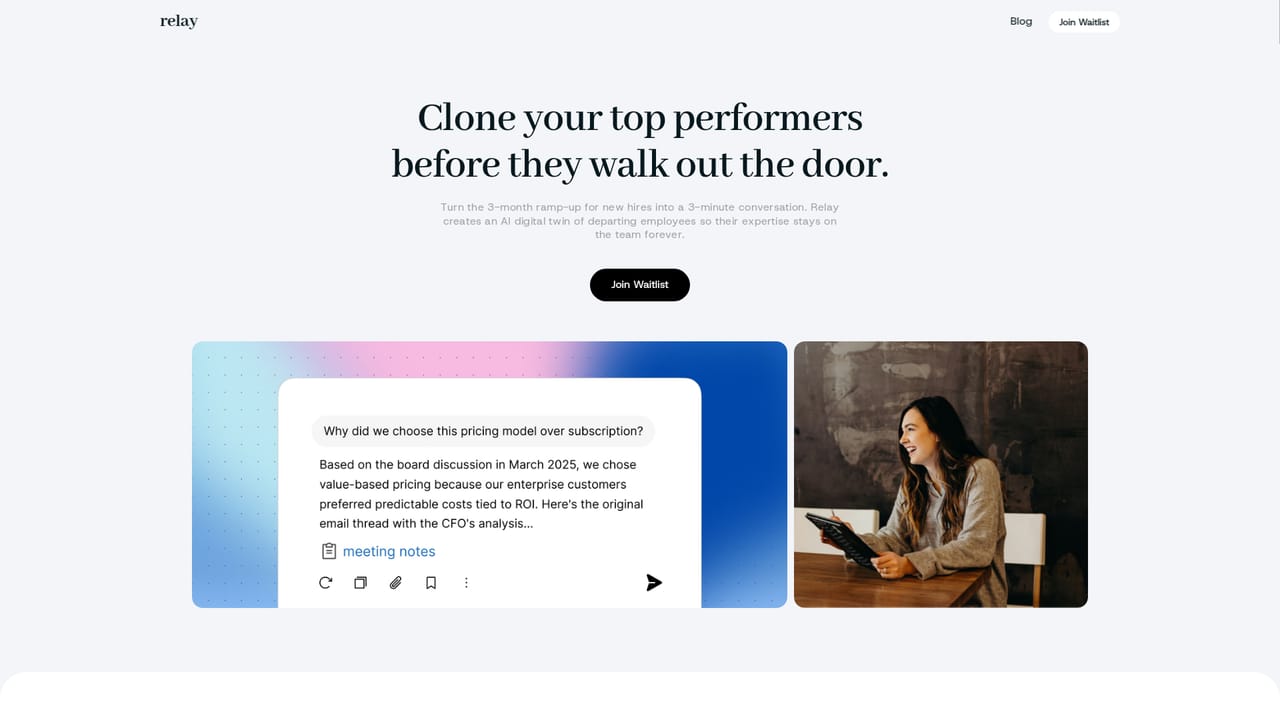
Tanka positions itself as an operating base for what it calls the AI-native company: a layer that sits above ordinary execution and captures the compact signal of human intent rather than the long trail of tasks that follow it. The core idea on the homepage is that teams should stop managing and start computing, letting software scale intelligence instead of headcount. It is less a single-purpose creative app and more a structural environment in which AI agents carry out work that would normally be coordinated by people. Two concepts anchor the product. The first is role, described in Tanka's writing as a first-principle coordinate rather than a job title, a way for digital twins to interpret what a person actually wants. The second is memory, framed not as storage but as intelligent data: a warehouse of books is inventory, while memory means the right page surfacing for the right person at the right moment. The company refers to this memory work as EverMind, building what it calls first-person neural circuits rather than a filing system. Tanka also publishes openly about the plumbing underneath: data piping that captures business reality instead of pursuing a human wave of one-off integrations, and a written position on data versus privacy in an AI-native organization. Entry happens through a sign-up portal, with a separate Relay product linked from the same site. The tone across the site is deliberately dense and conceptual, aimed at founders and operators designing how machines and people divide labor. It is early-stage. The site solicits early access rather than presenting finished documentation, and much of what Tanka claims is articulated through essays rather than interface walkthroughs. Buyers should treat it as a system to evaluate against existing internal tooling and agent platforms, not as a drop-in utility. The best fit is an organization already convinced that intent capture, not task tracking, is the bottleneck.
A single contact route is published: an email address, support@tanka.ai. No help center, documentation portal or live chat is listed on the homepage.
The homepage describes an operating base for AI-native companies built around three ideas: capturing high-density human intent instead of execution narrative, encoding roles as coordinates for digital twins, and an EverMind memory layer that surfaces the right context at the right moment. Data piping and a data versus privacy position are covered in the blog. No feature list beyond these concepts is published.
 AI Angels400+ customizable AI girlfriends for NSFW chat, voice calls, and roleplay
 Candy AIExperience the future of companionship with AI friends who chat, role-play, and connect with you on a human level.
 ourdream.aiA vast AI roleplay platform with millions of characters for chat, images, video and voiceAI Angels400+ customizable AI girlfriends for NSFW chat, voice calls, and roleplayCandy AIExperience the future of companionship with AI friends who chat, role-play, and connect with you on a human level.ourdream.aiA vast AI roleplay platform with millions of characters for chat, images, video and voice


