Integrations
The homepage names Cursor, AWS Bedrock, cloud agents, support agents and customer-facing agents as covered environments, and mentions MCP discovery. No formal integrations list is given.
Agent-side security that blocks agentjacking before agents act
Own Tenet Security? Verify ownership to get a dofollow link

Tenet Security is a chat tool. Tenet Security protects enterprise AI agents from agentjacking, secrets leakage and data exfiltration. It covers discovery, detection, real-time protection, management and testing across endpoint and cloud, without proxies or gateways.
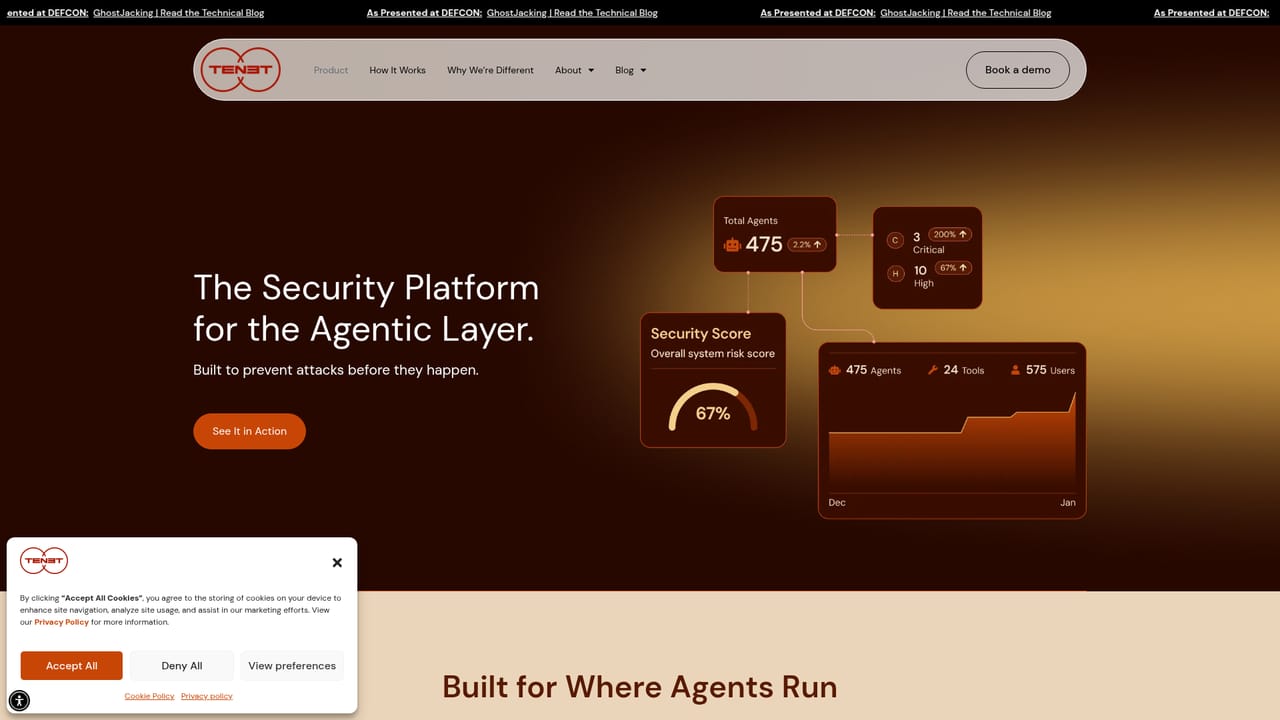
Tenet Security is a security platform aimed at the agentic layer: the autonomous AI agents that now run inside enterprises, from coding assistants such as Cursor to cloud agents on AWS Bedrock, support agents and customer-facing agents. Its central concern is agentjacking, where an attacker manipulates an agent into doing something its owner never intended. The vendor backs this with a claim that it took over agents at more than 100 global companies and made them execute its own code, and it argues that most teams cannot even tell which of their agents are exposed. The product is organised around five stages. Discover builds an inventory of autonomous agents, MCP servers and associated risks across endpoint and cloud, with a full agent risk assessment promised in under three hours. Detect and Investigate provides AI Detection and Response (AIDR) for external attacks and for misuse by the agents themselves. Protect blocks manipulation and hijacking in real time, and the vendor states this works without proxies, gateways or runtime friction. Manage gives one place to control agent risk from coding tools through to production. Validate tests agents against real-world attacks, including the OWASP Top-10 for Agents and MITRE ATLAS, before they ship. A distinguishing element is Agent-Side Simulation, which is described as patent pending. It tries to predict what an agent will do next and stop dangerous actions before they execute, rather than reacting to traffic after the fact. The listed threat coverage includes secrets leaking, hidden and ordinary data exfiltration, PII leakage, rogue sessions and intent drift. Tenet fits security teams, platform engineers and CISOs who are rolling out coding agents or production agents and need visibility and control over them. It sits in the emerging AI security category alongside gateway and proxy based guardrail products, but positions itself as an endpoint and cloud deployment that avoids inline traffic interception. Access is sales-led: the site directs visitors to book a demo or request an agent risk assessment, and it publishes no self-serve signup or public pricing.
The homepage names Cursor, AWS Bedrock, cloud agents, support agents and customer-facing agents as covered environments, and mentions MCP discovery. No formal integrations list is given.
Agent discovery across endpoint and cloud, AI Detection and Response (AIDR), real-time blocking of agentjacking, secrets and PII leakage and data exfiltration, centralised agent risk management, Agent-Side Simulation (patent pending), and validation against OWASP Top-10 for Agents and MITRE ATLAS.
Learn more


