Free trial
Premium includes a 14-day free trial. A card is required to start, nothing is charged during the 14 days, and the subscription can be cancelled at any time. The free plan needs no card.
Learn moreA Monday email with the papers that match your research
Own The Academic Digest? Verify ownership to get a dofollow link

The Academic Digest is an academic research tool. A weekly email digest that scans 100,000+ papers from 290+ journals plus bioRxiv, medRxiv and arXiv, then ranks and summarises the ones matching your project topics and keywords. Free tier covers one project and five papers a week; Premium adds more projects, citation networks, author h-index ranking and Zotero saving.
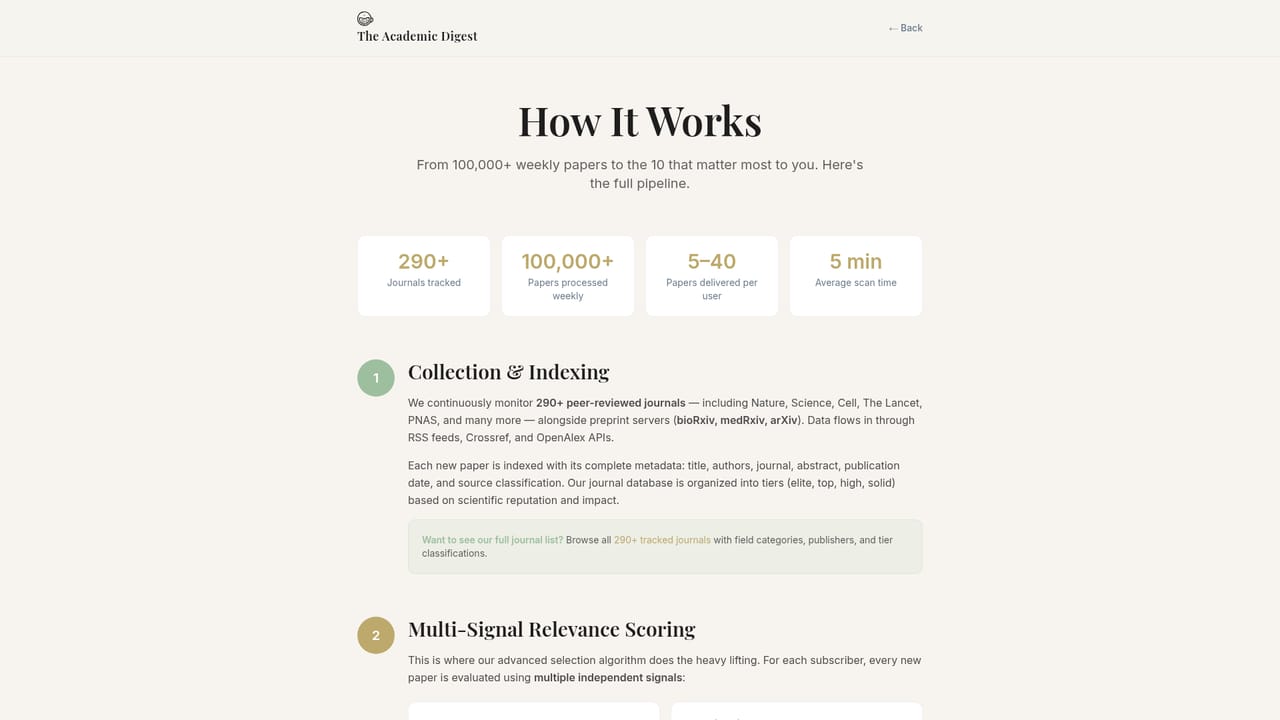
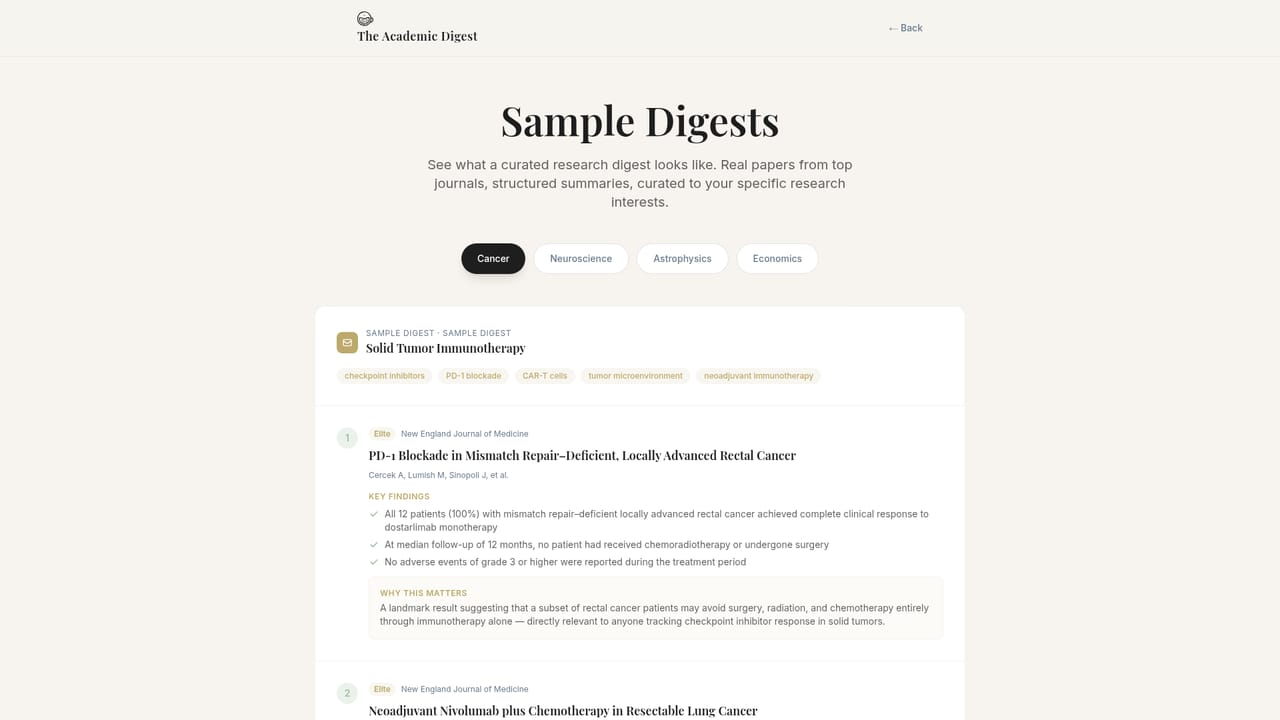
The Academic Digest is a weekly literature monitoring service that turns a sprawling journal landscape into one curated email. Each Monday it scans more than 100,000 papers drawn from over 290 journals, including Nature, Science and Cell, plus preprints from bioRxiv, medRxiv and arXiv, and delivers the ones that map to research interests you define in advance. Instead of running the same keyword searches in Google Scholar or PubMed every morning and triaging dozens of titles, subscribers open a single message and work through a short ranked list. The setup is deliberately narrow. You create a research project, give it a name such as Tumor Immunology, pick a topic, and add a handful of specific keywords. The service itself suggests that five to seven keywords is the sweet spot because tight terms produce better matches than broad ones. From there, each paper in the digest arrives with three to five extracted findings covering methods, results and conclusions, a short Why This Matters note, and a link to the original publication. Titles and abstracts alone are not the whole story, so the summaries are meant to let you decide in seconds whether a paper deserves a full read. The product is built for working academics, PhD students, lab leads and clinicians who need to stay current across one or a few adjacent fields without living inside databases. Premium adds a citation network so you can trace ideas forward and backward from any paper, ranking that nudges up work from authors with strong h-indexes in your field, cross-field suggestions to break out of an echo chamber, a like button that tunes future digests, and one-click saving to a Zotero library. Against manual search tools, the trade is control for calm: you give up the ability to browse everything matching a keyword and get a smaller, ranked selection instead. Coverage is journal-based, and the site notes that users can request journals for the tracked list, so niche or regional publications may not appear immediately. The free tier caps you at one project and five papers a week, which suits a single focused research question more than a multi-project lab.
Premium includes a 14-day free trial. A card is required to start, nothing is charged during the 14 days, and the subscription can be cancelled at any time. The free plan needs no card.
Learn moreFree Digest costs €0 forever with no card: 1 project, 5 papers weekly, 1 topic and 5 keywords. Premium Digest is €3.75 per month when billed annually at €45, or monthly with a 25% yearly saving, and adds 4 projects, 40 papers, 5 topics and 15 keywords per project, citation networks, h-index ranking, likes and Zotero saving.
Learn moreOne-click saving to a personal Zotero library is the only named integration. Digests are delivered by email, and journals can be requested for the tracked list.
Separate research projects each with their own topics and keywords, structured key findings (3 to 5 per paper), Why This Matters analysis, preprint coverage from bioRxiv, medRxiv and arXiv, cross-field discovery to escape filter bubbles, a related papers citation network, author h-index ranking, a like button for tuning future digests, and one-click Zotero saving.
Learn more AI Angels400+ customizable AI girlfriends for NSFW chat, voice calls, and roleplay
 Candy AIExperience the future of companionship with AI friends who chat, role-play, and connect with you on a human level.
 ourdream.aiA vast AI roleplay platform with millions of characters for chat, images, video and voiceAI Angels400+ customizable AI girlfriends for NSFW chat, voice calls, and roleplayCandy AIExperience the future of companionship with AI friends who chat, role-play, and connect with you on a human level.ourdream.aiA vast AI roleplay platform with millions of characters for chat, images, video and voice