Free trial
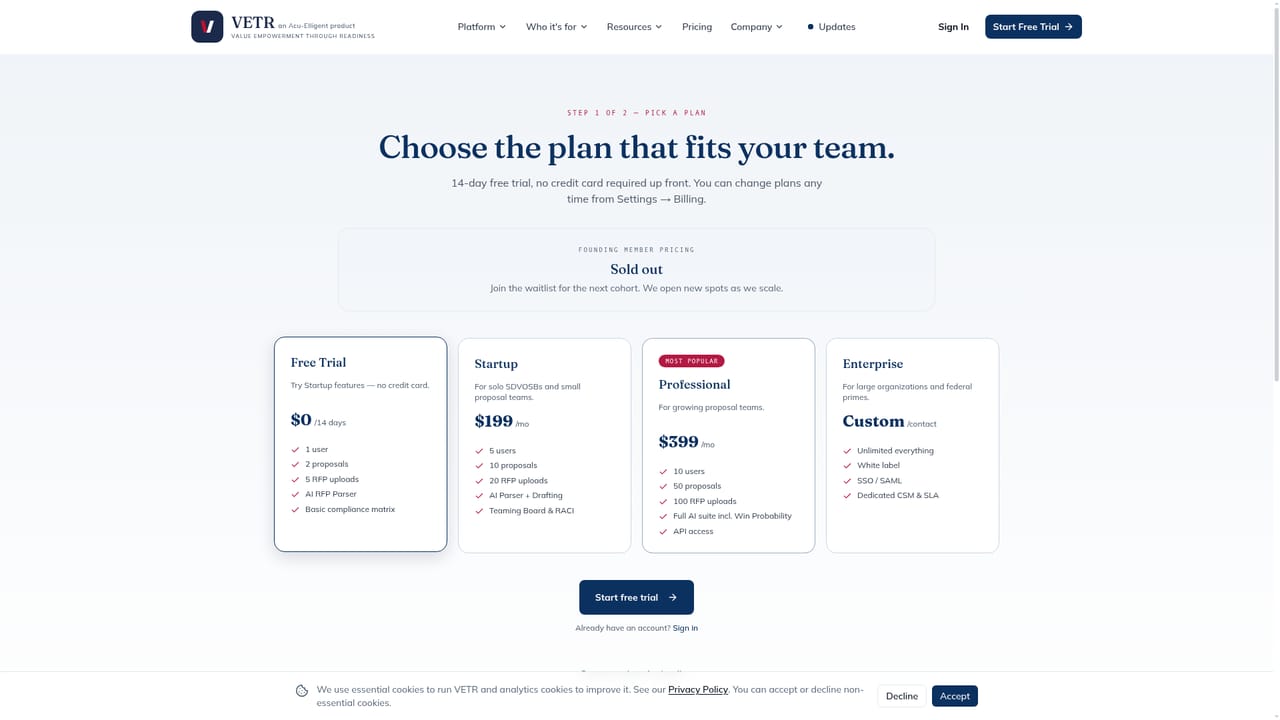
A 14-day free trial is offered with no credit card required; the vendor says onboarding takes about 24 hours and the subscription can be cancelled at any time.
Learn moreFederal proposal platform for set-aside small businesses.
Own VETR Proposal? Verify ownership to get a dofollow link

VETR Proposal is a federal proposal management platform for veteran-owned and set-aside small businesses. It parses RFPs into compliance matrices, supports teaming and past-performance matching, drafts volumes with in-boundary AI on AWS GovCloud, and scores proposals on the VETR framework.
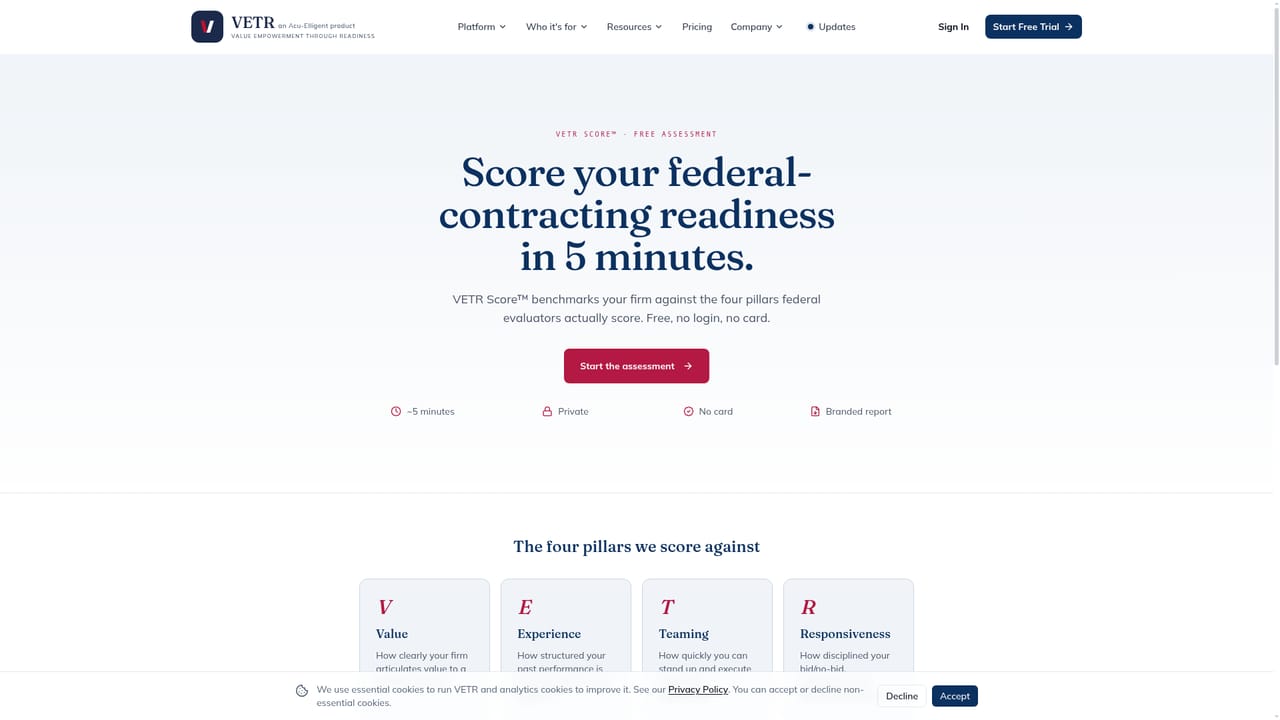
VETR Proposal is a proposal management platform aimed squarely at small businesses chasing U.S. federal contracts, with a particular focus on veteran-owned and set-aside contractors (SDVOSB, WOSB, EDWOSB, 8(a), HUBZone). Built by Acu-Elligent LLC, a veteran-owned company in Savannah, Georgia, it wraps capture, compliance, teaming, drafting and scoring into one workflow organized around a four-part method the vendor calls the VETR framework: Value, Experience, Teaming and Responsiveness. In practice the tool ingests a solicitation and parses Section L instructions and Section M evaluation criteria in roughly 90 seconds, turning every "shall" into a row in a compliance matrix. It also extracts and de-duplicates FAR and DFARS clauses, flags amendments for material change, and uses a published clause-reading model (FedProc) to decide whether each clause binds the contract. From there, teams close capability gaps by attaching subcontractors and CPARS citations from a past-performance library, draft each volume against its own requirements, and score the result on the VETR pillars alongside a directional probability of win. Security is central to the pitch: AI processing runs in-boundary on AWS GovCloud (us-gov-west-1) via Amazon Bedrock, proposal content is never sent to a third-party model provider and never used to train shared models. Controls are mapped to NIST SP 800-171 and aligned with CMMC Level 2, with FedRAMP 20x and SOC 2 Type II listed as in preparation. Integrations cover SAM.gov, GovCon, Grants.gov and a Microsoft Word add-in, with CRM and e-signature connectors in preparation. It competes with general proposal platforms and legacy GovCon suites rather than with writing assistants. The difference is the set-aside framing, the published procurement research behind its clause analysis, and small-business pricing, though it is a young product: the certifications are not yet complete and the price-to-win engine only becomes useful once a firm has several won bids on record.
A 14-day free trial is offered with no credit card required; the vendor says onboarding takes about 24 hours and the subscription can be cancelled at any time.
Learn moreThe homepage advertises small-business pricing and a 14-day free trial with no credit card required, cancellable at any time. Specific plan tiers and figures are not shown in the homepage content and should be confirmed on the pricing page.
Learn moreSupport details are not described in the homepage content. The site offers an FAQ and a contact page, and onboarding is stated to take about 24 hours.
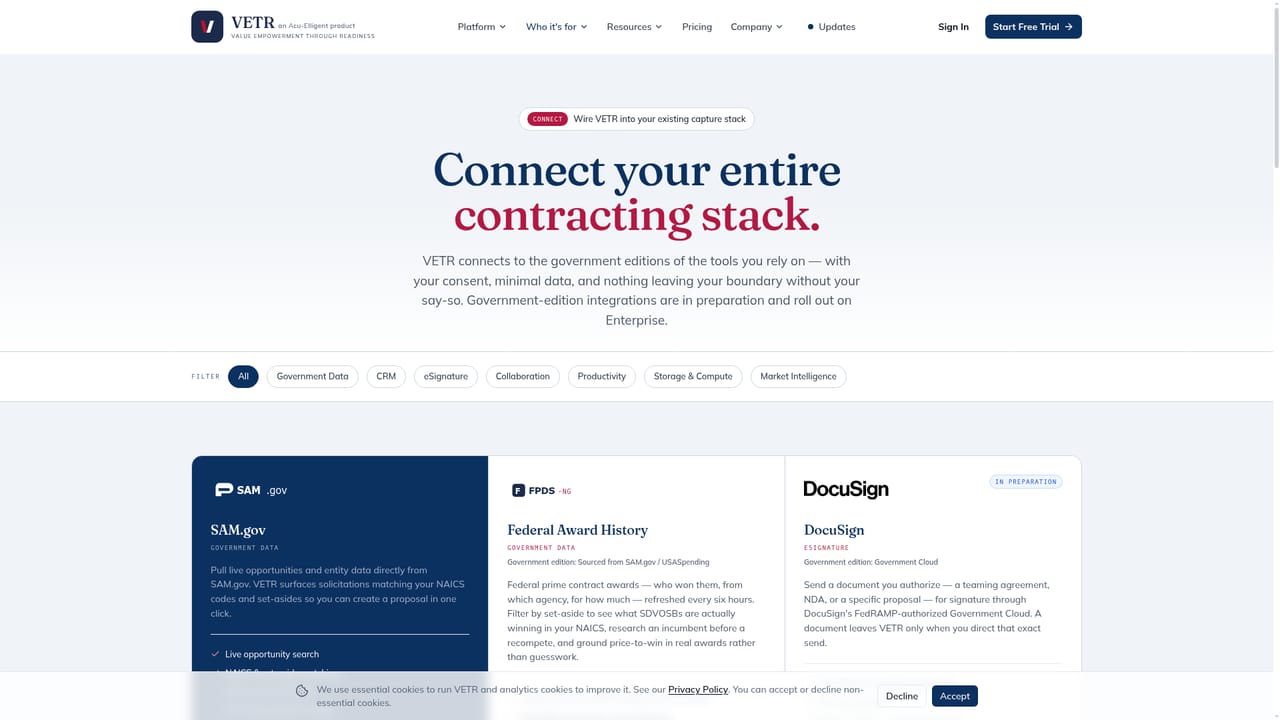
Learn moreConnectors cover SAM.gov, GovCon, Grants.gov and a Microsoft Word add-in; CRM and e-signature connectors are listed as in preparation.
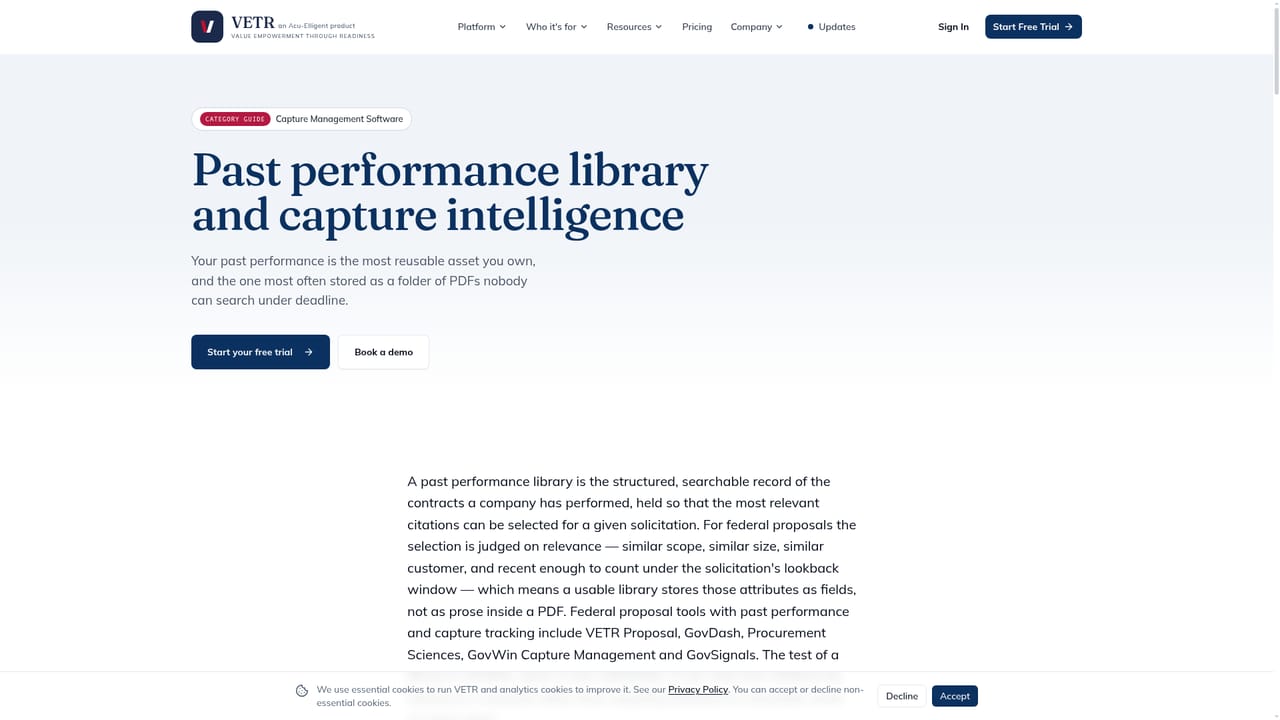
Learn moreCore features include SAM.gov, GovCon and Grants.gov opportunity syncing, RFP parsing of Section L and Section M in about 90 seconds, automated compliance matrices with FAR and DFARS clause extraction, a past-performance and CPARS library, teaming support, in-boundary AI drafting, a price-to-win curve built from the firm's own won bids, VETR scoring, and win-rate and cycle-time analytics.
Learn more AI Angels400+ customizable AI girlfriends for NSFW chat, voice calls, and roleplay
 Candy AIExperience the future of companionship with AI friends who chat, role-play, and connect with you on a human level.
 ourdream.aiA vast AI roleplay platform with millions of characters for chat, images, video and voiceAI Angels400+ customizable AI girlfriends for NSFW chat, voice calls, and roleplayCandy AIExperience the future of companionship with AI friends who chat, role-play, and connect with you on a human level.ourdream.aiA vast AI roleplay platform with millions of characters for chat, images, video and voice