Integrations
External inference providers including OpenAI, Anthropic and Google can be managed from within Adaptive Engine, and NVIDIA NIMs are supported for inference.
Learn moreReinforcement fine-tuning, evaluation and inference for enterprise LLMs
Own Adaptive Engine? Verify ownership to get a dofollow link

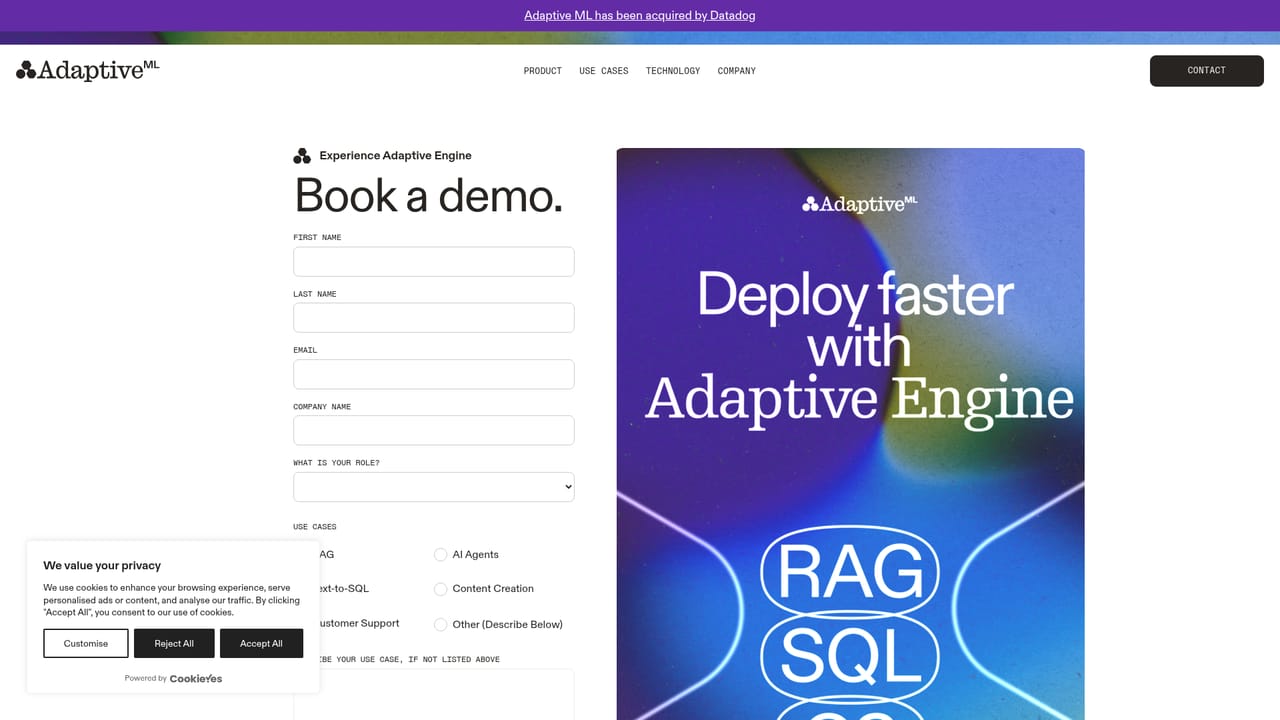
Adaptive Engine is an enterprise LLM platform that combines reinforcement fine-tuning, custom AI-judge evaluation and fast self-hosted inference, with deployment in your own cloud or on-premise.
Adaptive Engine is an enterprise platform for taking a large language model from a general purpose API call to a tuned, evaluated and self-hosted system that matches a specific business objective. The product is organised around three stages that feed into one another: Adapt, Evaluate and Serve. In the Adapt stage, teams run reinforcement fine-tuning with one-click PPO, GRPO or DPO, choosing between full model tuning and lighter adapter tuning. The pitch is direct: if a business can measure an outcome, the engine can be pointed at it, including metrics that come from production rather than from a static test set. Data does not have to be hand-labelled from scratch. The platform ships pre-built synthetic data recipes that let a team start from written guidelines, then layer in expert feedback and distill the behaviour of a larger model into a smaller one. Reasoning is handled with automated inference-time tuning and test-time search, so a model can be pushed to think longer on hard inputs. A metrics-logging API feeds production signals back into training, which is how the tuning loop keeps pace with changing operations. Teams that want control beyond the presets can write Python recipes and run custom jobs. Evaluation is treated as a first class step rather than an afterthought. Proprietary APIs and open models can be compared in a single view, scored by a customisable AI judge that supports built-in RAG evaluators and custom guidelines, then released through A/B tests against a subset of users. Granular monitoring, model interaction traces and custom dashboards cover the period after launch. On the serving side, a proprietary inference engine (described as up to 30 percent faster than vLLM, with prefix caching and quantization) runs alongside the ability to host hundreds of fine-tuned adapters on a shared model backbone. This is infrastructure for machine learning and platform teams at companies with proprietary data they cannot send to a public API. Deployment is offered on-premise or in a private cloud, with control over model updates. The main trade-off is scope: this is a heavy engineering product, not a prompt playground, and it assumes in-house ML capability and a defined metric to optimise.
External inference providers including OpenAI, Anthropic and Google can be managed from within Adaptive Engine, and NVIDIA NIMs are supported for inference.
Learn moreThree connected stages: Adapt handles reinforcement fine-tuning, synthetic data recipes, reasoning tuning and Python-based custom jobs. Evaluate provides a centralised model comparison view, a customisable AI judge with built-in RAG evaluators, A/B testing and production monitoring. Serve offers a proprietary inference engine, shared-backbone adapter serving and a single pane for external inference providers.
 AI Angels400+ customizable AI girlfriends for NSFW chat, voice calls, and roleplay
 Candy AIExperience the future of companionship with AI friends who chat, role-play, and connect with you on a human level.
 ourdream.aiA vast AI roleplay platform with millions of characters for chat, images, video and voiceAI Angels400+ customizable AI girlfriends for NSFW chat, voice calls, and roleplayCandy AIExperience the future of companionship with AI friends who chat, role-play, and connect with you on a human level.ourdream.aiA vast AI roleplay platform with millions of characters for chat, images, video and voice