Free trial
No formal trial is described. The MCP connector is free without sign-up, and the AI chat assistant includes two euros of starting credit.
Learn moreSEC filing search and citation built for AI research

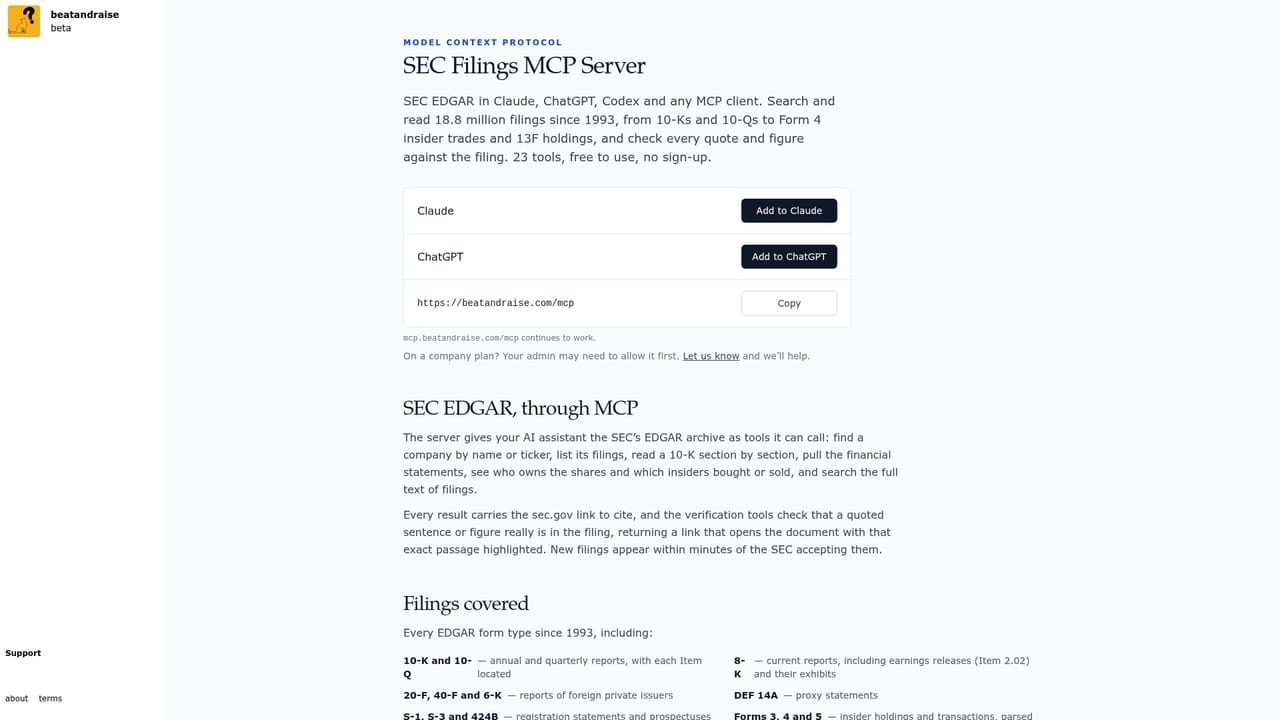
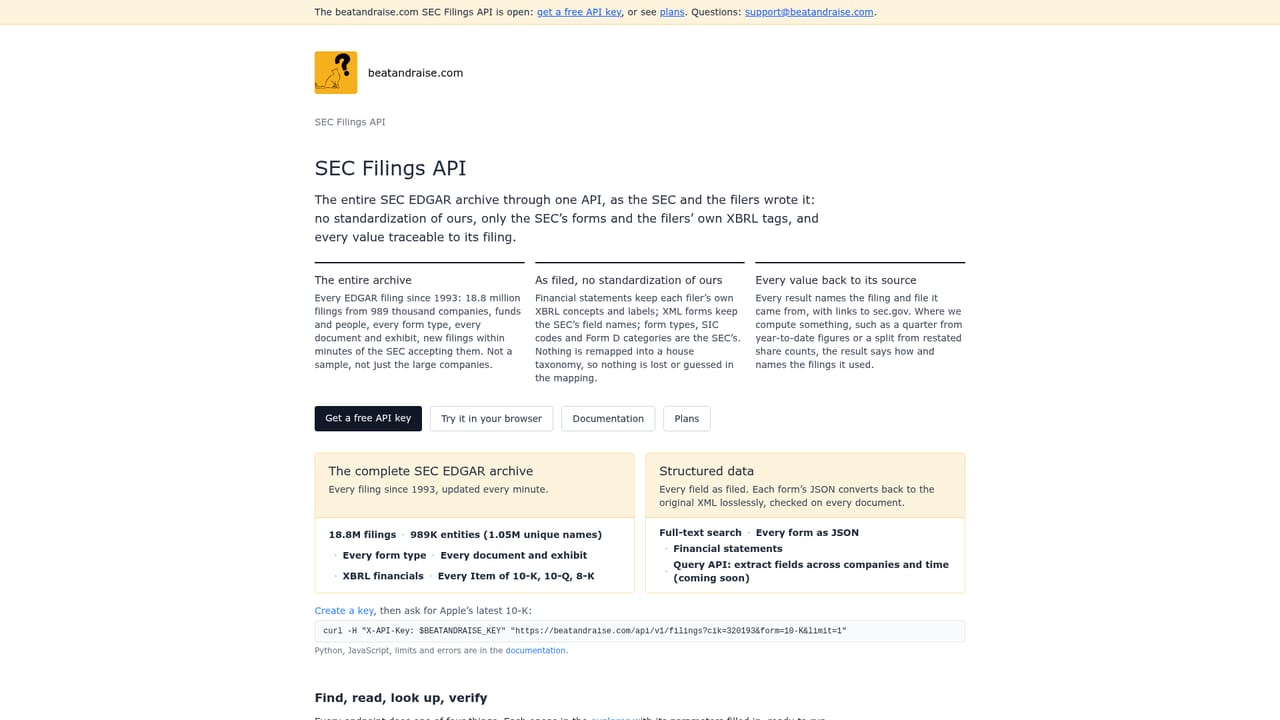
BeatandRaise is an AI search tool. BeatandRaise indexes 18.8 million SEC filings since 1993 and serves them through a web workspace, an API and an MCP connector for Claude, ChatGPT and Codex. Its distinguishing feature is verification: quotes and figures are checked against the source document and linked to the highlighted passage, with sec.gov citations attached.
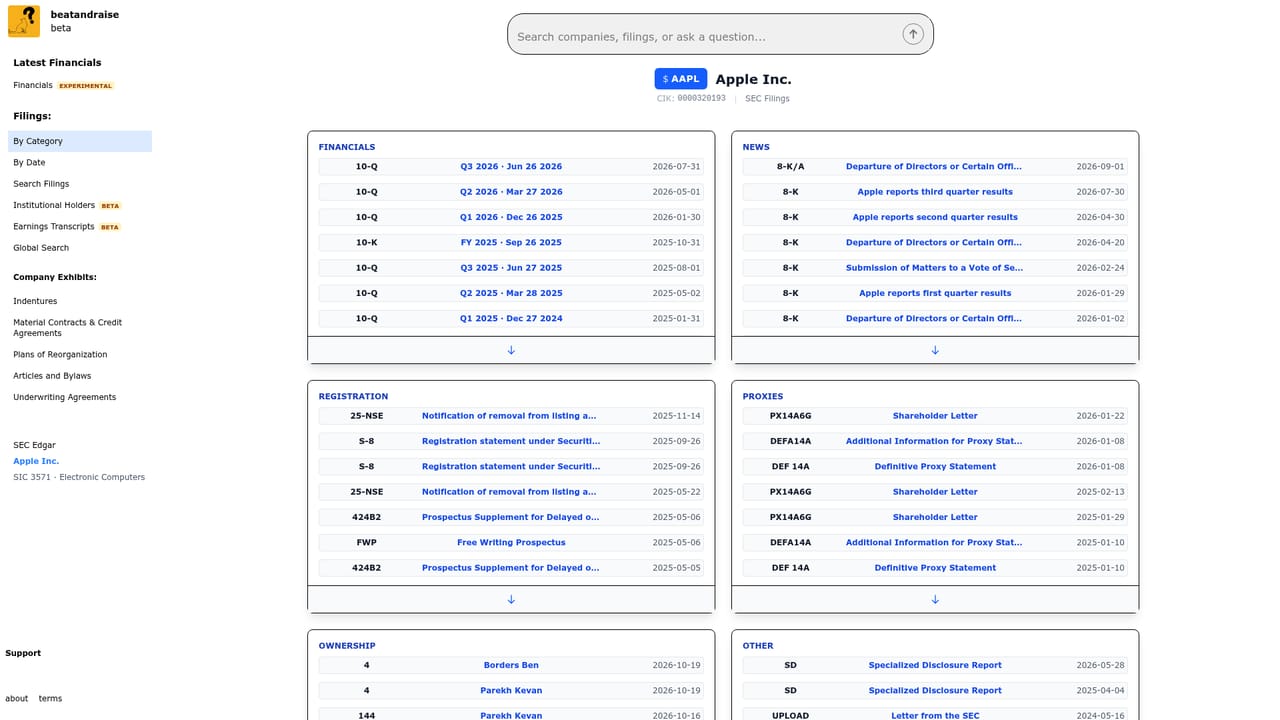
BeatandRaise is infrastructure for reading US regulatory filings, wrapped around a browsable archive of 18.8 million SEC documents filed since 1993. The Munich-based team processes and indexes everything on EDGAR, keeps the archive current within minutes of the SEC accepting a filing, and exposes it three ways: a web workspace, a search API for developers, and an MCP connector that drops the same corpus into Claude, ChatGPT and Codex. Coverage spans 10-Ks, 10-Qs, 8-Ks, proxy and registration statements, every exhibit, insider forms 3, 4 and 5, 13F holdings, 13D and 13G schedules, N-PORT fund holdings, XBRL financial statements and individual filing items located by heading. The core problem it targets is citation drift. Language models summarize filings fluently but misquote them, so every figure BeatandRaise returns carries a link that opens the original document with the exact passage highlighted, plus the sec.gov address for formal citation. The connector checks an assistant's quotes word for word and marks anything that cannot be confirmed as unverified. Documents render as filed, including XML forms using the SEC's own stylesheets, and financial tables export to Excel. The web application adds a filings browser grouped by form type, full-text search of filings since 2020 with highlighted hits and filters by form and year, statements as filed, and a chat assistant that starts with two euros of free credit. Analysts comparing periods, pulling numbers out of exhibits and following up across a session get sourced answers with the document alongside. It suits equity analysts, investment researchers, finance journalists, compliance teams and developers building filing-aware tools. The MCP route is free without sign-up and is a low-friction alternative to wiring the API. Buyers weighing it against general research chatbots should note that deep history is the differentiator: 1993 onward versus the shallower lookback most consumer assistants offer. Teams with strict data rules can ask about on-premise deployment, self-hosted local models and direct wiring into existing systems.
No formal trial is described. The MCP connector is free without sign-up, and the AI chat assistant includes two euros of starting credit.
Learn moreThe homepage does not publish prices or plan tiers. It states that the MCP connector for Claude, ChatGPT, Codex and other MCP clients is free with no sign-up, that the web chat assistant starts with two euros of free credit, and that custom solutions are arranged by contacting support@beatandraise.com.
Learn moreSupport runs through support@beatandraise.com, which also handles custom solution enquiries about on-premise deployment, locally hosted models and integration into existing systems. No help centre or documentation portal is listed on the homepage.
Learn moreAn MCP connector works inside Claude, ChatGPT, Codex, Claude Code and any MCP client, and is listed in the Claude and ChatGPT connector directories. A separate SEC filings API is available for custom applications.
Learn moreFilings browser grouped by form type, financial statements as filed with Excel export, full-text search of filings since 2020 with highlighted hits, and a sourced AI chat assistant. Coverage includes 10-K, 10-Q, 8-K, proxies, exhibits, insider forms, 13F, 13D and 13G, N-PORT, XBRL statements and beta earnings-call transcripts, with quote and figure verification linking back to the source passage.
 AI Angels400+ customizable AI girlfriends for NSFW chat, voice calls, and roleplay
 Candy AIExperience the future of companionship with AI friends who chat, role-play, and connect with you on a human level.
 ourdream.aiA vast AI roleplay platform with millions of characters for chat, images, video and voiceAI Angels400+ customizable AI girlfriends for NSFW chat, voice calls, and roleplayCandy AIExperience the future of companionship with AI friends who chat, role-play, and connect with you on a human level.ourdream.aiA vast AI roleplay platform with millions of characters for chat, images, video and voice