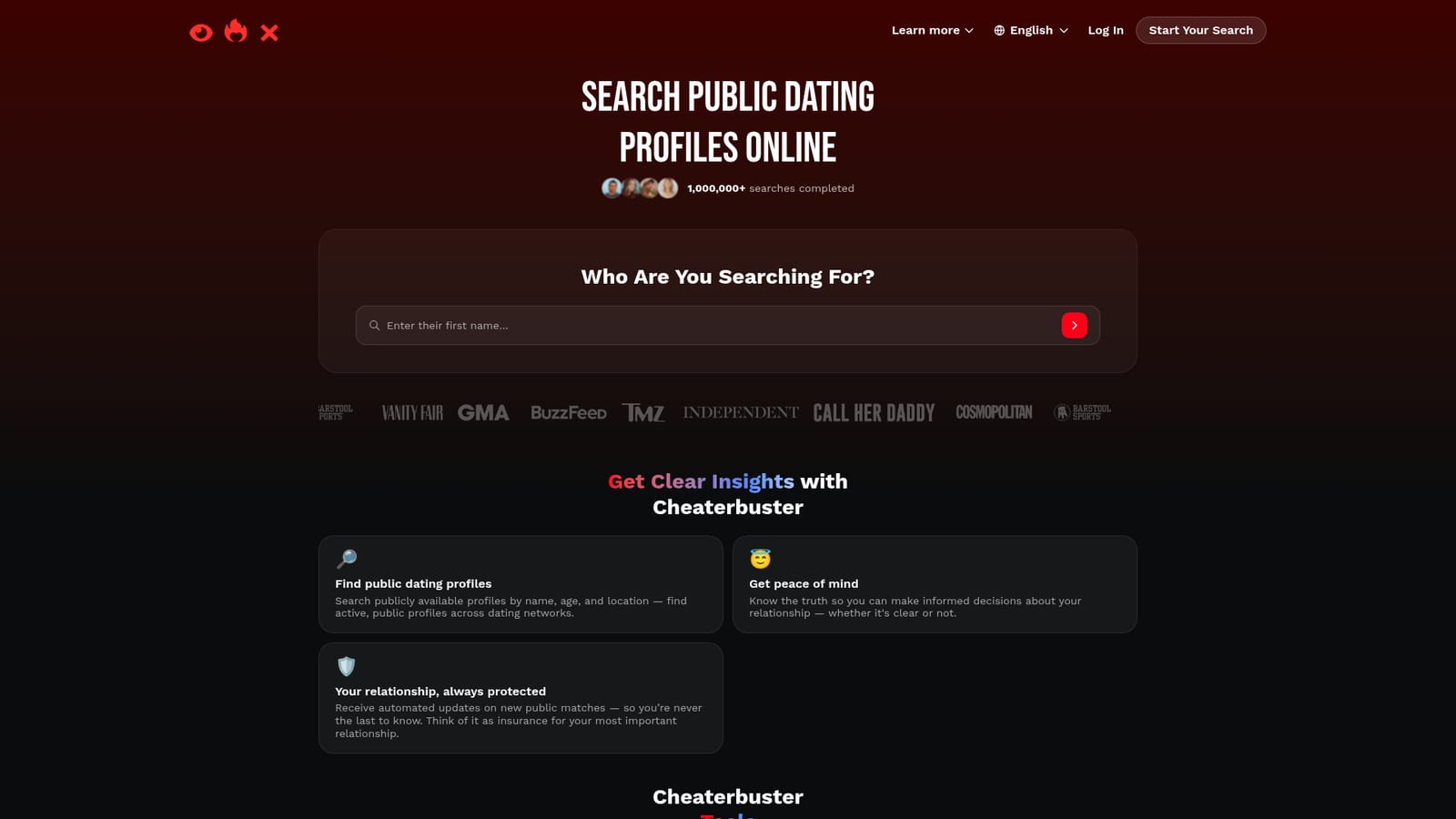
Cheaterbuster searches public dating profiles by name, age and location, and offers photo-based lookups and related people-search tools for people who want to check a partner's online presence.
Cheaterbuster is a people-search service built around one question: does a partner or date have public dating profiles they have not mentioned? The homepage centers on searching publicly available profiles by name, age and location across dating networks, and it reports more than one million completed searches. The pitch is emotional rather than technical, promising clarity and peace of mind for people who suspect something is off in a relationship.
Several tools sit under the same roof. Dating Profile Search is the core product, alongside Following AI, Face Trace, a Tea App Checker, DataSafe search and Username Trace, with the Tea checker and Username Trace marked as new. The page metadata also lists social profile analysis and reverse phone, name and address lookups. Quoted user posts on the homepage describe the photo workflow as taking pictures from a person's Instagram or Facebook and scanning public profile sources for matching images, and one of them notes that access requires payment. Those are testimonials, not documentation, so the vendor does not spell out its data sources or matching method on the homepage.
In practice a search starts from basic identifying details or a photo, and the service returns public matches for review. A monitoring angle is also advertised: automated updates when new public matches appear, framed as a kind of insurance for a relationship. The audience is individuals in personal relationships, not teams or professional investigators, and the interface is a web experience with an onboarding flow for new searches.
Among alternatives, it overlaps with general people-search sites and reverse image lookup tools, but it narrows the focus to relationship checking and dating networks. That focus brings real caveats: results reflect only what is publicly visible, a match is not proof of wrongdoing, and the nature of the product raises privacy and consent questions for the person being searched.