Integrations
Agents can be connected to MCP servers, custom APIs, custom skills and an entire custom codebase, per the homepage. No named third party integrations are listed.
An AI operating system that runs company departments with agents

Cofounder is an agent orchestration platform that runs company departments (marketing, sales, finance, design, ops and more) from shared context, with human approval on risky actions. It covers launch, growth and ongoing operations for small teams.
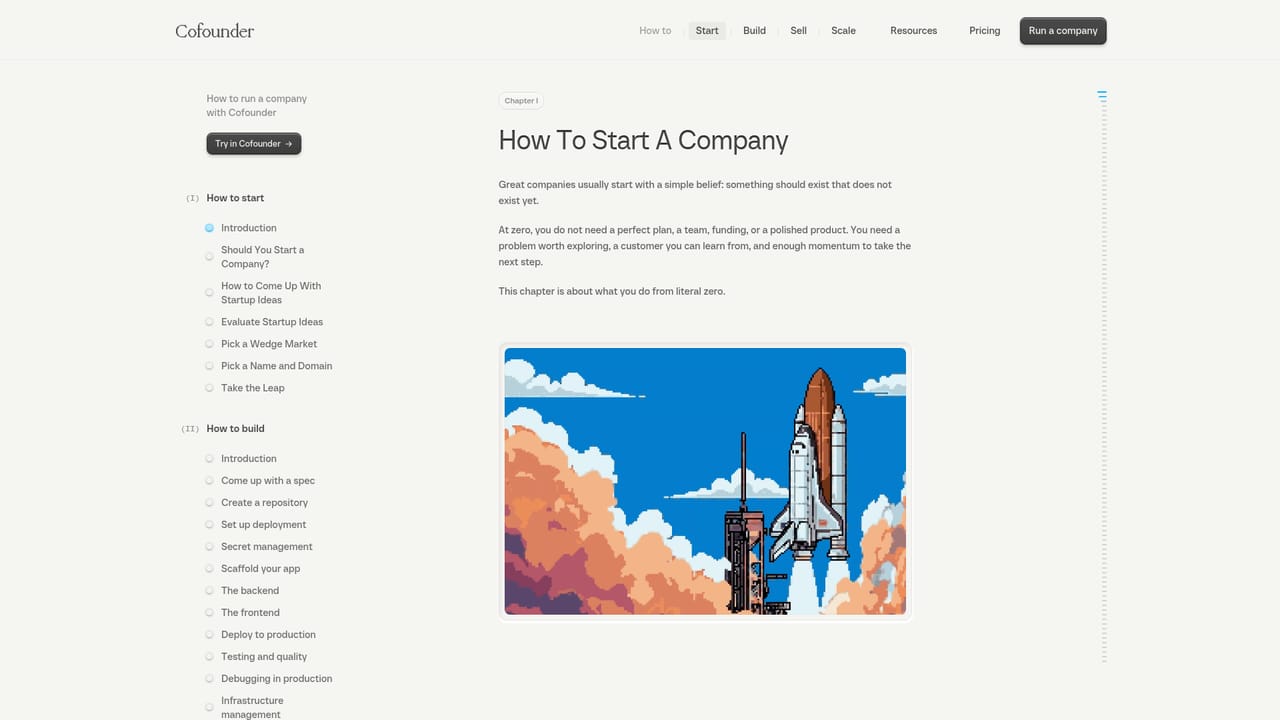
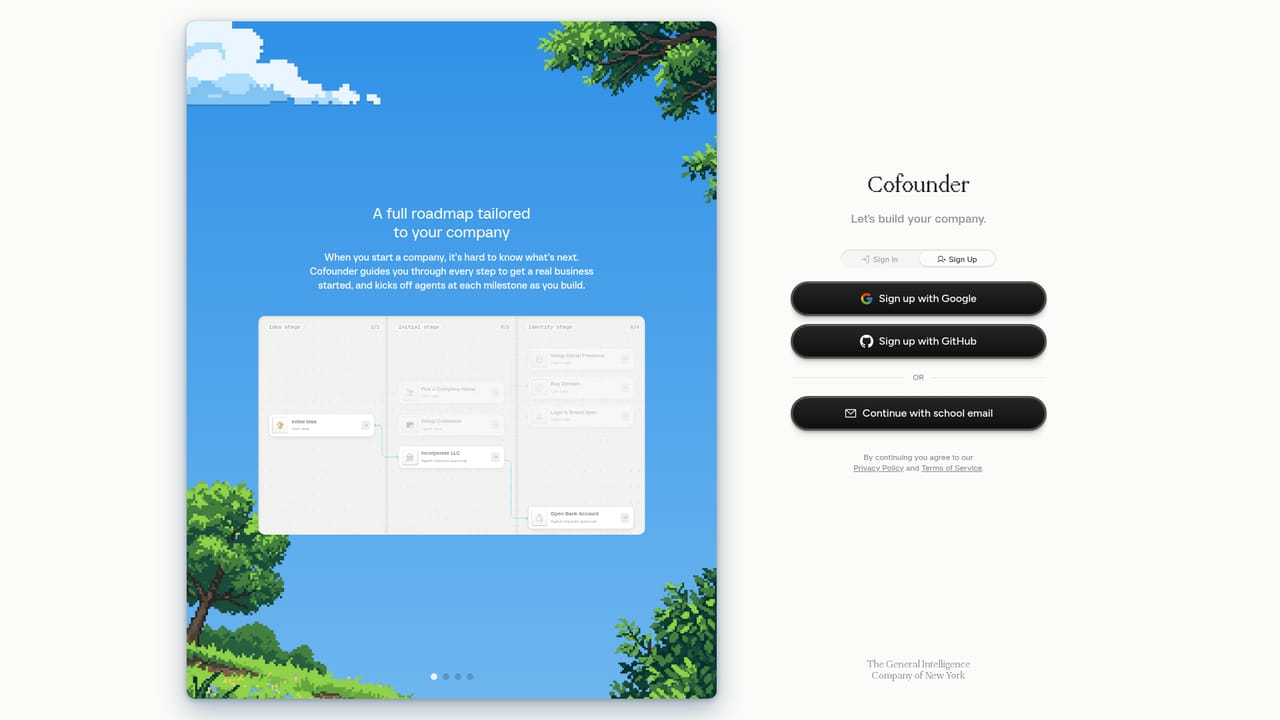
Cofounder is an agent orchestration platform built around a simple premise: a founder should be able to hand off the operational work of a company to AI agents while keeping final approval on every consequential decision. The product is organized like a business rather than a chat window, with distinct departments for strategy, finance, marketing, support, website, operations, design and sales, each staffed by agents that share a common company context. You supply the context (typically the product you have already built), and Cofounder turns it into positioning, brand identity, a marketing site and launch materials that all stay consistent with one story. The workflow moves through three phases. In the launch phase, Cofounder walks a founder from initial idea and company name through connecting product context, filing an LLC, setting up social presence, buying a domain and producing a brand spec. In the growth phase, it researches the market, builds prospect lists from signals like hiring activity, drafts personalized outreach emails, and runs newsletters. In the operate phase, incorporation, product analytics, customer support and recurring workflows are pulled into the same environment so the business keeps moving after launch. It suits solo founders and very small teams who have a working product but no staff to cover go to market and back office functions. The interface mixes user tasks and agent tasks in a single roadmap, and agents working on potentially risky actions pause for human approval before anything ships. Multiple tasks can run in the background at once, and agents can be extended with MCP connections, custom APIs, custom skills, or an entire custom codebase. Cofounder says more than 10,650 companies run on it. Compared with general assistants, Cofounder is narrower and more opinionated: it assumes you want a company built around a product, not a set of isolated prompts. Compared with hiring contractors or stitching together separate marketing, CRM and support tools, it trades depth in any single function for coordination across all of them.
Agents can be connected to MCP servers, custom APIs, custom skills and an entire custom codebase, per the homepage. No named third party integrations are listed.
Agentic departments (strategy, finance, marketing, support, website, operations, design, sales) sharing company context; human approval on risky actions; concurrent background tasks; extensibility via MCP, custom APIs, custom skills and custom codebases; launch assets including positioning, brand identity, marketing website and launch content; prospect research and personalized email outreach; product analytics and recurring workflows.
 AI Angels400+ customizable AI girlfriends for NSFW chat, voice calls, and roleplay
 Candy AIExperience the future of companionship with AI friends who chat, role-play, and connect with you on a human level.
 ourdream.aiA vast AI roleplay platform with millions of characters for chat, images, video and voiceAI Angels400+ customizable AI girlfriends for NSFW chat, voice calls, and roleplayCandy AIExperience the future of companionship with AI friends who chat, role-play, and connect with you on a human level.ourdream.aiA vast AI roleplay platform with millions of characters for chat, images, video and voice


