Pricing
The homepage promotes joining for free and paid enrollment paths for courses, certificates and degrees. It does not state subscription or per-course prices, so exact costs have to be checked on individual program pages.
Learn moreUniversity-grade AI and tech courses, certificates and degrees, online

Coursera is a career tool. A large online learning platform offering AI, data, business and technology courses, Professional Certificates, Specializations and degrees from universities and companies including Google, IBM, Microsoft, OpenAI, Anthropic, Stanford and DeepLearning.AI.
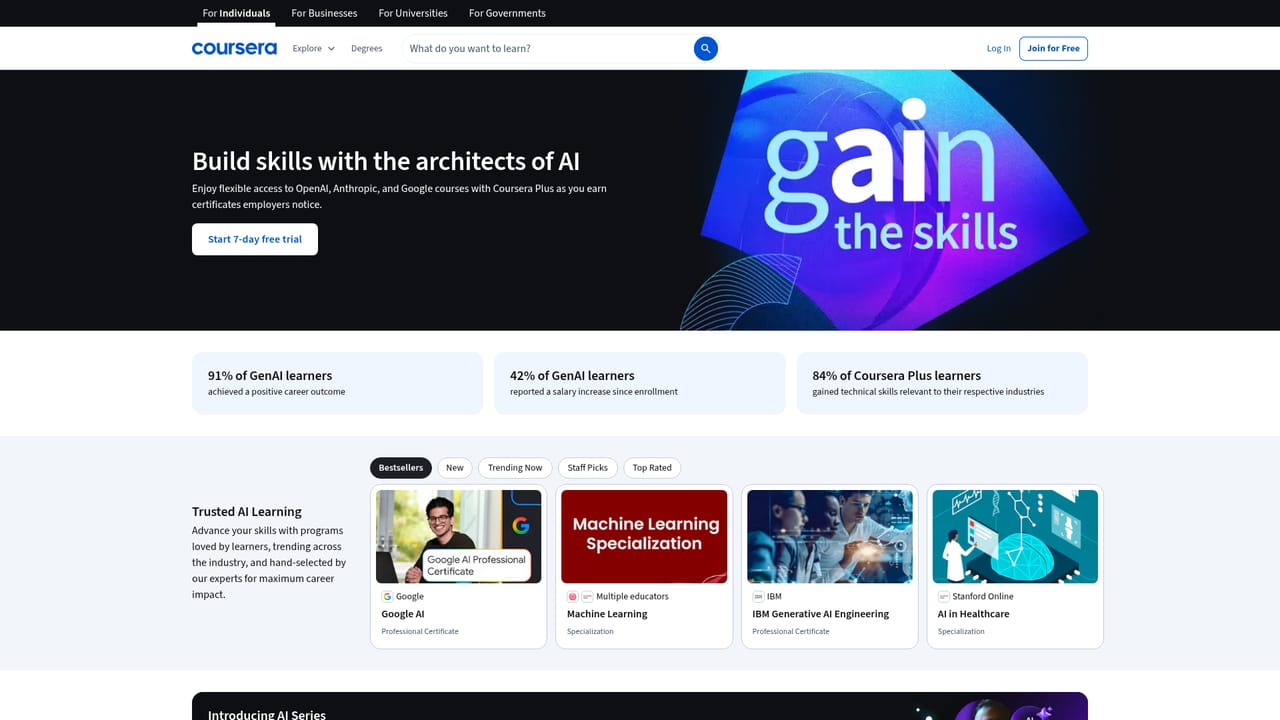
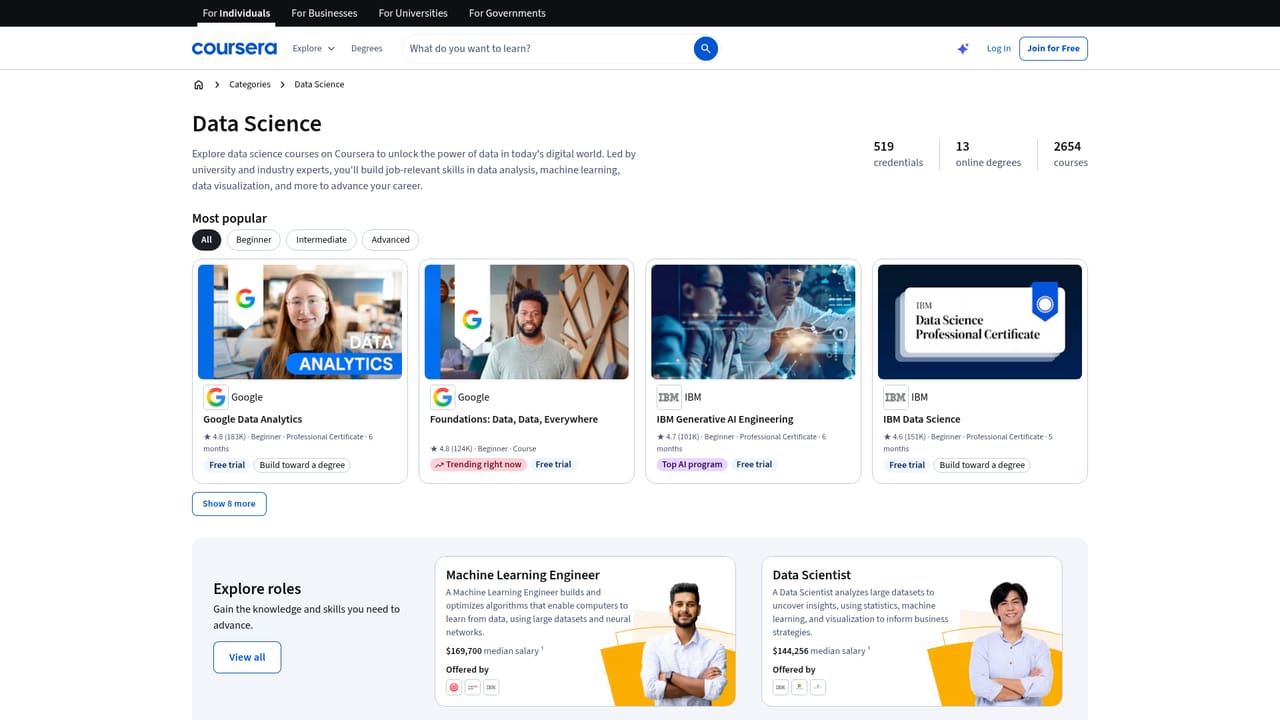
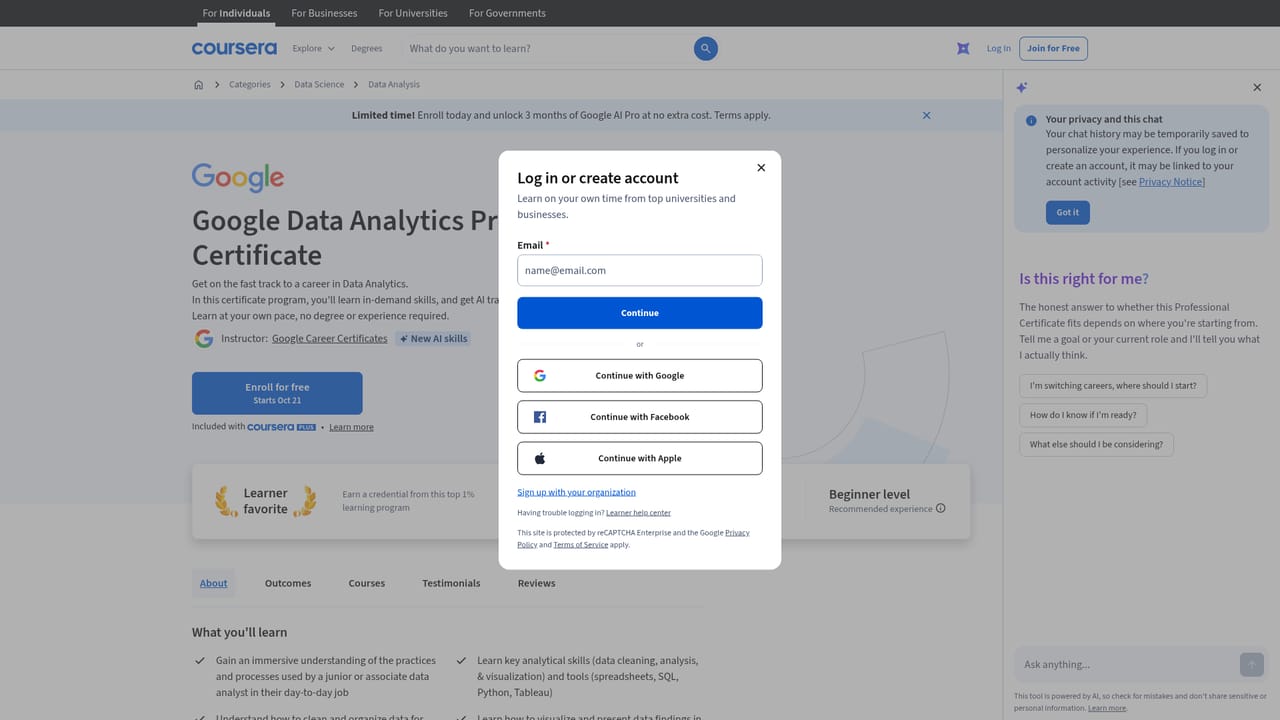
Coursera is an online learning marketplace built around courses, Specializations, Professional Certificates and full degrees delivered by universities and companies. The catalog is unusually broad, covering business, data science, computer science, information technology, personal development, health, language learning, social sciences, arts and humanities, math and logic, and physical science and engineering. The homepage claims more than 350 partner universities and companies, with Google, IBM, Microsoft, Meta, OpenAI, Anthropic, DeepLearning.AI, Stanford, the University of Michigan, the University of Pennsylvania and the University of Illinois among the names on display. For AI specifically, Coursera positions itself as a place to learn from the organisations building the technology. Programs range from a Google Data Analytics certificate and the University of Michigan's Python for Everybody specialization to DeepLearning.AI's Deep Learning and Machine Learning specializations, IBM Generative AI Engineering, Vanderbilt's AI Agents course, and Google Cloud AI Agents for enterprise scale. Short courses sit alongside multi-course certificates, so a learner can sample a single subject or commit to a longer structured track with a credential at the end. In practice, enrolment is self-paced and online. Google Career Certificate learners are currently offered three months of Google AI Pro, described as a way to study faster and build a portfolio. The site also points to Coursera for Business for teams and to degree programs for learners who want formal qualifications rather than certificates. Reviews and star ratings are shown on individual programs, which helps when comparing similar tracks from different providers. Coursera fits learners who want accredited or employer-branded instruction rather than a chatbot that answers questions on demand. It competes with other MOOC platforms and with free video tutorials, and its advantage is the credential and the institutional name behind the material. Anyone expecting a single AI tutor product will find a structured course catalog instead, and the volume of choice means some curation work falls to the learner.
The homepage promotes joining for free and paid enrollment paths for courses, certificates and degrees. It does not state subscription or per-course prices, so exact costs have to be checked on individual program pages.
Learn moreCourses, Specializations, Professional Certificates and degrees from 350+ universities and companies. Topic coverage includes AI, data science, computer science, IT, business, health, languages, social sciences, arts and math. Self-paced online study with star ratings and review counts on programs, plus Coursera for Business for teams.
Learn more AI Angels400+ customizable AI girlfriends for NSFW chat, voice calls, and roleplay
 Candy AIExperience the future of companionship with AI friends who chat, role-play, and connect with you on a human level.
 ourdream.aiA vast AI roleplay platform with millions of characters for chat, images, video and voiceAI Angels400+ customizable AI girlfriends for NSFW chat, voice calls, and roleplayCandy AIExperience the future of companionship with AI friends who chat, role-play, and connect with you on a human level.ourdream.aiA vast AI roleplay platform with millions of characters for chat, images, video and voice


