Free trial
A no card trial gives 3 lifetime credits with access to every feature, including transcription, translation, metadata, articles and exhibits. Once used, a credit bundle or subscription is required.
Learn moreTurn handwritten historical documents into searchable, organized archives
Own Document Transcribe? Verify ownership to get a dofollow link
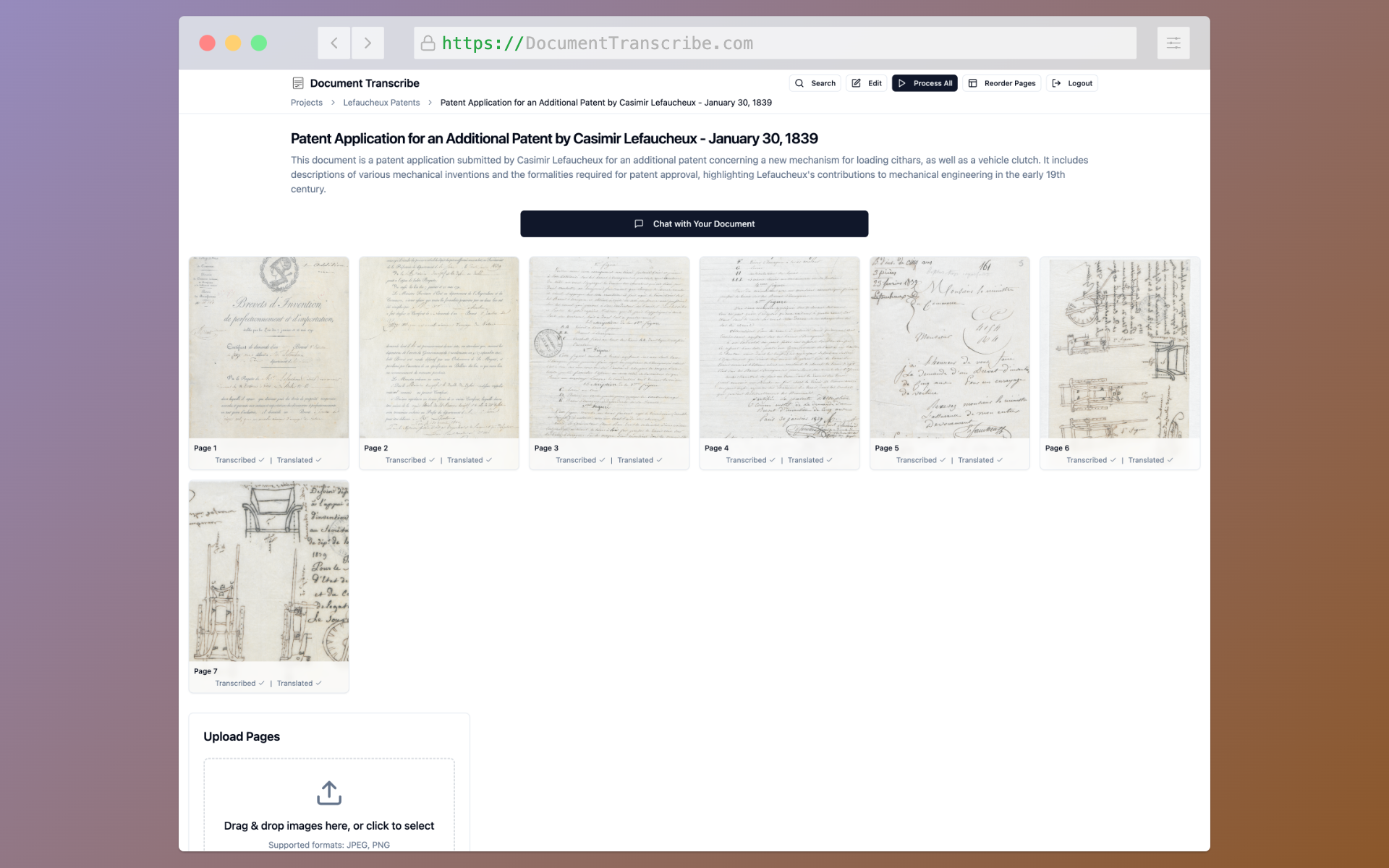
Document Transcribe is an academic research tool that turns handwritten historical documents into searchable, organized archives. AI transcription, translation and archive management for handwritten and historical documents. Upload scans, get editable text with metadata and tags, then build searchable collections and public exhibits.
Document Transcribe is a web platform for turning scanned handwritten and printed historical documents into editable, searchable text. It goes past basic OCR by reading letterforms, page layout and surrounding context together, then returning structured output with items such as a document title, author, date and language attached. The site's own sample pairs a faded 1860s letter with a clean transcript, noting ink smudges and marginal fading rather than guessing through them. Translation sits alongside transcription. A source page in one language can be rendered into another with meaning and context kept intact, which matters for manuscript collections that mix languages. From there the platform builds collections: metadata, tags and contextual notes are attached to each item, and selected material can be published as exhibits for research or public access. The stated audience is narrow and specific: family historians and genealogists, small archives and historical societies, independent researchers, and collectors cataloguing artifacts and provenance. In practice the workflow runs in four stages. A user uploads scans, the AI produces and translates text, organizational fields are generated, and the resulting collection is shared or searched. Every action on the platform (transcription, translation, research, metadata, article generation, exhibits) draws on a credit balance, so heavy users should model their volume before committing to a tier. The pricing structure is credit based rather than flat. A no card trial grants 3 lifetime credits with full feature access, a one time $5 bundle buys 40 credits, and subscriptions at $19 per month (Individual, 300 credits) and $79 per month (Team, 2,000 credits, multi-user workspace, priority support) add unlimited metadata, article generation and exhibits. Annual billing is offered at a 16.7% saving on both subscription tiers.
A no card trial gives 3 lifetime credits with access to every feature, including transcription, translation, metadata, articles and exhibits. Once used, a credit bundle or subscription is required.
Learn moreCredit based. A free trial gives 3 lifetime credits. A one time $5 bundle buys 40 credits. Individual is $19 per month for 300 credits, and Team is $79 per month for 2,000 credits plus a multi-user workspace and priority support; both subscriptions include unlimited metadata, articles and exhibits. Annual billing saves 16.7%.
Learn morePriority support is listed as a benefit of the Team subscription. No other support channels are described on the homepage.
AI handwriting and printed text transcription that accounts for layout and context, multi-language translation that preserves meaning, automatic metadata, tags and document fields, article generation, searchable collections and public exhibits, plus exports, sharing and chat across projects.
 AI Angels400+ customizable AI girlfriends for NSFW chat, voice calls, and roleplay
 Candy AIExperience the future of companionship with AI friends who chat, role-play, and connect with you on a human level.
 ourdream.aiA vast AI roleplay platform with millions of characters for chat, images, video and voiceAI Angels400+ customizable AI girlfriends for NSFW chat, voice calls, and roleplayCandy AIExperience the future of companionship with AI friends who chat, role-play, and connect with you on a human level.ourdream.aiA vast AI roleplay platform with millions of characters for chat, images, video and voice