Free trial
A free trial is offered from the homepage, and the call to action appears throughout the site. No trial length, usage limits or feature restrictions are stated on the page.
Learn moreNo-code AI decisioning platform for credit and collection scoring.
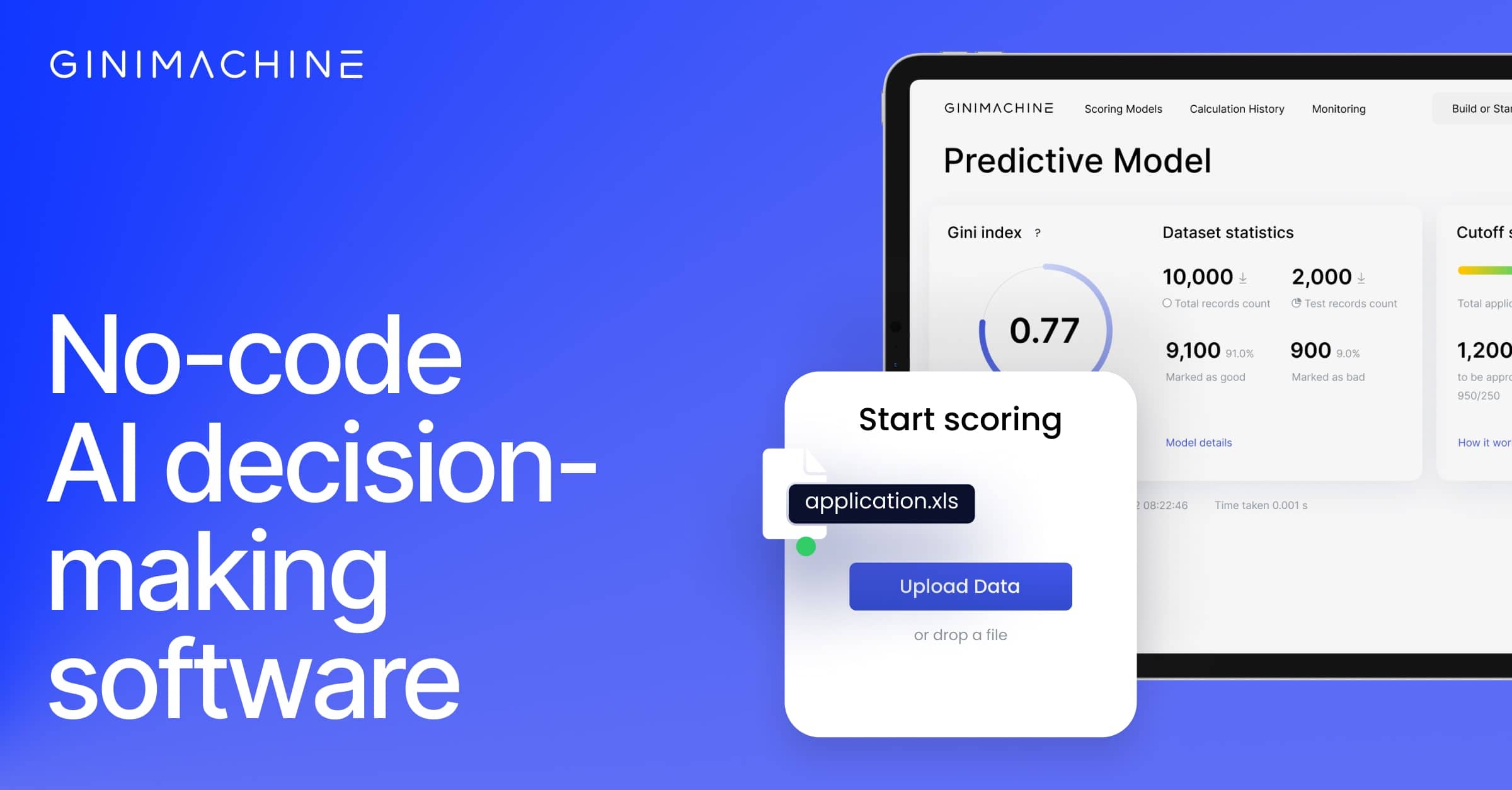
GiniMachine is a no-code platform for building credit, collection and lead scoring models from historical decision data. It targets lenders and collection agencies that want predictive scoring without an in-house data science team.
GiniMachine is a no-code predictive modeling platform aimed at lenders, debt collectors and other businesses that make repeated high-volume decisions from historical records. The company positions it as a way to replace spreadsheets and static reporting with models that score each case as it arrives, without hiring machine learning engineers or a data science team. The workflow is deliberately narrow. A user uploads at least 1,000 raw records of past decisions and their known outcomes, and the platform identifies the factors that separated good results from bad ones. It then builds a model, checks its own accuracy and reports whether the model is suitable for forecasting. Once a model passes, new records can be scored in bulk, and each prediction comes with an indication of how much each variable influenced the result. Typical applications are credit underwriting for thin-file borrowers, prioritizing debtors likely to repay quickly, churn prediction, and lead scoring. The product fits organisations in financial services that want predictive scoring without a modeling team: alternative lenders using rental, utility or public records data, collection agencies deciding between calls and messages, and non-financial companies moving into lending. The published case studies cover an Asian auto lender, an Asian collection company and a Kenyan lender (Fanaka). GiniMachine competes less with general BI tools than with custom scoring builds and legacy scorecard vendors, and it leans on speed of deployment as its main differentiator. What the homepage does not disclose is pricing. A free trial is offered, but no tiers, limits or contract terms appear on the page, so cost has to be established directly with the vendor. The 1,000-record minimum also means very small datasets are not a good fit, and the platform is oriented around structured tabular data rather than free text or unstructured sources.
A free trial is offered from the homepage, and the call to action appears throughout the site. No trial length, usage limits or feature restrictions are stated on the page.
Learn moreCore features include no-code model building from historical records, automatic variable importance analysis, self-validation of model accuracy, and deployment for scoring new data. Preset use cases cover credit scoring for thin-file borrowers, collection scoring to prioritize debtors, churn prediction and lead scoring. The platform runs as SaaS and states that it can process terabytes of historical data, with models built in minutes.
Learn more AI Angels400+ customizable AI girlfriends for NSFW chat, voice calls, and roleplay
 Candy AIExperience the future of companionship with AI friends who chat, role-play, and connect with you on a human level.
 ourdream.aiA vast AI roleplay platform with millions of characters for chat, images, video and voiceAI Angels400+ customizable AI girlfriends for NSFW chat, voice calls, and roleplayCandy AIExperience the future of companionship with AI friends who chat, role-play, and connect with you on a human level.ourdream.aiA vast AI roleplay platform with millions of characters for chat, images, video and voice


