Hume AI

Voice-native evaluation infrastructure for teams building and shipping voice AI.

Advanced API
Screenshot of Hume AI, Voice-native evaluation infrastructure for teams building and shipping voice AI

What is Hume AI?

Hume AI is an AI humanizer tool. An evaluation platform that measures how voice models and voice agents perform in real conversations, scoring tone, timing, emotion and interruption behaviour beyond transcript accuracy. Aimed at model developers and enterprises running voice agents.

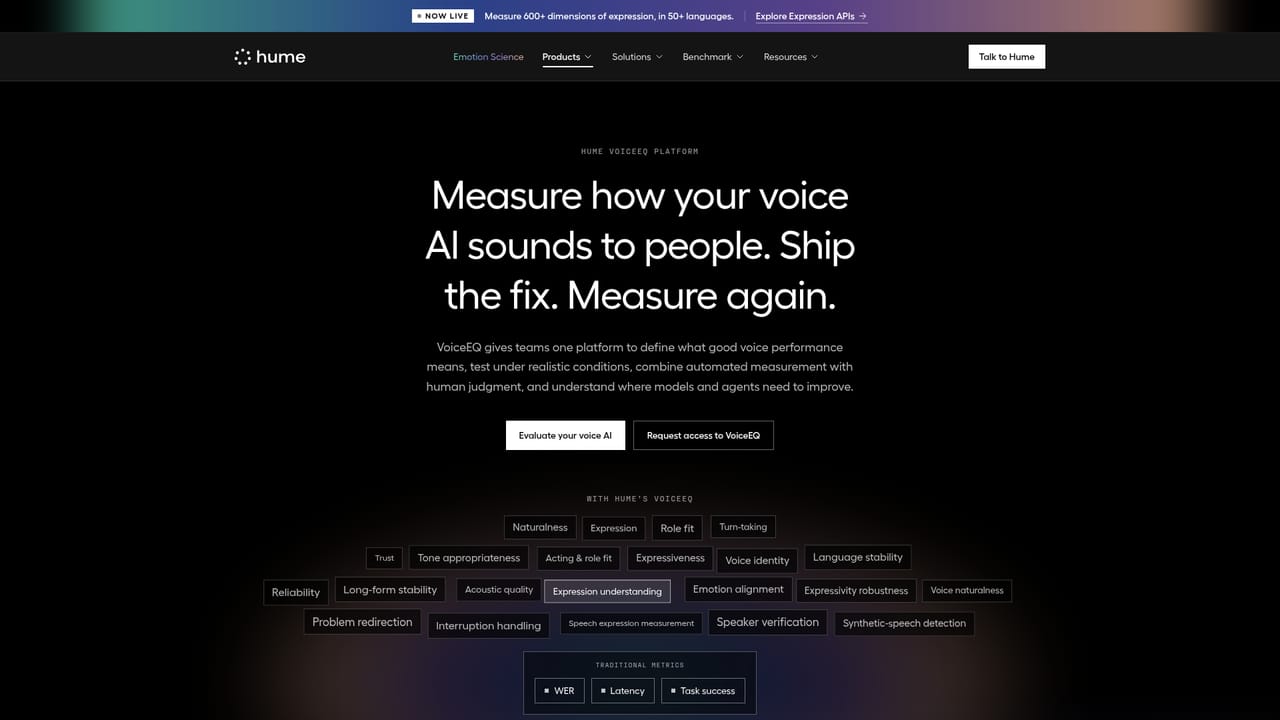
Hume AI is an evaluation and measurement platform for voice systems. Rather than generating speech itself, it builds the infrastructure that tells you whether a voice model or voice agent actually performs well once real users start talking to it. The homepage frames the problem plainly: a task can succeed while the conversation fails. Transcripts capture words but miss timing, tone, emotional expression, interruption behaviour, accent handling, background noise resilience and context adaptation. Hume measures those dimensions, claiming coverage of 600 or more expressive dimensions across 50 or more languages, and reports a library of over 100 million speech samples and more than a decade of emotion science research behind the scoring. In practice the platform, called VoiceEQ, runs a four-stage loop. It generates targeted evaluation suites from your own conversation data, stress-tests the system against realistic scenarios, diagnoses where each failure originated, and validates whether a fix actually improved things. Around that sit three supporting components: a Prism Pipeline that turns unstructured audio into searchable, expression-rich inputs, Expression APIs for scoring vocal qualities, and a Human Feedback API that brings trained human raters into the loop so automated scores can be checked against human judgment. Two audiences are served. Model developers use it to enrich training data, compare checkpoints and benchmark TTS, speech-to-speech, ASR and cascaded systems. Agent teams in healthcare, contact centres, financial services and retail use it to pick the right underlying model, define use-case-specific quality criteria and validate live interactions. There is also a public benchmark leaderboard comparing systems such as GPT-4o Realtime, Gemini Live, Hume Octave, ElevenLabs and Cartesia across expression, naturalness, timing and transcript accuracy. The competition here is closer to internal QA spreadsheets and ad hoc listening tests than to consumer text to speech tools. Buyers who simply want a voice generator should look elsewhere; this is for organisations treating conversational quality as an engineering metric worth tracking continuously.

How do you use Hume AI?

  1. 1Review how real-world voice performance is scored
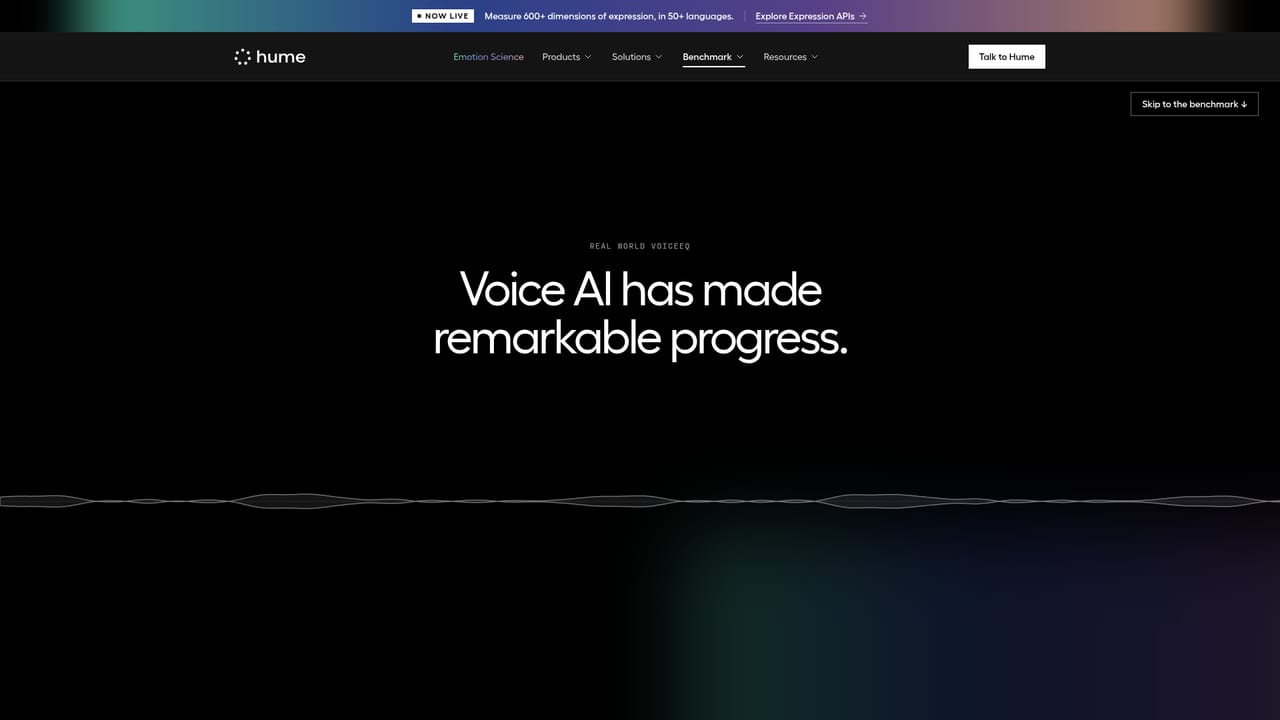
    Read the benchmark overview to understand the dimensions Hume reports, such as expression, naturalness, timing and contextual appropriateness, before deciding what matters for your use case.
    Hume AI — Review how real-world voice performance is scored
  2. 2Bring your conversation data into VoiceEQ
    VoiceEQ analyses your conversation data to surface use cases and turn them into an evaluation suite with test cases, scenarios and success criteria.
    Hume AI — Bring your conversation data into VoiceEQ
  3. 3Stress-test and diagnose the system
    Run the suite against your voice model or agent, then use the diagnosis output to see exactly which moments break and why.
  4. 4Enrich audio with the infrastructure APIs
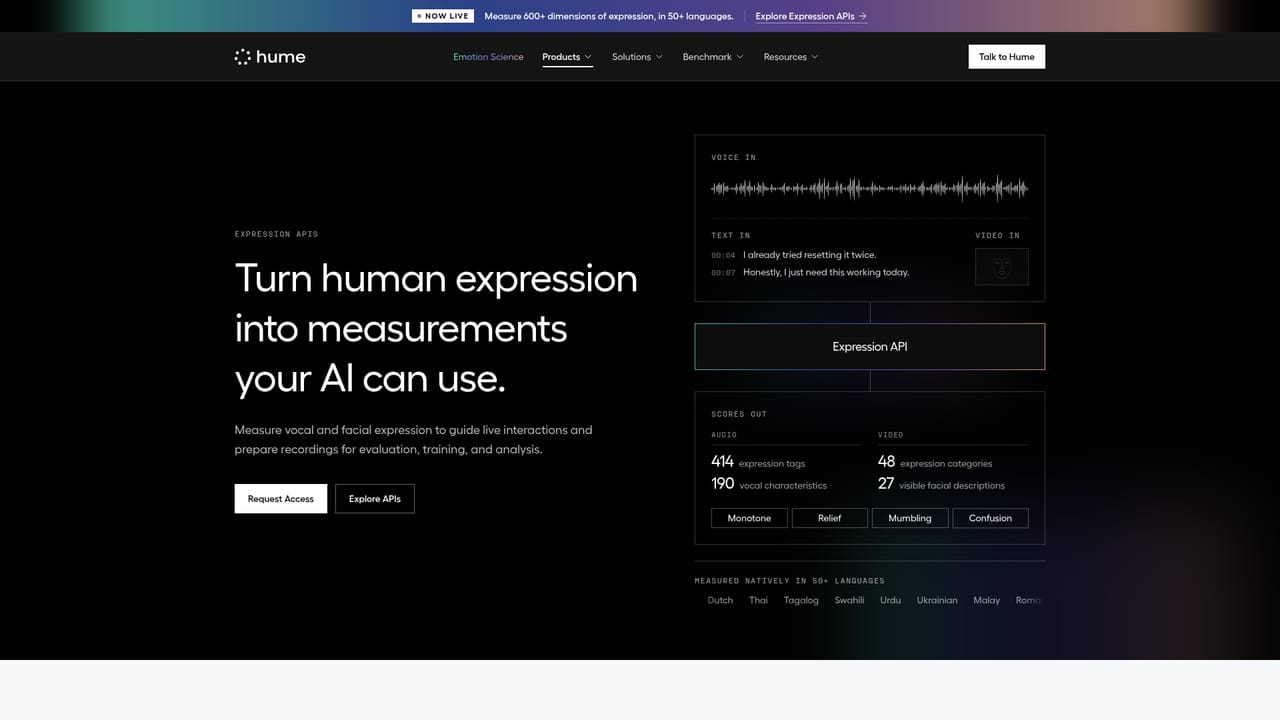
    Use the Prism Pipeline and Expression APIs to transform raw audio into expression-rich inputs and score vocal qualities that transcripts do not capture.
    Hume AI — Enrich audio with the infrastructure APIs
  5. 5Validate improvements and compare checkpoints
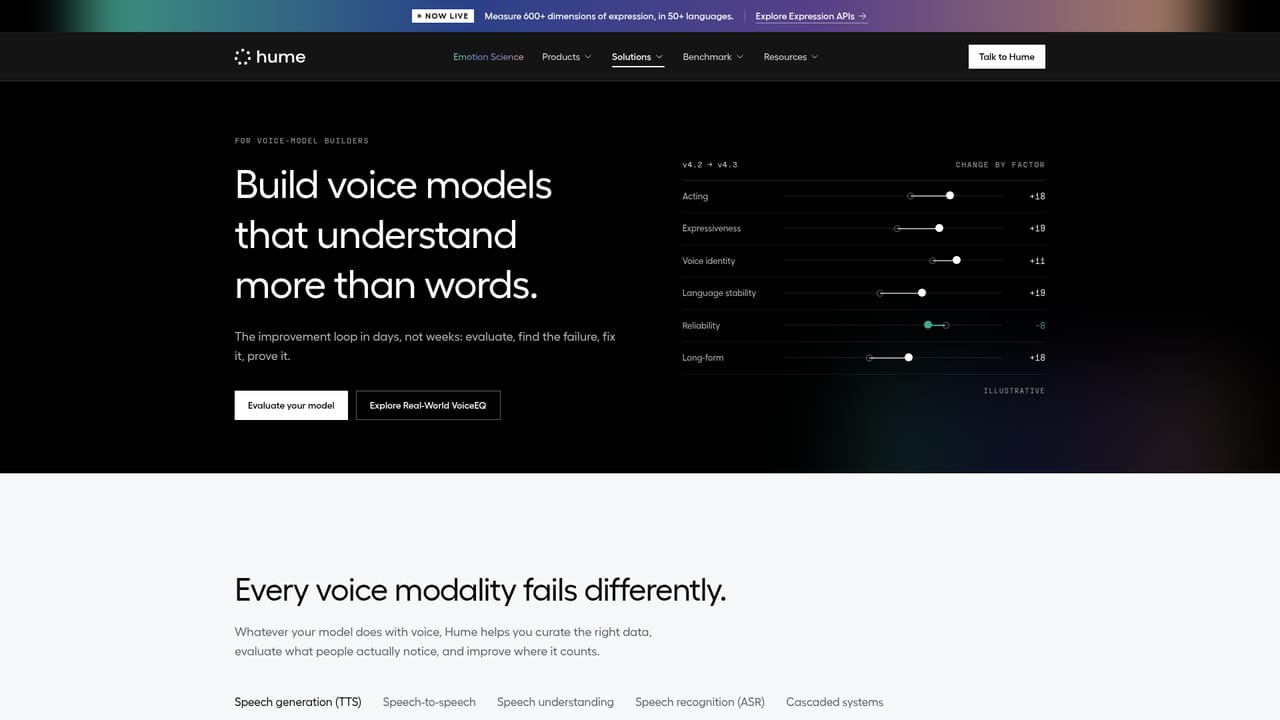
    Re-run evaluations to confirm that fixes moved the metrics, and compare baselines against candidates across TTS, speech-to-speech, ASR or cascaded setups.
    Hume AI — Validate improvements and compare checkpoints
  6. 6Talk to Hume about a tailored evaluation
    Teams with specific deployment requirements can use the contact form to discuss an evaluation plan for their own voice agents.

Pros and cons

Pros

  • Measures voice qualities that transcripts miss, including timing, interruption behaviour, accent handling and emotional expressionAI
  • Four-stage loop (generate, stress-test, diagnose, validate) gives teams a repeatable improvement process rather than one-off listening testsAI
  • Public leaderboard compares major voice systems side by side across several dimensions of real-world performanceAI
  • Human Feedback API adds trained raters, so automated scores can be validated against human judgmentAI
  • Covers TTS, speech-to-speech, ASR and cascaded systems, which suits teams working across multiple architecturesAI

Cons

  • It is an evaluation and infrastructure product, not a speech generator, so it will not help anyone looking for a simple text to speech toolAI
  • The published leaderboard scores are labelled as illustrative rather than real data, so rankings should not be treated as settledAI
  • Per-model and per-dimension scoring demands someone who can interpret the metrics and act on themAI
  • No pricing figures, plan tiers or self-serve signup details are published on the homepage, so cost needs a sales conversationAI
  • Evaluation depth depends on having your own conversation data to build suites from, which disadvantages teams without traffic yetAI

How much does Hume AI cost?

Features

VoiceEQ turns conversation data into targeted evaluation suites, stress-tests voice systems, diagnoses failures and validates fixes. Expression APIs score 600 or more expressive dimensions in 50 or more languages, the Prism Pipeline prepares audio for evaluation and training, and a Human Feedback API adds vetted human raters.

Learn more

Frequently asked questions about Hume AI

  • Does Hume AI have an API?
    Yes, Hume AI offers an API.
  • How do you use Hume AI?
    The walkthrough on this page covers 6 steps: 1. Review how real-world voice performance is scored 2. Bring your conversation data into VoiceEQ 3. Stress-test and diagnose the system 4. Enrich audio with the infrastructure APIs 5. Validate improvements and compare checkpoints 6. Talk to Hume about a tailored evaluation.
  • What platforms does Hume AI support?
    Hume AI is available on Web App.
  • What are the limitations of Hume AI?
    It is an evaluation and infrastructure product, not a speech generator, so it will not help anyone looking for a simple text to speech tool. The published leaderboard scores are labelled as illustrative rather than real data, so rankings should not be treated as settled. Per-model and per-dimension scoring demands someone who can interpret the metrics and act on them.

Status

StatusActive
Views0
Outbound clicks0
Added10/21/2026

Platforms

Web App

Pricing

Paid