Integrations
Pre-built connectors are advertised for 60 or more platforms, including Banner, Salesforce, Canvas and Shopify, plus messaging channels such as SMS and WhatsApp.
Purpose-built AI agents for higher education and eCommerce, built and managed end to end

InSync builds, deploys and manages custom AI agents for higher education and eCommerce. Its agents cover admissions, lead scoring, transfer review, LMS support and student risk, with human-in-the-loop controls, confidence thresholds and a single management dashboard. Deployment is a managed engagement rather than self-serve signup.
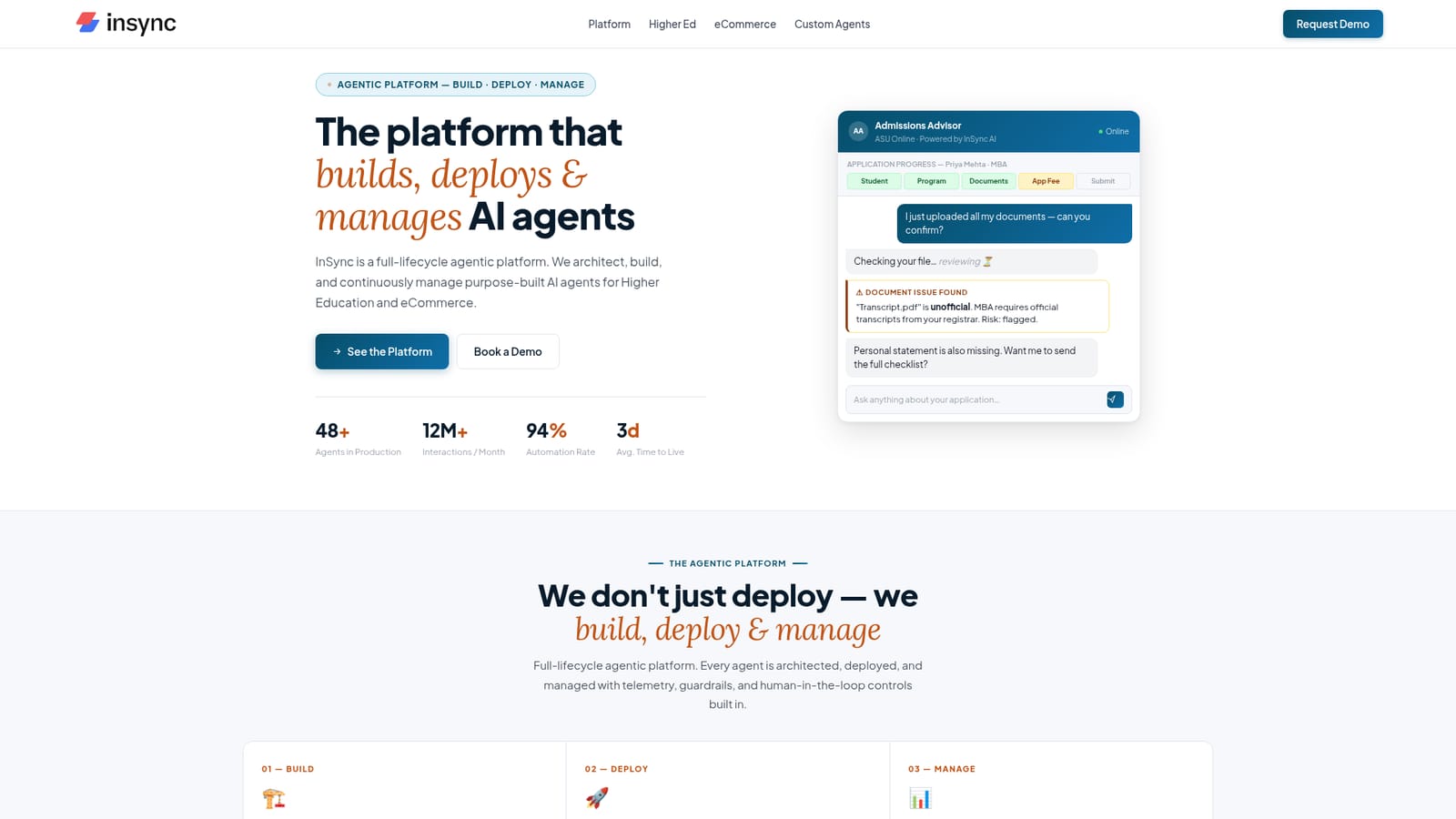
InSync is a full-lifecycle agentic platform rather than a single chatbot product. The company architects, builds and then continuously manages purpose-built AI agents for two verticals: higher education and eCommerce. The homepage positions three stages in one workflow: build agents fine-tuned on institutional data and tested against real workflows, deploy them through pre-built connectors, and manage the fleet from a single dashboard that tracks resolution rates, sentiment, gap detection and ROI attribution. Agents are designed to learn from every human-approved response. The higher education offering is the most detailed on the site and spans the student lifecycle in three themes. Enrollment and Admissions covers an Enrollment Chat agent across web, SMS and WhatsApp, an Application Advisor that gives staff an AI summary, live checklist and drafted follow-up email per applicant, a Form Agent that embeds guidance inside application fields, and a UniMail agent that auto-sends replies above a confidence threshold. Decision Support and Operations adds Lead Intelligence scoring, a Content Intelligence agent that surfaces knowledge base gaps from bot failures, and a Transfer Review console for credit mapping against policy. Retention and Student Success includes LMS chat inside Canvas, Blackboard and Moodle, risk prediction with automated outreach, follow-up and course evaluation agents. The practical pitch is speed and coverage: 48 or more agents in production, 12 million or more interactions per month, a 94% automation rate and an average of three days from kickoff to live. Institutional logos include Arizona State University, Johns Hopkins, Purdue and Michigan State. That makes InSync a fit for university admissions, advising and student success teams, and for eCommerce operations groups, that want a managed deployment partner rather than a toolkit to assemble themselves. Teams expecting transparent self-serve pricing or an off the shelf creative tool will find this a different kind of purchase: the site routes everything through a demo request, and the creative and content angles are secondary to operational automation.
Pre-built connectors are advertised for 60 or more platforms, including Banner, Salesforce, Canvas and Shopify, plus messaging channels such as SMS and WhatsApp.
Agent catalogue spans enrollment chat, application advisor, in-form guidance, email auto-reply, lead scoring, content gap analysis, transfer review, LMS chat, risk prediction and follow-up. The platform adds telemetry, guardrails, human-in-the-loop approval, confidence thresholds and a single management dashboard with ROI attribution.
 AI Angels400+ customizable AI girlfriends for NSFW chat, voice calls, and roleplay
 Candy AIExperience the future of companionship with AI friends who chat, role-play, and connect with you on a human level.
 ourdream.aiA vast AI roleplay platform with millions of characters for chat, images, video and voiceAI Angels400+ customizable AI girlfriends for NSFW chat, voice calls, and roleplayCandy AIExperience the future of companionship with AI friends who chat, role-play, and connect with you on a human level.ourdream.aiA vast AI roleplay platform with millions of characters for chat, images, video and voice