Support
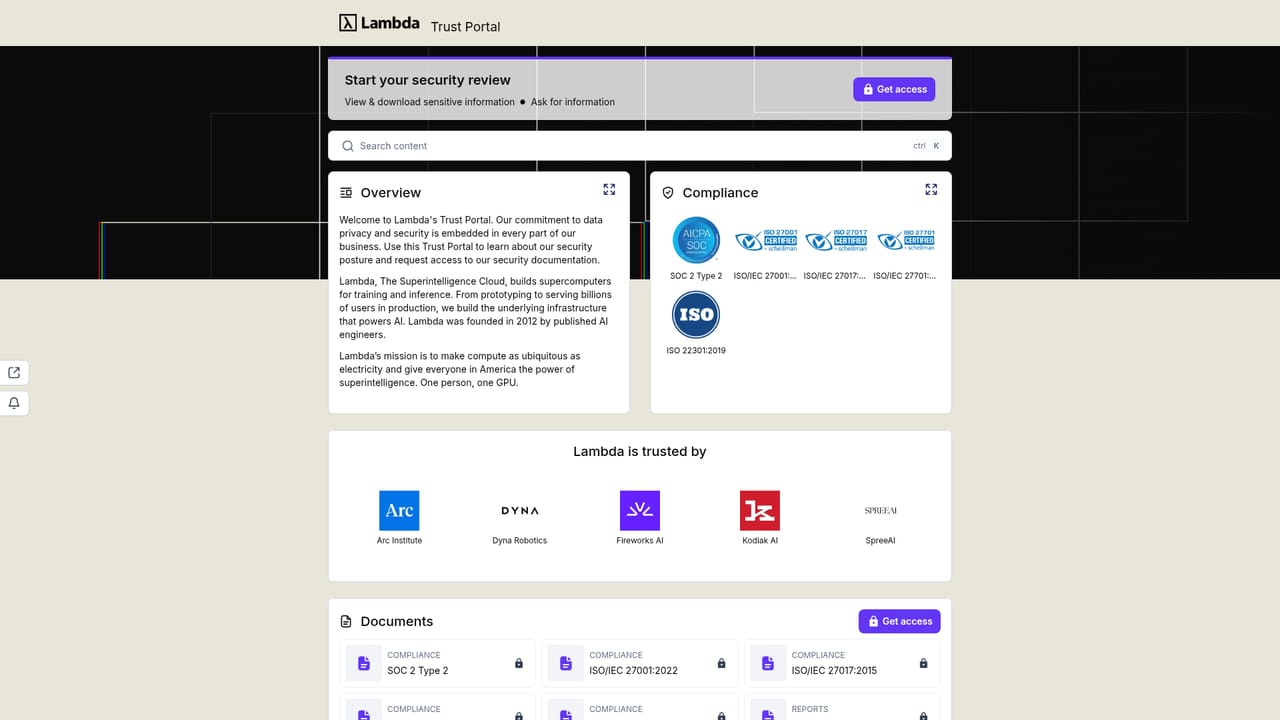
Support runs through a direct sales and engineering relationship: a contact form for tailored deployments and a technical solutions brief. A separate Trust Portal handles security and compliance documentation.
Learn moreModular, liquid-cooled AI factories for training and inference at scale
Own Lambda AI Infrastructure? Verify ownership to get a dofollow link

Lambda AI Infrastructure is a research tool. Lambda's AI infrastructure offering is about dedicated AI factories: modular data centers with liquid and precision air cooling, contiguous campuses above 75MW or distributed sites of 5 to 75MW, plus zero-trust security and ISO and SOC 2 compliance for large training and inference clusters.
Lambda builds AI factories: data centers purpose-built for large-scale training and inference, sized and cooled to keep dense GPU clusters running at peak output. The site frames the pitch around "superintelligence," but the substance is physical engineering. Rack power, direct-to-chip liquid cooling paired with precision air cooling, redundant cooling loops, and a roadmap toward 1 megawatt rack-scale designs. The stated goal is maximizing intelligence produced per watt, which makes this a capacity and efficiency play rather than a software product. Two deployment shapes are offered. Contiguous AI factories are 75MW and larger campuses for big clusters and mission-critical workloads, with on-site off-grid power and fully isolated environments for privacy-sensitive work. Distributed AI factories run 5 to 75MW in strategic metros, keeping compute close to users, satisfying sovereign AI and data protection rules, and drawing on metros with strong networks and cheaper energy. Both are described as modular and interoperable, so new GPUs, interconnects and cooling slots integrate as they ship instead of forcing a disruptive retrofit. Security and reliability get explicit treatment. Superclusters sit inside steel cages with biometric, RFID and two-factor checkpoints, logical separation through IPsec VPN and network peering, and encrypted storage. Compliance claims cover ISO 27001, ISO 27017, ISO 27701, ISO 22301 and SOC 2 Type II, with a public Trust Portal for verification. Lambda also notes co-engineering with customers and a validated-performance design process with integrated telemetry. This is not a self-serve tool for individual creators. The realistic buyer is an AI lab, enterprise platform team or sovereign program that needs dedicated compute capacity, custom architectures or data residency, and wants an operator to design and run the facility. Compared with renting generic cloud GPU hours, Lambda is selling the factory itself: power, cooling, networking and a deployment path. Pricing is quoted per engagement, so smaller teams and hobbyists are out of scope.
Support runs through a direct sales and engineering relationship: a contact form for tailored deployments and a technical solutions brief. A separate Trust Portal handles security and compliance documentation.
Learn moreNVIDIA GPU platforms including GB300 NVL72 systems and Quantum-X Photonics InfiniBand and Spectrum-X Photonics Ethernet networking. Data center partners named on the site include Equinix, EdgeConneX, Aligned and Prime Data Centers.
Learn moreModular AI factories with direct-to-chip liquid and precision air cooling, redundant cooling from N+1 to N+N, rack density designed toward 1MW rack scale, contiguous 75MW+ campuses and distributed 5 to 75MW sites, off-grid power options, isolated environments, IPsec VPN and network peering, encrypted storage, biometric and RFID physical access controls, and ISO and SOC 2 compliance.
 AI Angels400+ customizable AI girlfriends for NSFW chat, voice calls, and roleplay
 Candy AIExperience the future of companionship with AI friends who chat, role-play, and connect with you on a human level.
 ourdream.aiA vast AI roleplay platform with millions of characters for chat, images, video and voiceAI Angels400+ customizable AI girlfriends for NSFW chat, voice calls, and roleplayCandy AIExperience the future of companionship with AI friends who chat, role-play, and connect with you on a human level.ourdream.aiA vast AI roleplay platform with millions of characters for chat, images, video and voice


