Free trial
A free tier is available and requires no credit card, which allows evaluation of the platform before committing to a paid plan.
Learn moreAI peptide binder design from target discovery to validated sequences

LigandAI is a research tool. LigandAI (Ligandal) is a peptide design platform combining Predictive Interactomics target discovery, the LigandForge diffusion generator, Boltz-2 structural validation and DeltaForge affinity scoring, with optional wet-lab BLI confirmation. Aimed at computational biology and biotech teams; free tier available, paid plans from $299/mo.
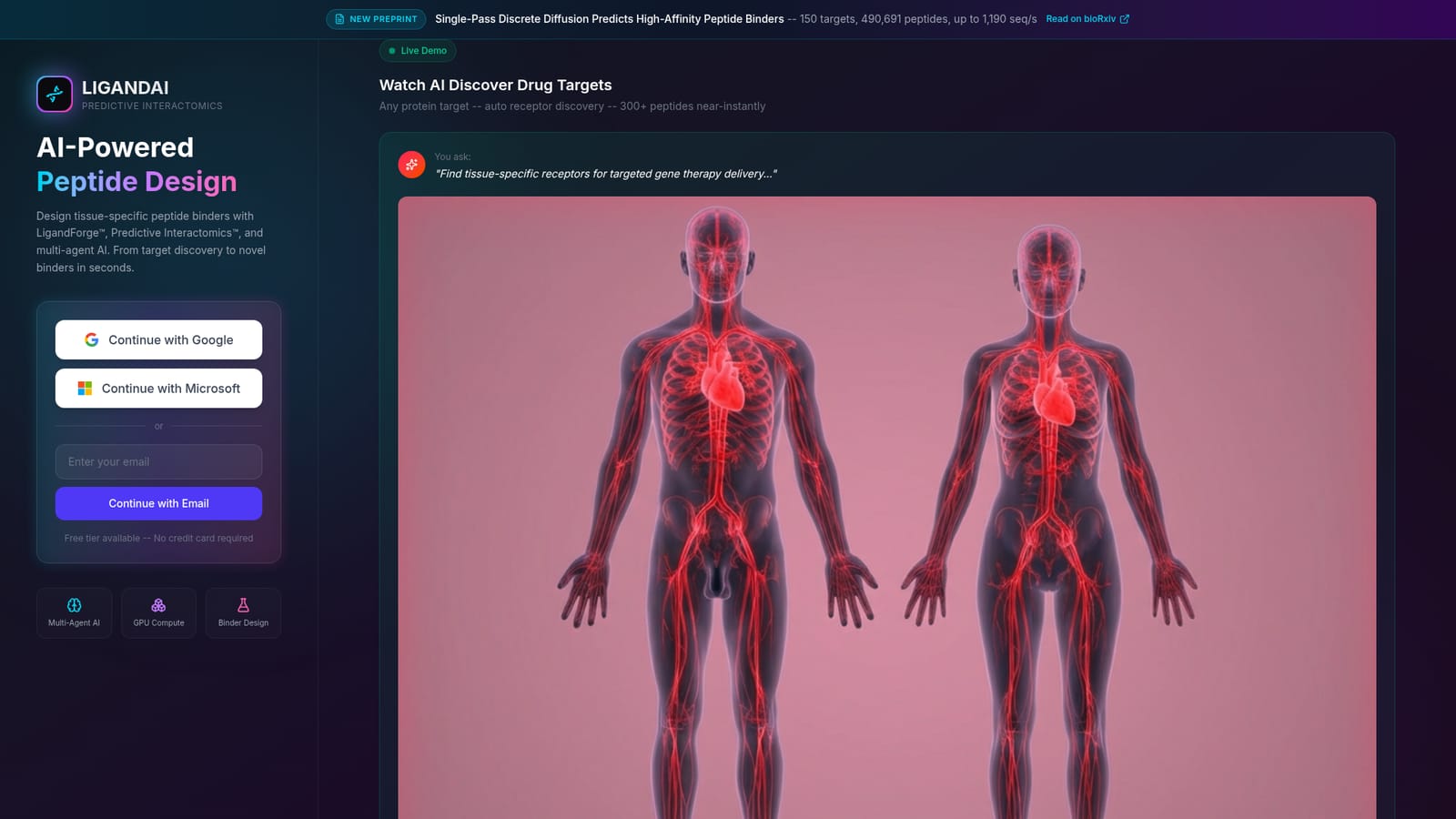
LigandAI is the web platform from Ligandal, a company working on computational peptide therapeutics since 2014. It packages three internal engines into one pipeline: Predictive Interactomics for target discovery, LigandForge for peptide generation, and DeltaForge for thermodynamic scoring, with Boltz-2 used for structural validation. The pitch is speed and compression of a workflow that normally spans several specialist tools: identify a tissue-specific receptor from transcriptomic data, generate candidate binders against its geometry, fold the peptide-receptor complexes, score predicted binding free energy and affinity, then order top candidates for wet-lab confirmation. The generation model is the technical centrepiece. LigandForge is a pocket-conditioned discrete diffusion model that produces sequences from receptor geometry without running a folding step inside the generation loop. In the company's bioRxiv preprint, it generated 490,691 peptides across 150 human receptor targets at up to 1,190 sequences per second, with 732 per second aggregate on a single NVIDIA B200. Validation runs through Boltz-2 on GPU clusters advertised at up to 96 concurrent B200 folds, then DeltaForge, a Rust scoring engine, reports predicted delta G and Kd per complex. The preprint claims sub-100 nM candidates on 140 of 144 scored targets and a gene-disjoint Pearson correlation of 0.727 against 3,141 X-ray-grounded complexes. The audience is computational biologists, peptide discovery groups, and biotech teams that already understand binding affinity, IC50 style metrics and structure prediction outputs. It is not a teaching tool: the interface assumes familiarity with receptor biology and with interpreting pTM, ipTM, pLDDT and predicted Kd values. Top candidates can be carried through to cell-free protein synthesis and biolayer interferometry to measure actual affinity, which makes the platform a bridge between dry-lab screening and bench validation rather than a replacement for either. Against alternatives such as BindCraft, BoltzGen or Genie3, LigandAI's differentiation is throughput and an integrated scoring layer, and the preprint positions those tools as three to six orders of magnitude slower on generation. The trade-off is that most performance claims originate with the vendor and rest on a single preprint, so independent replication matters before committing to paid tiers.
A free tier is available and requires no credit card, which allows evaluation of the platform before committing to a paid plan.
Learn moreFour tiers: a free tier with no credit card, Basic at $799/mo, Academia at $299/mo and Pro at $5,000/mo. Enterprise licensing and API access are quoted on request through the contact form.
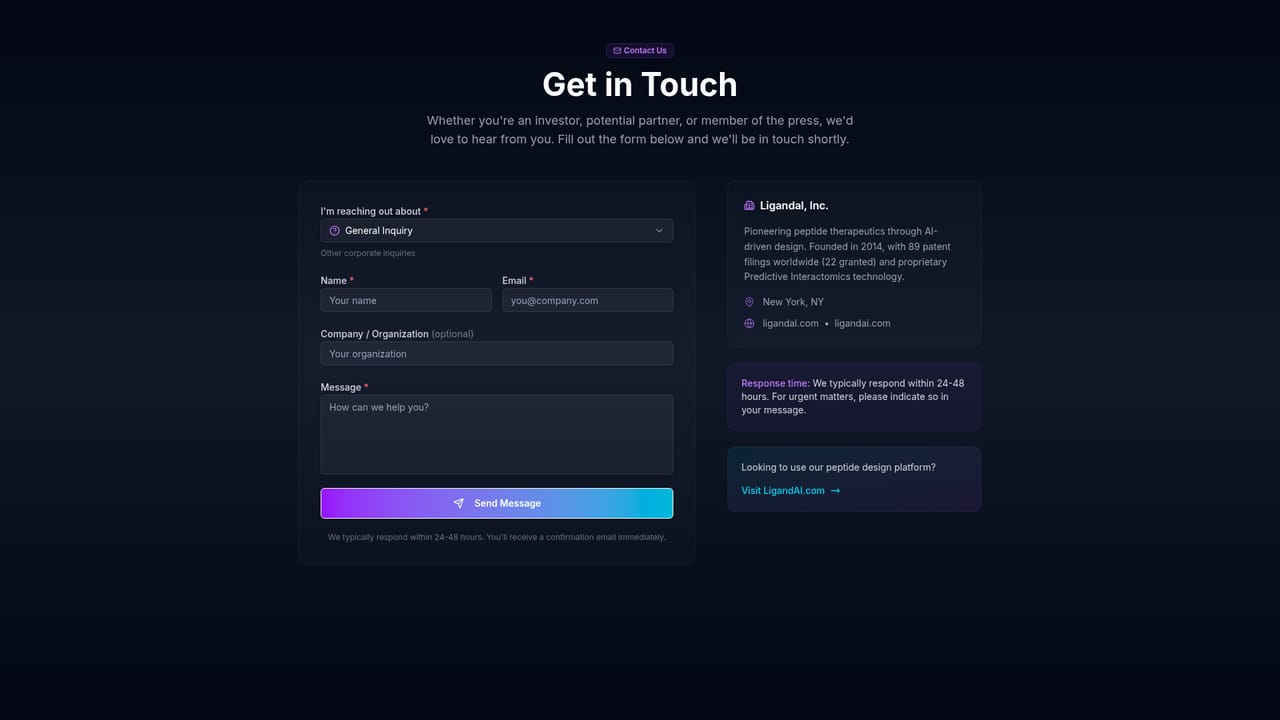
Learn moreTechnical support for platform features, jobs and account issues is handled through a contact form, with a stated response window of 24 to 48 hours.
Learn moreNo named third-party integrations are documented on the site. Enterprise API access for commercial use is available on request.
Learn morePredictive Interactomics multi-agent target discovery over transcriptomic atlases, LigandForge pocket-conditioned diffusion for peptide binder generation, Boltz-2 structure prediction at up to 96 concurrent B200 folds, DeltaForge Rust scoring engine for predicted delta G and Kd, plus an optional cell-free synthesis and BLI validation path.
Learn more AI Angels400+ customizable AI girlfriends for NSFW chat, voice calls, and roleplay
 Candy AIExperience the future of companionship with AI friends who chat, role-play, and connect with you on a human level.
 ourdream.aiA vast AI roleplay platform with millions of characters for chat, images, video and voiceAI Angels400+ customizable AI girlfriends for NSFW chat, voice calls, and roleplayCandy AIExperience the future of companionship with AI friends who chat, role-play, and connect with you on a human level.ourdream.aiA vast AI roleplay platform with millions of characters for chat, images, video and voice


