Free trial
The free plan provides 10,000 credits monthly, roughly 1,000 pages, covering agentic OCR, structured extraction and end-to-end document agents. Sign-up is available in global and EU regions.
Learn moreAgentic OCR that turns messy documents into AI-ready context

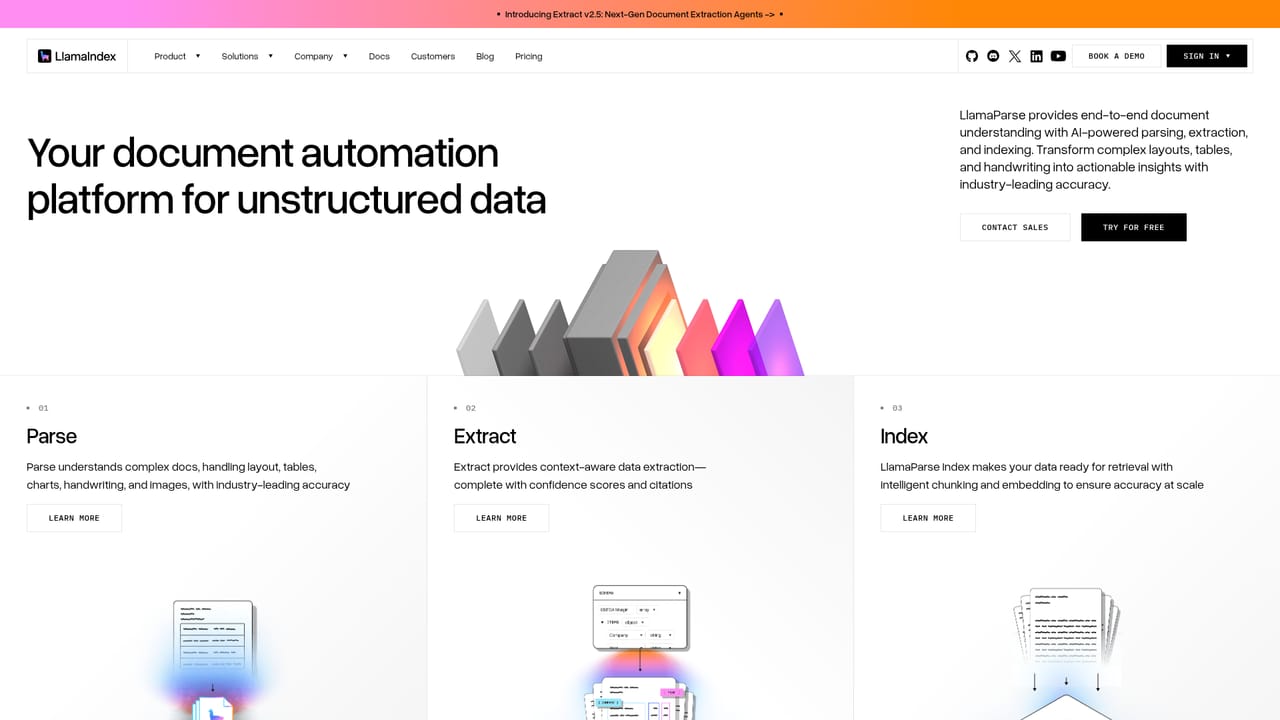
LlamaIndex builds LlamaParse, an agentic OCR and extraction service that converts complex PDFs, Office files and scans into structured, LLM-ready output. It handles tables, charts, handwriting and dense layouts, then chunks and indexes the results for retrieval, making it the ingestion layer behind document Q&A and agent workflows.
LlamaIndex is an applied AI lab whose product line centers on document intelligence. The flagship service, LlamaParse, is an agentic OCR layer built to convert unstructured files into clean output that language models and retrieval pipelines can actually use. The team positions it against two familiar options: legacy intelligent document processing suites that depend on hand-built templates, and raw vision model calls that struggle with dense layouts. Roughly 50+ unstructured file types are supported, including PDFs, Office documents and images, with handling for embedded images, multi-page tables, charts and handwriting. Under the hood, parsing runs as a chain of specialized agents. Task-specific experts break content apart by modality (text, tables, charts), an agentic understanding layer applies semantic reasoning to the layout, and recursive auto-correction loops check and repair errors before output. Beyond parsing, the platform adds schema-based extraction with no model training required, document splitting driven by natural language descriptions, rule-based classification, and an enterprise chunking and embedding pipeline aimed at RAG retrieval quality. For database Q&A and internal search work, this is the ingestion half of the stack. Teams feed parsed, chunked and indexed documents into their own retrieval or agent layer, so answers to questions about contracts, filings, manuals or records rest on accurate source text rather than garbled extraction. Published case work spans investment research, insurance, manufacturing and healthcare, and the vendor reports 1B+ documents processed, 300k+ LlamaParse users and 99.9% uptime commitments. A companion open-source project, LiteParse, handles local parsing of PDFs, Office files and images with no cloud dependency and no token costs, which suits privacy-sensitive or air-gapped jobs. Cloud deployment is available in global and EU regions, or fully inside a customer VPC. Expect a developer-first product: the value shows up inside a pipeline, not in a polished consumer interface.
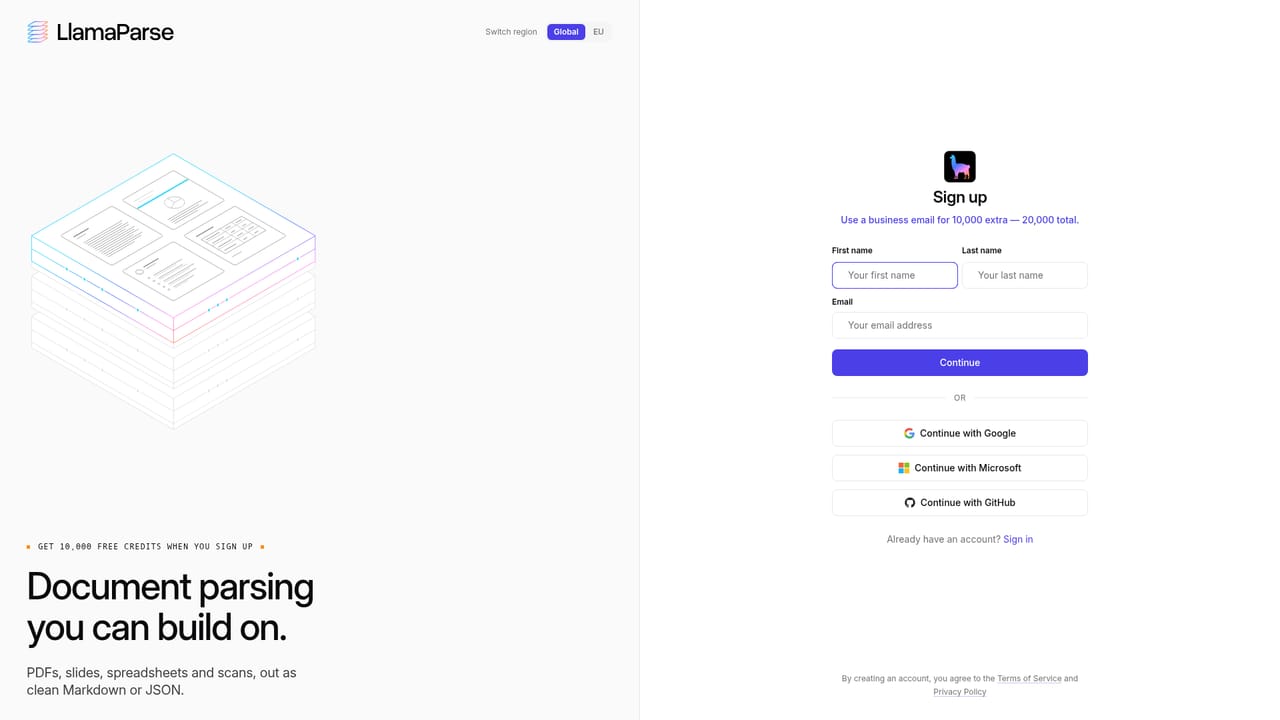
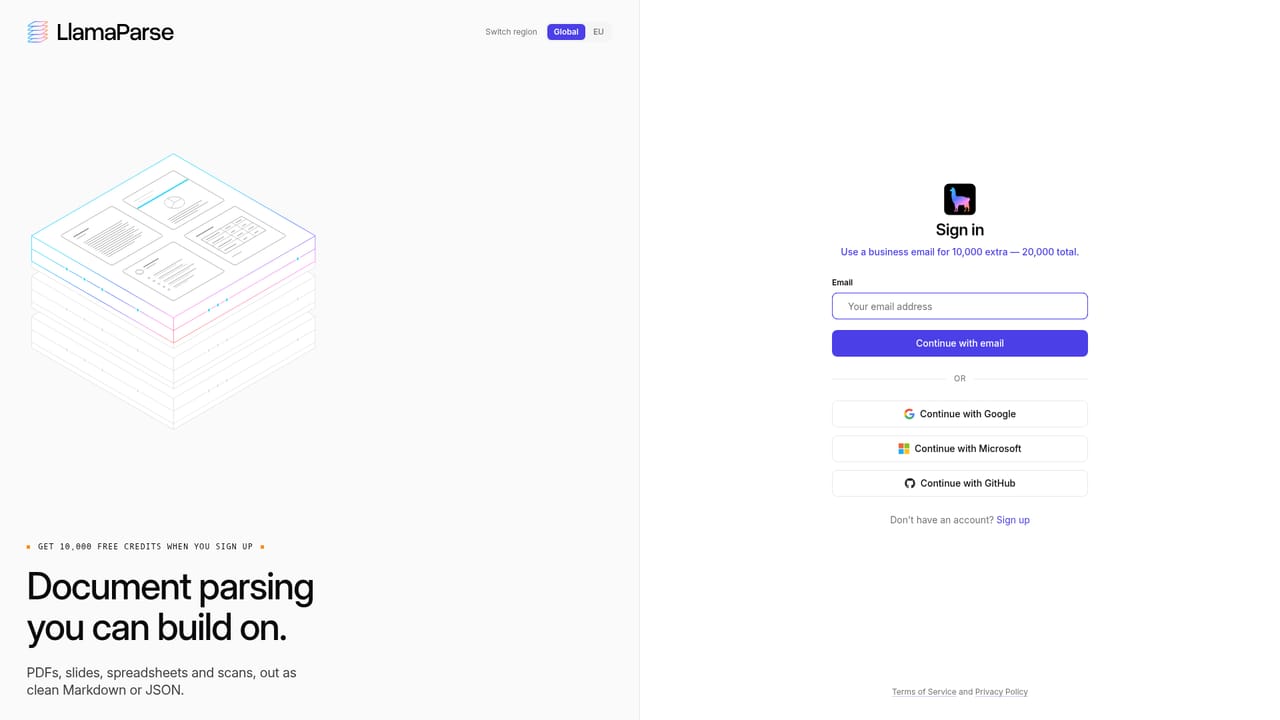
The free plan provides 10,000 credits monthly, roughly 1,000 pages, covering agentic OCR, structured extraction and end-to-end document agents. Sign-up is available in global and EU regions.
Learn moreA free plan includes 10,000 credits per month (about 1,000 pages), agentic OCR, structured schema extraction and document agent building. Paid tiers and enterprise terms are not published on the homepage; pricing is discussed through a demo request.
Learn moreEnterprise plans include dedicated support, fast response times and SLAs tailored to production AI workloads. A contact form handles demos and sales questions; no public help centre page is listed.
Learn moreAgentic OCR for 50+ unstructured file types, including tables, charts, handwriting and embedded images. Adds schema-based extraction without training, natural-language document splitting, rule-based classification, and an enterprise chunking and embedding pipeline for RAG. Recursive auto-correction loops improve pass-through on messy scans. LiteParse offers open-source local parsing.
Learn more AI Angels400+ customizable AI girlfriends for NSFW chat, voice calls, and roleplay
 Candy AIExperience the future of companionship with AI friends who chat, role-play, and connect with you on a human level.
 ourdream.aiA vast AI roleplay platform with millions of characters for chat, images, video and voiceAI Angels400+ customizable AI girlfriends for NSFW chat, voice calls, and roleplayCandy AIExperience the future of companionship with AI friends who chat, role-play, and connect with you on a human level.ourdream.aiA vast AI roleplay platform with millions of characters for chat, images, video and voice


