Support
Support runs through the demo and contact path on the homepage, where a booking link connects prospects directly with the team. A separate documentation site covers product usage.
Learn moreCustom model and agent harness training built around your data

Lucidic.AI is an AI engineering problem solver tool. Lucidic AI trains custom models and agent harnesses together, using simulation runs to tune prompts, tools, guardrails and context against measurable outcomes like deflection and resolution alignment. Aimed at AI engineering teams rather than individual users, with access through a demo rather than self-serve signup.
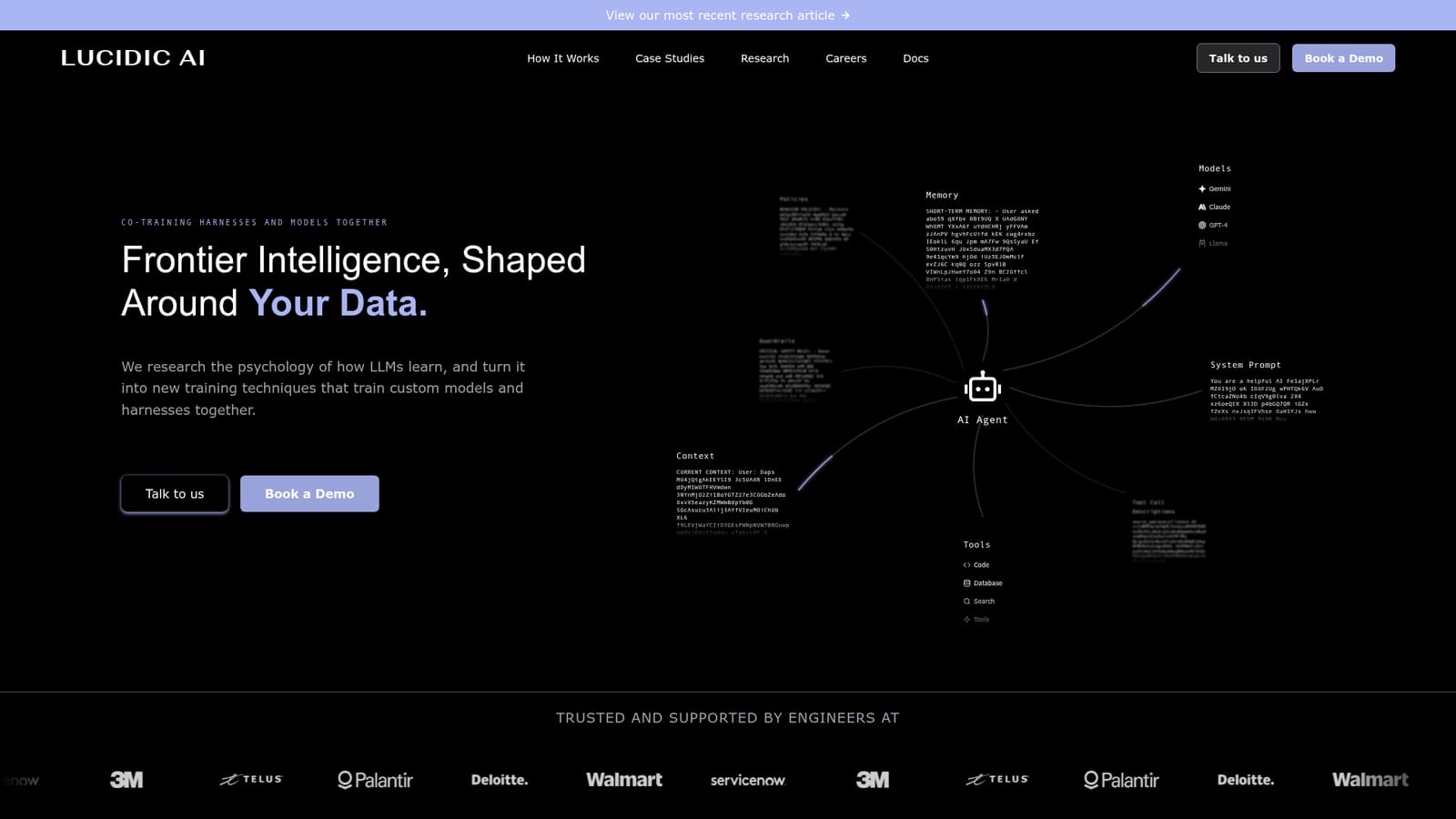
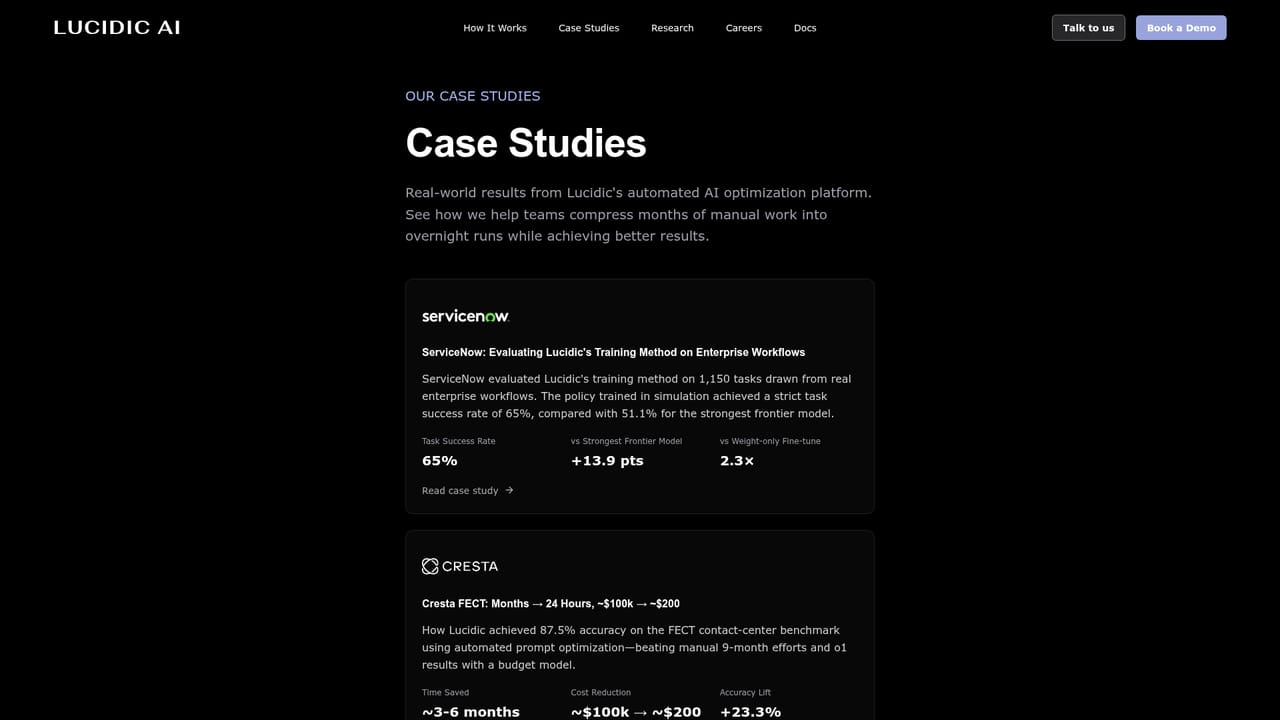
Lucidic AI is a research-driven platform for teams that need an AI agent to behave reliably on their own data rather than on generic benchmarks. The company studies how large language models learn, then applies those findings to a training method it describes as co-training: the underlying model and the harness around it (system prompt, tool definitions, guardrails, policies, context and memory) are tuned together instead of separately. The premise is that a strong base model alone does not produce a dependable agent, because most failures come from the scaffolding that decides how the model uses tools and context. In practice the product looks like a simulation and evaluation environment. Users define the agent configuration, run iterations against a scenario, and watch metrics such as deflection rate, fake deflection, resolution alignment and average number of turns move over time. The homepage shows a run where hundreds of configurations and thousands of adjustments were tested across four models, with the best configuration surfaced alongside its temperature, retry, timeout and context window settings. That loop of test, measure, adjust is the core workflow, and it treats prompt engineering as an empirical discipline rather than guesswork. The platform lists Claude, GPT-4, Llama and Gemini among the models it works with, and the harness controls cover tools (search, database, code) as well as explicit guardrails and policies. This positions Lucidic less as a chat interface and more as infrastructure for teams already building agents on top of commercial or open models. It sits in the same conversation as agent evaluation and observability tooling, but its emphasis is on training and configuration search rather than passive monitoring. The audience is technical: AI engineers, applied research teams and platform groups in larger organizations who own an agent in production or near it. The homepage names Deloitte, Walmart, ServiceNow, 3M, TELUS and Palantir as companies whose engineers use it, which signals an enterprise sales motion. Pricing is not published, and the primary path in is a demo booking rather than self-serve signup, so smaller teams should expect a conversation before any hands-on trial.
Support runs through the demo and contact path on the homepage, where a booking link connects prospects directly with the team. A separate documentation site covers product usage.
Learn moreSimulation environment for training custom models and agent harnesses together, with iteration tracking and configuration comparison. Harness controls cover system prompt, tool call descriptions, tools such as search, database and code, guardrails, policies, context and memory. Metrics include deflection rate, fake deflection, resolution alignment and number of turns, and supported models include Claude, GPT-4, Llama and Gemini.
 AI Angels400+ customizable AI girlfriends for NSFW chat, voice calls, and roleplay
 Candy AIExperience the future of companionship with AI friends who chat, role-play, and connect with you on a human level.
 ourdream.aiA vast AI roleplay platform with millions of characters for chat, images, video and voiceAI Angels400+ customizable AI girlfriends for NSFW chat, voice calls, and roleplayCandy AIExperience the future of companionship with AI friends who chat, role-play, and connect with you on a human level.ourdream.aiA vast AI roleplay platform with millions of characters for chat, images, video and voice