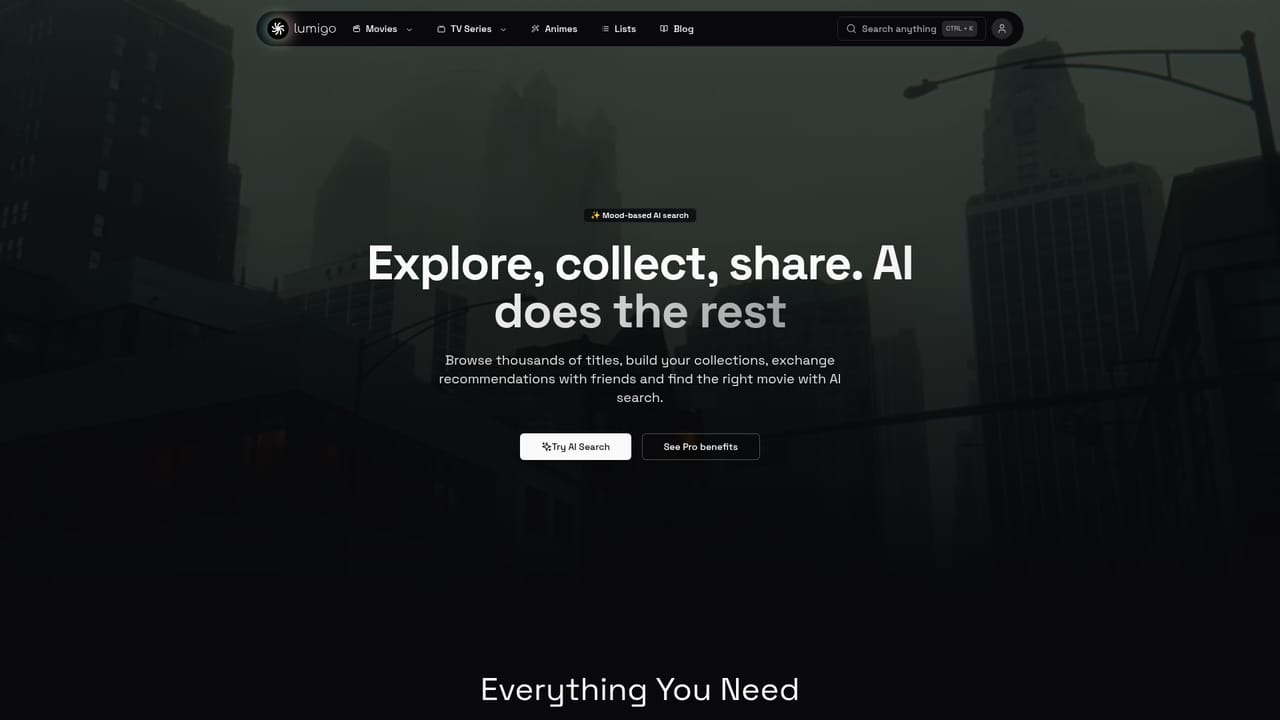
Lumigo Movies is a movie suggestion tool. A movie and TV discovery site with an AI agent that turns a described mood into title suggestions, backed by ratings, reviews, watch tracking and shareable lists across a catalogue of more than 10 million titles.
Lumigo Movies is a discovery and collection platform for films and television, built around an AI agent that takes a written description of a mood and returns matching titles. Instead of scrolling genre rows or guessing at keywords, a viewer types what they feel like watching and the agent searches a catalogue the site puts at more than 10 million movies and shows. Around that search sit the familiar tools of a tracking site: ratings, reviews, watched and planned states, and shareable lists.
The product suits people who stall at the "what should we watch" stage more than they enjoy browsing. Casual viewers can stay on the free tier, which includes full platform access, unlimited ratings and reviews, tracking across watched, watching and planned statuses, viewing of collaborative lists and up to two custom lists of their own. The AI search is capped at three queries a day on that plan, which is plenty for occasional use and restrictive for anyone who leans on it nightly. Pro at $3.50 per month (billed yearly at a 20 percent discount over monthly) removes the search cap, raises the accuracy the site advertises for AI results, makes custom lists unlimited and adds personalised recommendations plus detailed viewing statistics.
In practice the workflow is short. You open the mood search, describe a feeling or the kind of thing you want, and read through the agent's suggestions. Titles you like go onto lists, and those lists can be shared with the community so other users can browse your picks and swap recommendations. Standard discovery surfaces sit alongside the AI: top rated titles, what is popular now, upcoming premieres and a dedicated TV series section.
Lumigo positions itself as a lighter, AI-first alternative to established tracking communities. It competes on the quality of its conversational search and on list sharing rather than on the depth of its database tooling, and the free tier is generous enough to evaluate that claim before paying.