Integrations
Compatibility is listed for Narrative, Microsoft Word, Google Docs, Microsoft Excel, PDF files and email content, which serve as data sources for generated decks and reports.
AI that builds decks and reports from your data, on your rules

Matik generates business decks, documents and reports from your own data, constrained by custom guardrails and proven best practices so output stays on-brand and consistent across every user on the team.
Matik is a content generation platform built around a simple observation: general purpose AI writing tools are probabilistic, so the same prompt can produce a different deck every time. Matik addresses that by wrapping generation in guardrails. These are rules the customer defines plus defaults drawn from established best practices, and they constrain what the model is allowed to produce. The output is a presentation, document or report populated with the user's own data, written in a consistent house voice, and structured according to if-then logic rather than whatever the model happened to favor that day. In practice the workflow starts with connected data. Matik is described as compatible with Narrative, Microsoft Word, Google Docs, Microsoft Excel, PDF files and email content, and it pulls from those sources when assembling a deck. Generation covers more than body text: the platform also produces visuals and highlights key insights automatically, which is the part most teams currently handle by hand after a generic model returns a draft. Because the guardrails are shared, a whole team can generate material that looks and reads the same way regardless of who ran it, which removes a round of review and reformatting before anything reaches a customer. The tool is aimed at revenue, customer success and operations teams that produce recurring business reviews, account reports and shareable decks at volume. Those are the scenarios where consistency matters more than novelty, and where a plausible but unverifiable answer costs more than a slow one. It is not a general chat assistant and it is not a design tool; it sits between a data source and a finished document. Buyers comparing it against ChatGPT or Copilot should note the trade: Matik trades open-ended flexibility for repeatability, which is a good fit for teams who already know what a good report looks like and want that standard enforced automatically. Evaluation runs through a sales conversation, with a public demo request form as the entry point.
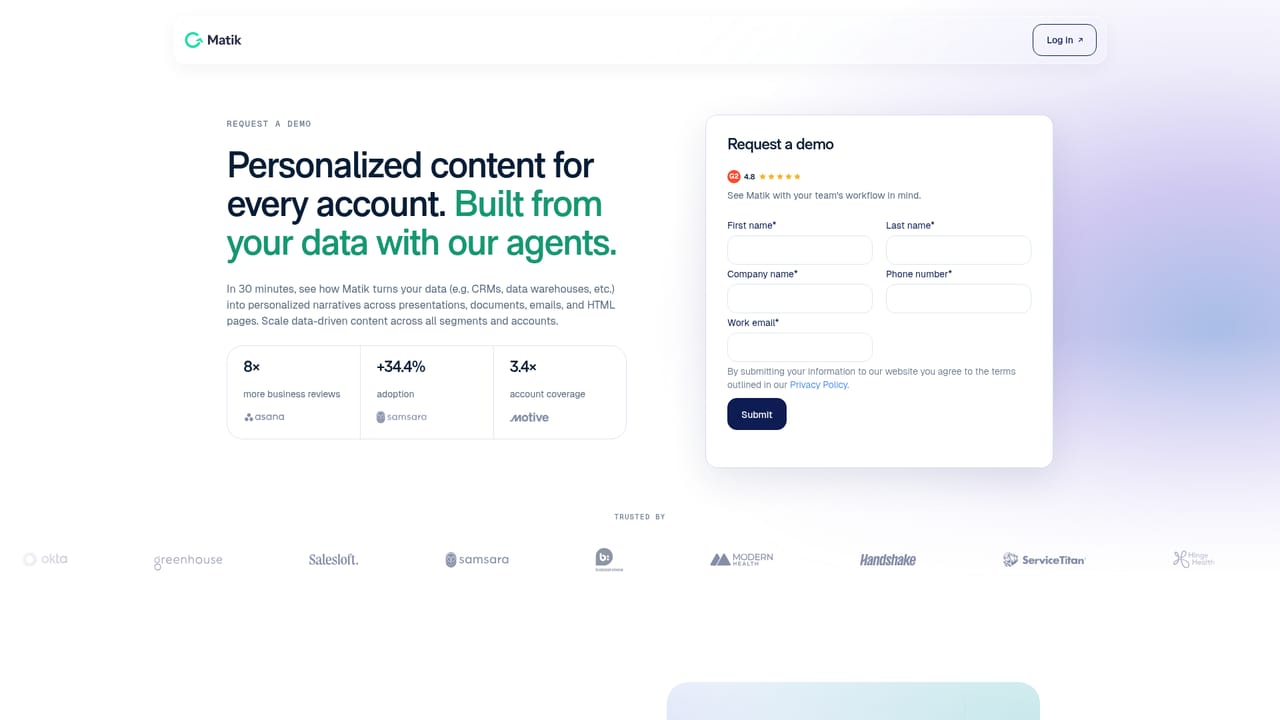
Compatibility is listed for Narrative, Microsoft Word, Google Docs, Microsoft Excel, PDF files and email content, which serve as data sources for generated decks and reports.
Guardrailed generation of decks, documents and reports using your own data. Rules combine customer-defined logic with Matik's best practice defaults, and output includes automated text, visuals and key insight extraction. The stated result is content that carries data context, follows if-then logic and stays consistent across all users.
 AI Angels400+ customizable AI girlfriends for NSFW chat, voice calls, and roleplay
 Candy AIExperience the future of companionship with AI friends who chat, role-play, and connect with you on a human level.
 ourdream.aiA vast AI roleplay platform with millions of characters for chat, images, video and voiceAI Angels400+ customizable AI girlfriends for NSFW chat, voice calls, and roleplayCandy AIExperience the future of companionship with AI friends who chat, role-play, and connect with you on a human level.ourdream.aiA vast AI roleplay platform with millions of characters for chat, images, video and voice


