Integrations
Grant Finder draws on federal grants from SAM.gov, and the knowledge base is built from a city's own documents, municipal code and GIS data. No other third-party integrations are documented on the site.
Learn moreAI knowledge base and workflow assistants built for city hall

Ordinal is an AI platform for city governments: an internal research assistant grounded in approved documents and municipal code, plus modules for a resident chatbot, code comparison, grant search, state legislation tracking, plan review and staff report drafting.
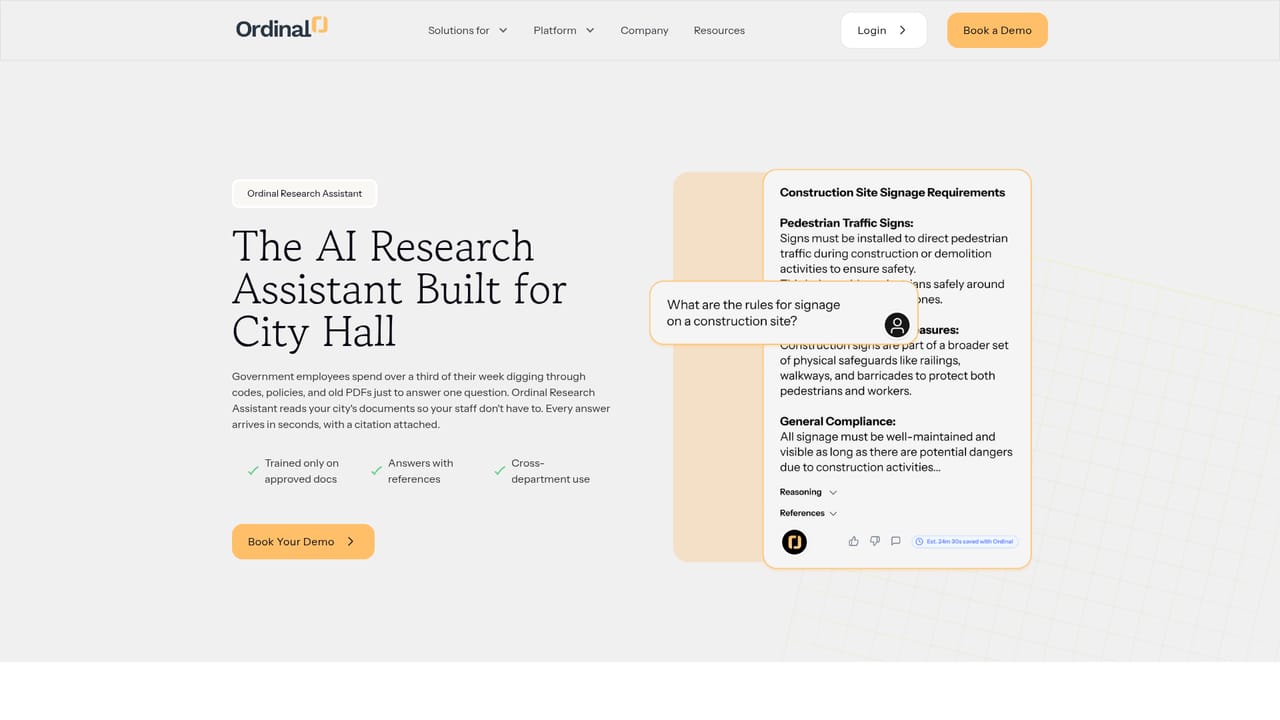
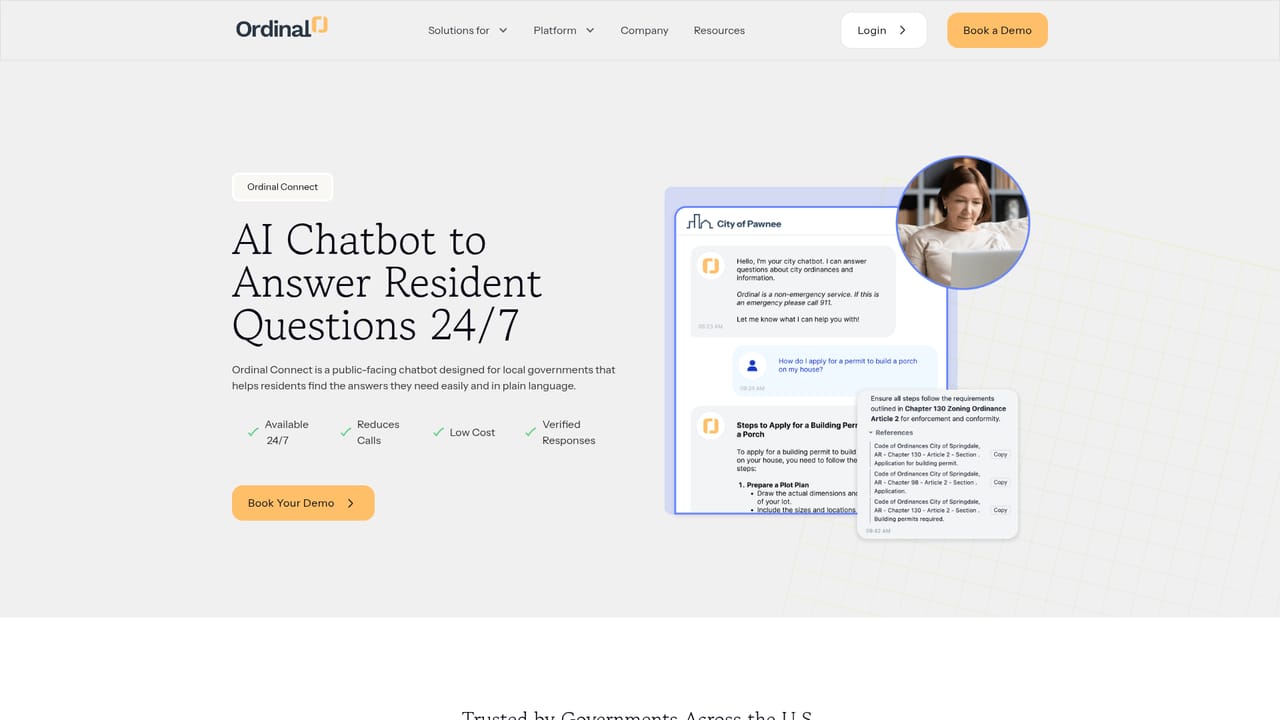
Ordinal is an AI platform aimed squarely at local government rather than general office work. It pairs an internal knowledge base with a set of task-specific assistants, all grounded in a city's own approved documents, municipal code, GIS data and other official data sets. The premise is simple: staff spend a large share of the week hunting through files or asking colleagues for answers, and a retrieval layer over trusted sources shortens that loop while keeping the answers traceable. The product is really a suite. Research Assistant answers staff questions and cites where each answer came from. Connect is a public-facing chatbot that handles resident questions on the city website around the clock. Code Library lets staff see how other municipalities worded similar ordinances. Grant Finder searches federal grants from SAM.gov against local priorities. Legislation Monitor watches newly passed state law and flags how it may touch existing code. Plan Review reads uploaded site plans against a compliance checklist and sorts them into pass, needs attention and fail. Report Assistant drafts staff reports, agendas and meeting notes using the city's own templates and phrasing. Day to day, this fits the people who answer questions for a living: planners, code enforcement officers, 3-1-1 teams, communications staff, administrators, attorneys, economic developers and the managers who oversee them. The workflow is upload and configure, then ask. Because answers are restricted to approved material, new hires can self-serve instead of interrupting senior colleagues, which is the knowledge transfer problem the vendor leans on hardest. Against generic chatbots and enterprise search, Ordinal's case rests on municipal specificity: code lookups, permit review and grant search are baked in rather than assembled from prompts. The trade-off is narrowness. This is not a tool for a business outside city government, and buyers should treat the demo as the real evaluation, since pricing and implementation detail are not published.
Grant Finder draws on federal grants from SAM.gov, and the knowledge base is built from a city's own documents, municipal code and GIS data. No other third-party integrations are documented on the site.
Learn moreResearch Assistant answers staff questions from approved documents, code and GIS data with citations. Connect is a public resident chatbot. Code Library compares ordinances across municipalities. Grant Finder searches SAM.gov. Legislation Monitor flags how new state law affects local code. Plan Review checks site plans against a checklist. Report Assistant drafts staff reports and agendas.
Learn more AI Angels400+ customizable AI girlfriends for NSFW chat, voice calls, and roleplay
 Candy AIExperience the future of companionship with AI friends who chat, role-play, and connect with you on a human level.
 ourdream.aiA vast AI roleplay platform with millions of characters for chat, images, video and voiceAI Angels400+ customizable AI girlfriends for NSFW chat, voice calls, and roleplayCandy AIExperience the future of companionship with AI friends who chat, role-play, and connect with you on a human level.ourdream.aiA vast AI roleplay platform with millions of characters for chat, images, video and voice


