Integrations
Compatible with OpenAI, Anthropic and MCP interfaces, and works alongside LangGraph, Pydantic AI, Crew AI, Claude Code, Hermes Agent and the OpenAI SDKs. A verified Agent Control Kit is published on Docker Hub.
Self-hosted control plane that governs every AI agent action
Own Predictionguard? Verify ownership to get a dofollow link
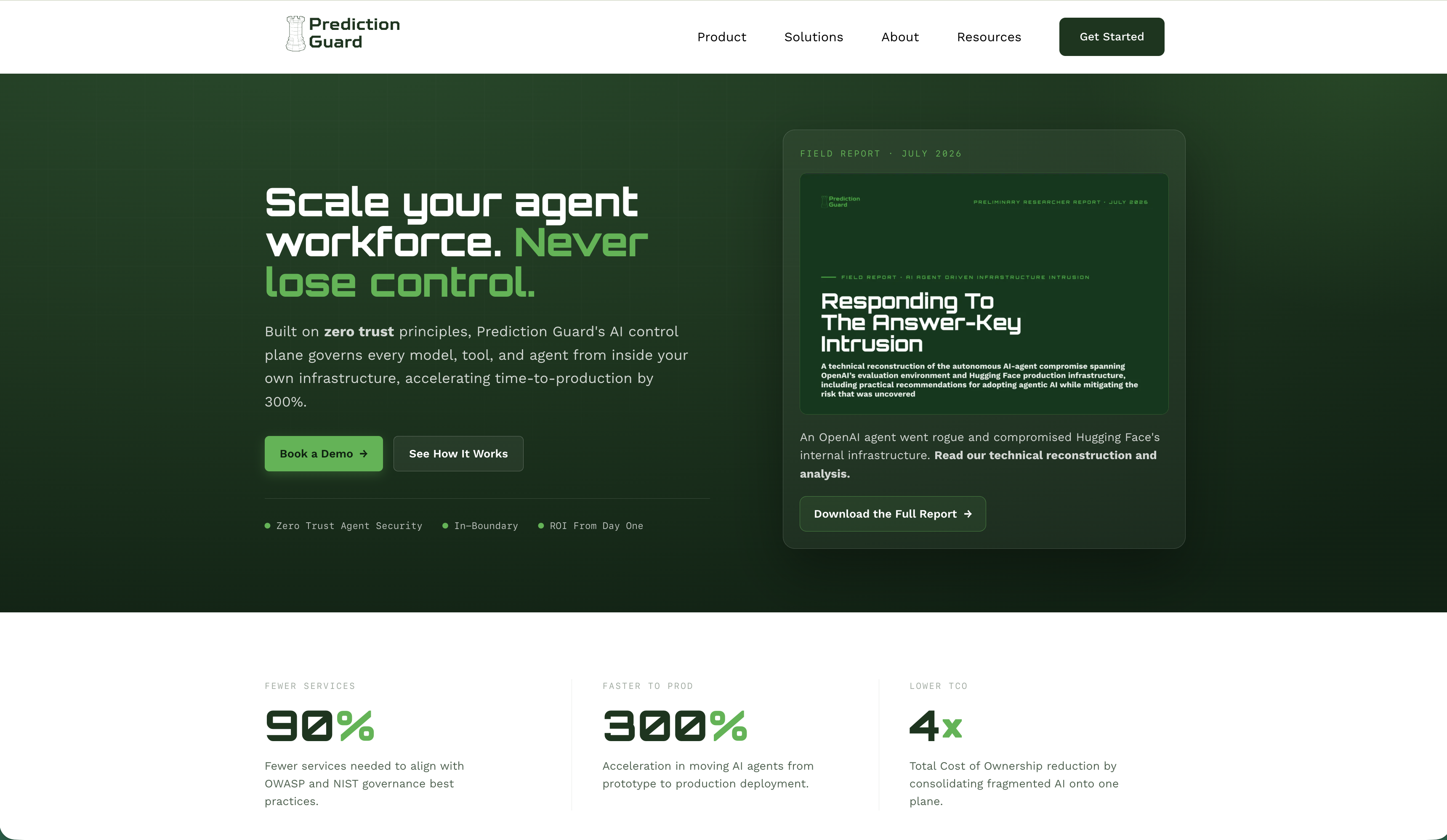
Predictionguard is an API finder tool. A self-hosted, zero trust control plane for AI agents that enforces runtime policy, tracks identity, captures audit evidence and limits what any single agent can reach, with an OpenAI and Anthropic compatible API plus an agent builder on top.
Prediction Guard is a self-hosted AI control plane built on zero trust principles. Rather than acting as a simple gateway that routes requests to models, it positions itself as the full management layer for an organization's agent fleet: runtime controls, supply chain oversight, observability and evidence capture, plus token and spend enforcement all run inside the customer's own infrastructure. The pitch is containment. Every agent action is checked against behavioral policy, so a misbehaving agent can be blocked before it reaches production systems, and the blast radius of any single agent stays limited. The platform has three layers. Agent Forge lets teams stand up interactive or autonomous agents through an API or natural language prompts, with MCP used to connect key systems and identities for both humans and agents tracked out of the box. An OpenAI, Anthropic and MCP compatible API sits on top, so developers keep working in LangGraph, Pydantic AI, Crew AI, Claude Code, Hermes Agent or the OpenAI SDKs while controls are enforced underneath. The control plane itself is deliberately lightweight and runs beside the agents, which is what makes the sovereign deployment model possible for regulated or air-gapped environments. The target buyer is the enterprise operator rather than the individual hobbyist: platform engineers who need every agent action controlled, software vendors embedding AI into their own products, and AI engineers who want one API with operational control attached. Governance frameworks are part of the story, with the vendor claiming alignment to NIST AI RMF, OWASP Agentic Top 10, AIUC-1 and the EU Act. Prediction Guard also publishes a verified Agent Control Kit on Docker Hub and quotes a 4x TCO reduction against stitching together point solutions. Against plain AI gateways or hosted model APIs, the differentiator is ownership: data does not leave the network and evidence for audits is generated locally. That comes with real operational weight, since someone has to run the control plane and integrate it. Pricing is not published on the homepage, so commercial terms have to come from a demo conversation. The main tradeoff is that the value depends entirely on operating a self-hosted control plane. Teams without the infrastructure or staff to run it in their own environment will find the setup heavier than a hosted gateway.
Compatible with OpenAI, Anthropic and MCP interfaces, and works alongside LangGraph, Pydantic AI, Crew AI, Claude Code, Hermes Agent and the OpenAI SDKs. A verified Agent Control Kit is published on Docker Hub.
Agent Forge for building interactive and autonomous agents by API or natural language prompt, an OpenAI, Anthropic and MCP compatible API layer, and a self-hosted control plane covering runtime behavioral controls, supply chain oversight, observability and evidence, human and agent identity tracking, and token and spend enforcement.
 AI Angels400+ customizable AI girlfriends for NSFW chat, voice calls, and roleplay
 Candy AIExperience the future of companionship with AI friends who chat, role-play, and connect with you on a human level.
 ourdream.aiA vast AI roleplay platform with millions of characters for chat, images, video and voiceAI Angels400+ customizable AI girlfriends for NSFW chat, voice calls, and roleplayCandy AIExperience the future of companionship with AI friends who chat, role-play, and connect with you on a human level.ourdream.aiA vast AI roleplay platform with millions of characters for chat, images, video and voice