Productify

Turn raw product images and packaging into structured, compliant catalogue data

Advanced API
Screenshot of Productify, Turn raw product images and packaging into structured, compliant catalogue data

What is Productify?

Productify is a content tool that turns raw product images and packaging into structured, compliant catalogue data. API-first platform that converts product images, packaging, text and tables into structured, compliant product data, with OCR extraction, GS1 aligned categorisation, nutritional data, marketing copy and translation, aimed at agencies, distributors, retailers and PIM platforms handling catalogues at volume.

Productify.ai is an API-first platform built for one narrow but painful job: taking messy product content (pack shots, packaging photos, supplier text, embedded tables) and converting it into structured, reusable product data. Online since 2023, it targets the operational layer of eCommerce rather than the storefront. A supplier sends an image of a chocolate bar; Productify extracts the name, generates a marketing description, assigns a category path, and returns clean JSON with a confidence score attached to the extraction. The product suite is broad within that niche. It covers marketing copy, Google and GS1 aligned categorisation, bulleted feature and benefit lists, nutritional data pulled from the back of a pack, table digitisation for images containing tabular data, short descriptions, OCR text extraction, SEO keywords, summaries and translation. The workflow is split into four stages: ingestion via OCR, regulatory alignment against standard food codes, enrichment through schema mapping and multilingual output, and integration through a REST API with webhooks. In practice this suits organisations with catalogue volume problems, not individuals writing a handful of listings. The homepage names content agencies juggling thousands of SKUs for multiple clients, distributors onboarding large catalogues quickly, enterprise retailers keeping data consistent across channels and regions, and PIM platforms that need an automated ingestion pipeline feeding their existing system. It can be white-labelled or embedded directly into internal tooling, which makes it as much infrastructure as it is a tool. Compared with general purpose writing assistants, the differentiation is specialisation. The team claims grounding that reduces hallucination and processing tuned to product data rather than generic text. The honest trade-off is that Productify is not a self-serve content editor: it expects API consumption, batch jobs and some technical setup, so teams without engineering support will lean on sales-led onboarding.

How do you use Productify?

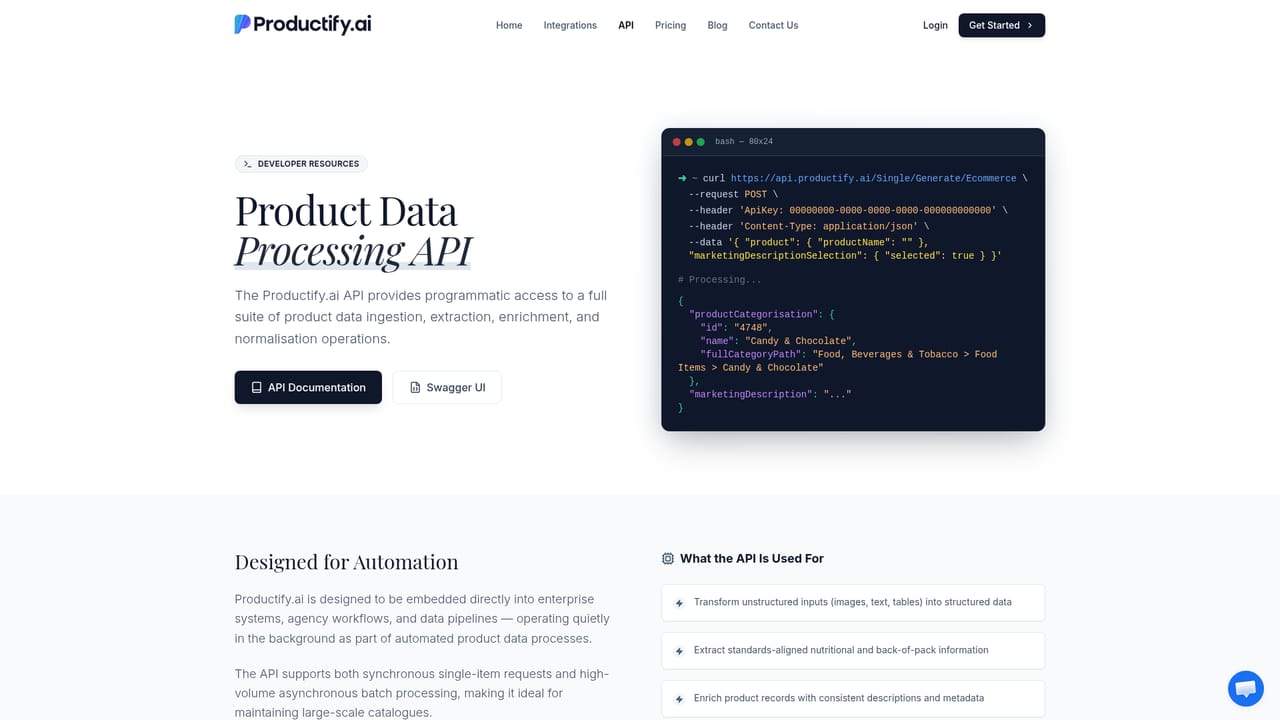
  1. 1Review the platform and documentation
    Read the API documentation to understand endpoints, payload shapes and how ingestion jobs are structured before committing to a conversation with sales.
    Productify — Review the platform and documentation
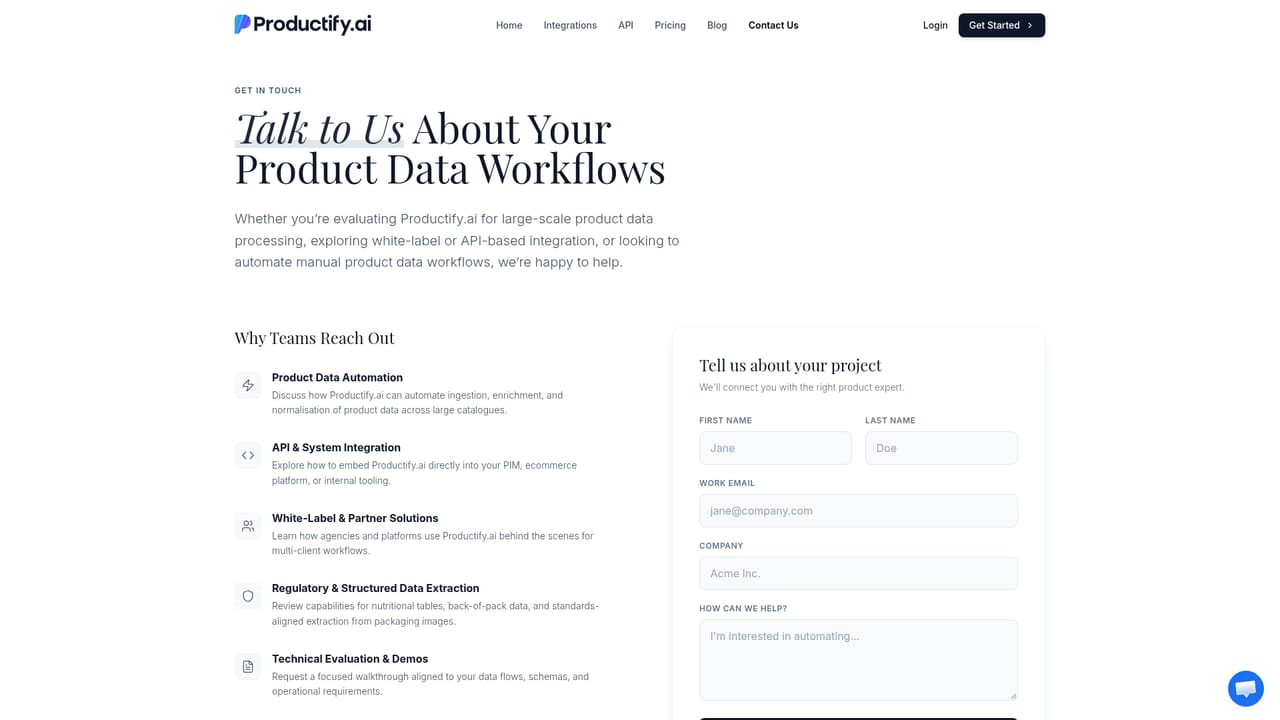
  2. 2Talk to the sales team
    Discuss catalogue size, data sources and any custom functionality needed so the team can scope the setup and credit volumes.
    Productify — Talk to the sales team
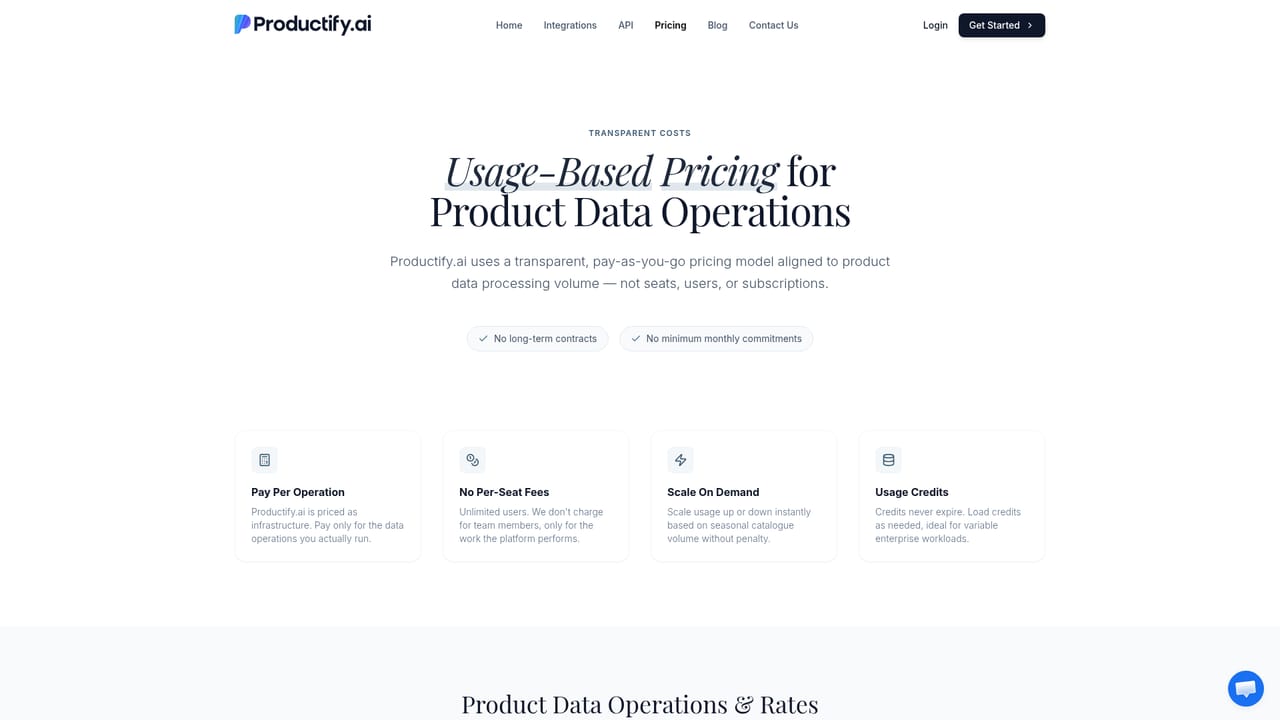
  3. 3Check pricing and volume terms
    Review the credit-based pricing page to map operations to expected monthly spend, and ask about enterprise volume discounts for large commitments.
    Productify — Check pricing and volume terms
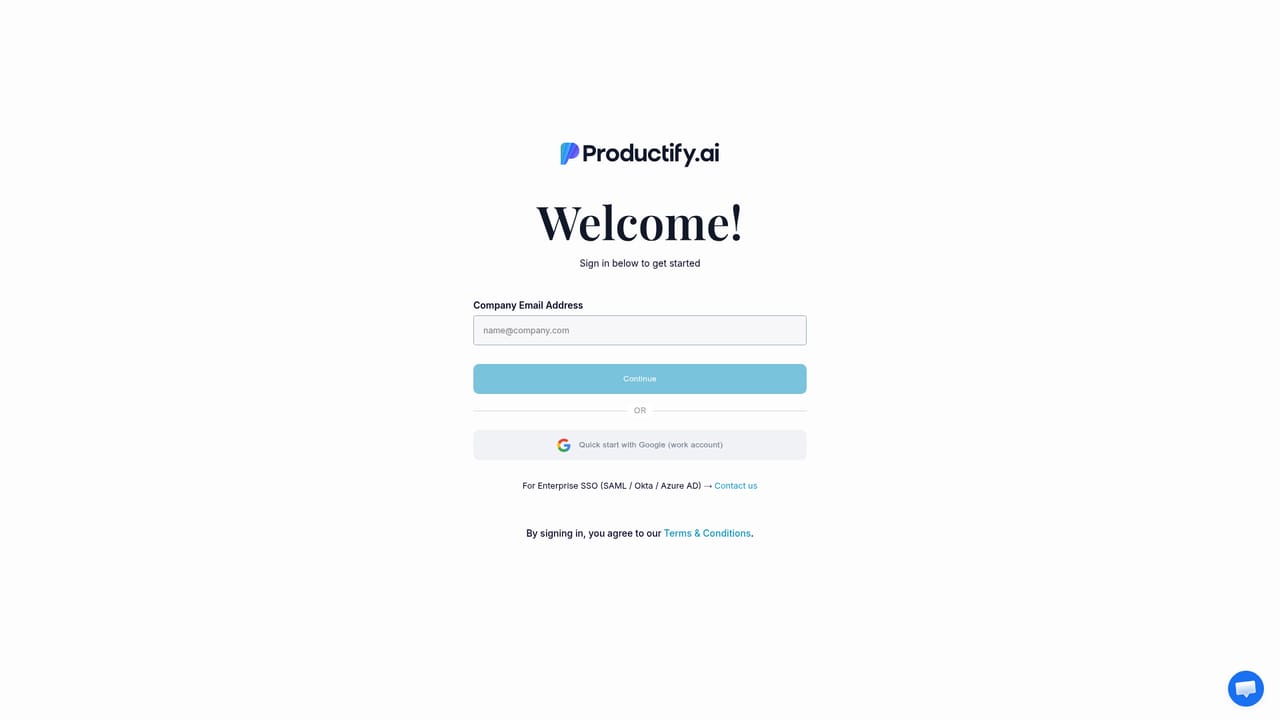
  4. 4Sign in and prepare a batch
    Log in to the platform, upload product images or packaging assets into a batch and confirm the raw inputs and extraction targets.
    Productify — Sign in and prepare a batch
  5. 5Run extraction and review confidence scores
    Process the batch, inspect the JSON output for each product and check the AI confidence score before accepting generated descriptions and category paths.
  6. 6Wire up the API in your pipeline
    Once outputs look right, connect your PIM or internal tooling using the REST API and webhooks so new SKUs flow through automatically.

Pros and cons

Pros

  • Purpose-built for product data rather than generic text generation, so outputs match catalogue fields teams actually needAI
  • Covers the full enrichment chain: OCR extraction, categorisation, nutrition, copywriting, SEO keywords and translationAI
  • API-first with REST and webhooks, which allows ingestion to slot into existing PIM and internal toolingAI
  • Credit-based usage pricing with no per-seat fees and no charges for inactive accountsAI
  • White-label and embed options make it viable for agencies reselling catalogue servicesAI

Cons

  • No self-serve trial is described on the homepage, so evaluation runs through a sales conversationAI
  • The API-first model assumes engineering capacity that smaller merchandising teams may not haveAI
  • Categorisation and regulatory claims are not backed by published accuracy benchmarks or sample outputsAI
  • Credit pricing is tied to operations, which makes cost forecasting harder for teams with spiky catalogue volumesAI
  • Most feature and compliance detail sits behind documentation rather than on public pagesAI

How much does Productify cost?

Pricing

Credit-based model aligned to data operations, aimed at agencies, platforms and enterprises with variable workloads. The homepage states there are no hidden monthly fees for inactive accounts, no per-seat licensing (unlimited team members included) and volume discounts for enterprise commitments. Exact credit rates are on the pricing page.

Learn more

Support

Support and onboarding begin with a conversation with the sales and solutions team via the contact page; public API documentation is available for technical evaluation.

Learn more

Integrations

API-first architecture with a REST API and webhooks for embedding into PIM platforms and internal tooling. White-label and embedded deployment are offered, and custom integrations are available through the contact team.

Learn more

Features

Marketing copy, Google and GS1 aligned categorisation, feature and benefit bullets, nutritional data extraction, back-of-pack data capture, table digitisation from images, short descriptions, OCR text extraction, SEO keywords, summaries and translation. Processing runs as an ingestion, regulatory alignment, enrichment and integration pipeline with confidence scoring on outputs.

Frequently asked questions about Productify

  • How much does Productify cost?
    Credit-based model aligned to data operations, aimed at agencies, platforms and enterprises with variable workloads. The homepage states there are no hidden monthly fees for inactive accounts, no per-seat licensing (unlimited team members included) and volume discounts for enterprise commitments. Exact credit rates are on the pricing page.
  • Does Productify have an API?
    Yes, Productify offers an API.
  • How do you use Productify?
    The walkthrough on this page covers 6 steps: 1. Review the platform and documentation 2. Talk to the sales team 3. Check pricing and volume terms 4. Sign in and prepare a batch 5. Run extraction and review confidence scores 6. Wire up the API in your pipeline.
  • What platforms does Productify support?
    Productify is available on Web App.
  • What does Productify integrate with?
    API-first architecture with a REST API and webhooks for embedding into PIM platforms and internal tooling. White-label and embedded deployment are offered, and custom integrations are available through the contact team.
  • What are the limitations of Productify?
    No self-serve trial is described on the homepage, so evaluation runs through a sales conversation. The API-first model assumes engineering capacity that smaller merchandising teams may not have. Categorisation and regulatory claims are not backed by published accuracy benchmarks or sample outputs.

Status

StatusActive
Views0
Outbound clicks0
Added10/21/2026

Platforms

Web App

Pricing

PaidSubscription