Sage Cooking

AI recipe generator that writes chef-level dishes to your taste

Beginner
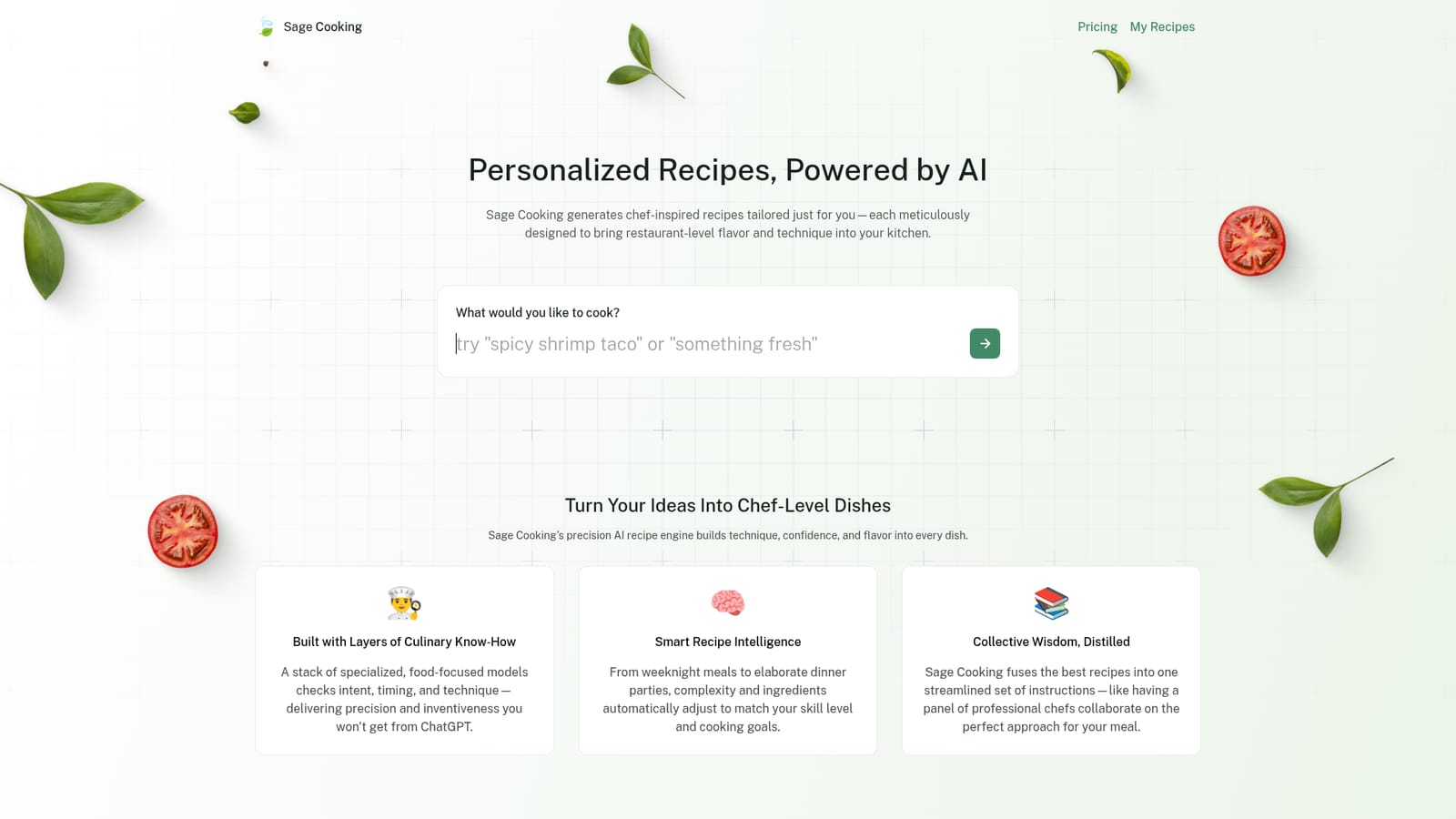
Screenshot of Sage Cooking, AI recipe generator that writes chef-level dishes to your taste

What is Sage Cooking?

Sage Cooking is an AI recipe generator built on a stack of food-specific models. It produces chef-style recipes with scaled quantities and technique, adapting complexity to your skill level, and can exclude ingredients or scale to large batches. Shared recipe pages let you revisit and pass on results.

Sage Cooking is an AI recipe generator that turns a plain idea (an ingredient, a craving, a dietary constraint) into a full, structured recipe written in professional kitchen language. The homepage positions it as a step above general chatbots: instead of one general model improvising a dish, a stack of food-focused models reviews intent, timing and technique before the recipe is produced. The builder is designed to add culinary knowledge at each layer rather than just remix existing text. The engine adapts complexity and ingredient lists to the cook. A weeknight pasta and a multi-component dinner party plate come out of the same prompt surface, with instructions scaled to the stated skill level and goal. Sage Cooking also describes a consensus approach: it fuses the strongest available versions of a dish into one streamlined set of instructions, framed as several chefs collaborating on the method rather than copying a single source. In practice the tool behaves like a private recipe developer. You describe what you want to cook, and the output is a named dish with quantities and step-by-step method. The public gallery shows the range: allium-free braises, a corn chowder scaled to 60 servings, restaurant-style lamb loin with pea and feta salad, Swedish cardamom buns, and cocktails such as The Crimson Pine 75. Scaling to volume and excluding ingredients are both handled in the prompt, so catering and allergy work do not need a separate workflow. Shared recipe pages give each result a permalink that can be sent to other cooks. Alternatives fall into two groups: static recipe sites with search but no generation, and general chat assistants that will write a recipe but often mishandle ratios, timing and allergen substitutions. Sage Cooking sits between them. The trade-off is density: the models optimise for technique and precision, so the output reads like a chef's spec rather than a friendly blog post, and cooks who want photos, stories or community comments will find it sparse. There is no public information on subscription tiers or connected services.

How do you use Sage Cooking?

  1. 1Open the generator
    Go to the Sage Cooking homepage and find the prompt field asking what you would like to cook. No account details are shown until you start generating.
    Sage Cooking — Open the generator
  2. 2Describe the dish and the constraints
    Type the dish you want plus any hard limits, such as an ingredient to avoid, a serving count or a skill level. Specific prompts get the model stack better results.
  3. 3Review the method before cooking
    Read the generated timings and technique notes with care. Check that quantities match your pan size and that every ingredient in the list appears in the steps.
  4. 4Compare against the public gallery
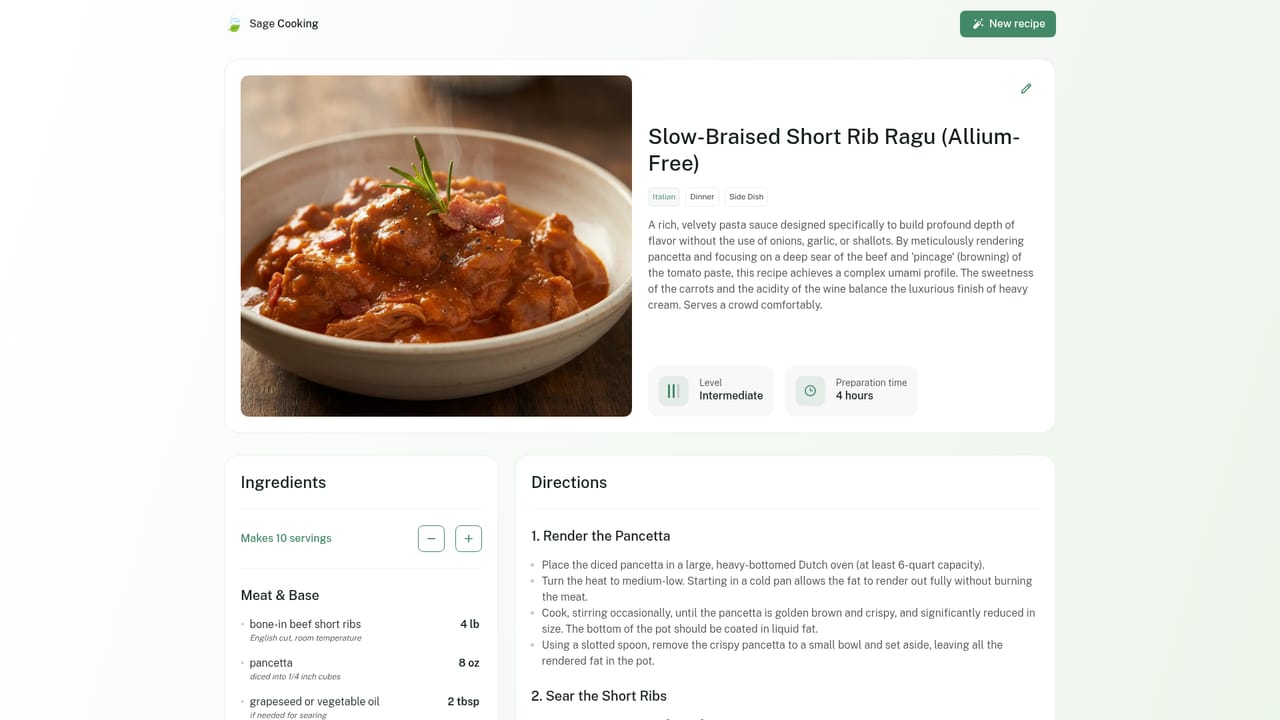
    Browse recently created recipes to see the level of detail to expect and to pick up prompt patterns that work, such as allium-free or large-batch phrasing.
    Sage Cooking — Compare against the public gallery
  5. 5Share or revisit the recipe
    Each result has its own recipe page URL. Save that link to return to the dish later or send it to someone else who will be cooking.

Pros and cons

Pros

  • Food-specific model stack checks intent, timing and technique instead of relying on one general chatbotAI
  • Automatically scales complexity and quantities, from a weeknight meal to a 60-serving batchAI
  • Handles exclusion requests cleanly, with published allium-free versions showing the filtration worksAI
  • Each generated recipe gets a permalink that can be shared or revisited laterAI
  • Covers a wide range: pasta, braises, seafood, baking and cocktailsAI

Cons

  • No pricing, free-tier or account details are published on the homepage, so cost is unknown before signing upAI
  • Outputs are written in terse chef language, which can be heavy going for beginner cooksAI
  • No nutritional analysis or macro data is advertised for the generated recipesAI
  • The public sharing features appear limited to viewing pages, with no stated collaboration or commenting toolsAI
  • Recipe quality depends entirely on the prompt; vague input is likely to produce generic resultsAI

How much does Sage Cooking cost?

Features

The core feature is a precision recipe engine backed by a stack of specialized food models that check intent, timing and technique. Recipes adapt in complexity and ingredient list to the cook's skill level and goals, and recurring dishes are merged into one streamlined instruction set. Every recipe has a public page, and browsing other users' generated dishes is built into the homepage.

Frequently asked questions about Sage Cooking

  • How do you use Sage Cooking?
    The walkthrough on this page covers 5 steps: 1. Open the generator 2. Describe the dish and the constraints 3. Review the method before cooking 4. Compare against the public gallery 5. Share or revisit the recipe.
  • What platforms does Sage Cooking support?
    Sage Cooking is available on Web App.
  • What are the limitations of Sage Cooking?
    No pricing, free-tier or account details are published on the homepage, so cost is unknown before signing up. Outputs are written in terse chef language, which can be heavy going for beginner cooks. No nutritional analysis or macro data is advertised for the generated recipes.

Status

StatusActive
Views0
Outbound clicks0
Added10/22/2026

Platforms

Web App

Pricing

Freemium