Sixfold

Underwriting AI that reads submissions, scores risk and recommends the next best action

Advanced
Screenshot of Sixfold, Underwriting AI that reads submissions, scores risk and recommends the next best action

What is Sixfold?

Sixfold is an AI underwriting agent for P&C and life and health carriers. It reads submission documents, scores risk with cited evidence, checks appetite and portfolio fit, and recommends the next action, while underwriters retain the final decision.

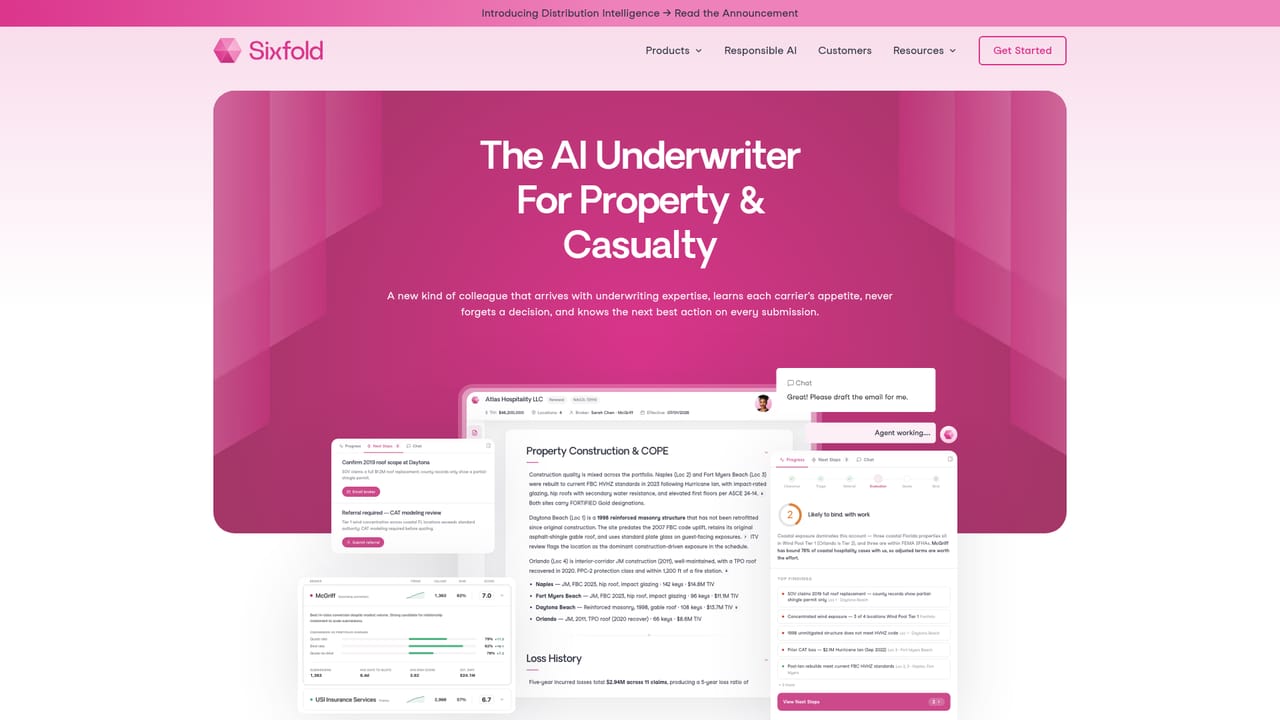
Sixfold is an underwriting AI platform built for commercial property and casualty insurers as well as life and health carriers. Rather than a general purpose model wrapped in an insurance interface, it ships with underwriting reasoning already in place: what to look for in a submission, how to work through a risk, and what a sound underwriting decision looks like. Carriers then teach it their own appetite so recommendations reflect book strategy rather than generic rules. On the P&C side, the agent ingests complex submission documents such as loss runs and statements of values, then scores each risk using explainable signals where every fact is cited back to its source. It evaluates appetite and portfolio fit on every submission and recommends the next best action to move a case forward. On the life and health side, the agent reviews prescription histories, lab results and driving records, surfaces key impairments with a suggested next step, and aligns its rationale to the carrier's underwriting guidelines. Underwriters keep the final call in both lines. The product is aimed at underwriting teams at insurers and managing general agents, not at individual consumers. Practical value shows up in the parts of the job underwriters must do anyway: gathering documents, chasing outstanding items and summarizing submissions. Sixfold also offers a distribution intelligence module and publishes research on AI adoption across the underwriting workforce. Among underwriting AI vendors, Sixfold positions itself on depth of domain reasoning and on governance. It publishes an annual responsible AI report and commentary on regulation such as the EU AI Act, and it invests in human oversight rather than full automation. Named customers include Zurich North America, AXIS, Generali GC&C, Skyward Specialty and Guardian. Pricing is not published on the site, so commercial terms come through a demo conversation rather than self serve checkout.

How do you use Sixfold?

  1. 1Request a demo and scope your lines of business
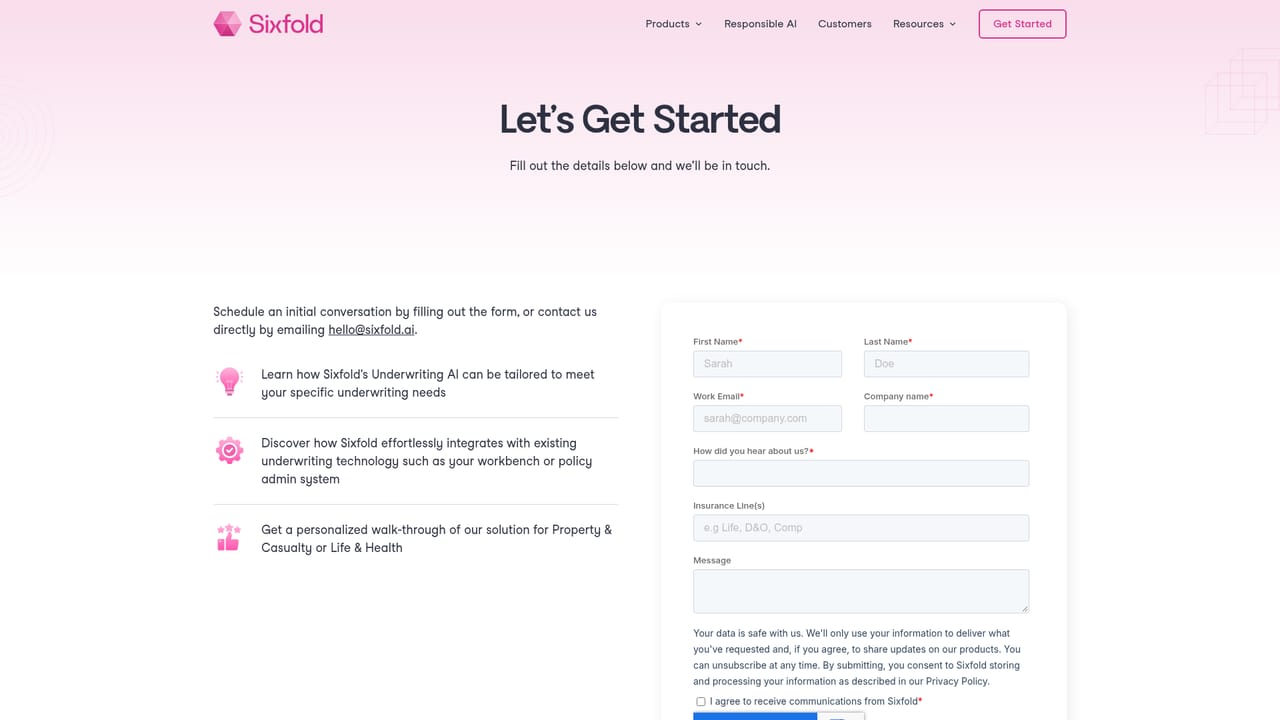
    Start on the contact page to book a walkthrough. Come prepared with the lines you write and the submission types you want assessed, whether that is commercial property, casualty, or life and health case review.
    Sixfold — Request a demo and scope your lines of business
  2. 2Review the product track that matches your book
    Read the P&C or life and health product page so the demo focuses on your workflow. The P&C track centers on submission documents and risk scoring, while the L&H track centers on case analysis and impairment review.
    Sixfold — Review the product track that matches your book
  3. 3Read a customer case study before the technical session
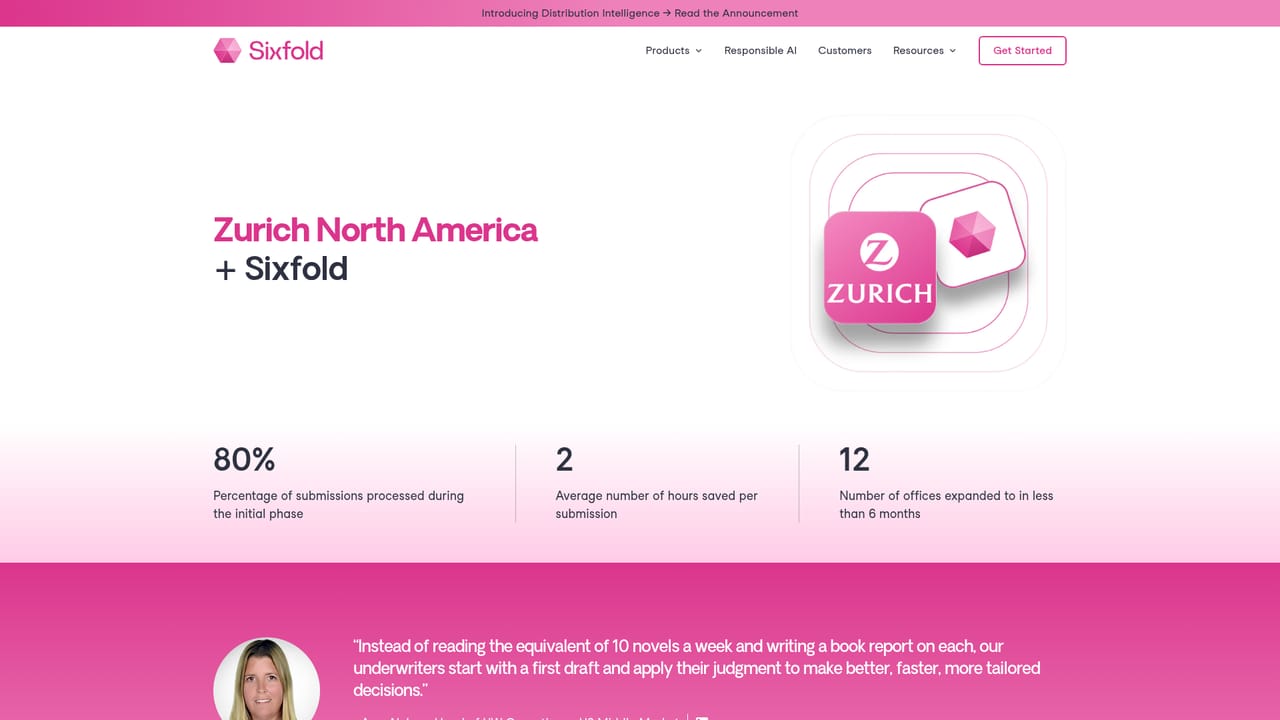
    Case studies from Zurich, AXIS and Generali GC&C show how carriers framed the rollout and what changed in underwriting operations. Pick the one closest to your size and lines.
    Sixfold — Read a customer case study before the technical session
  4. 4Validate governance and regulatory fit
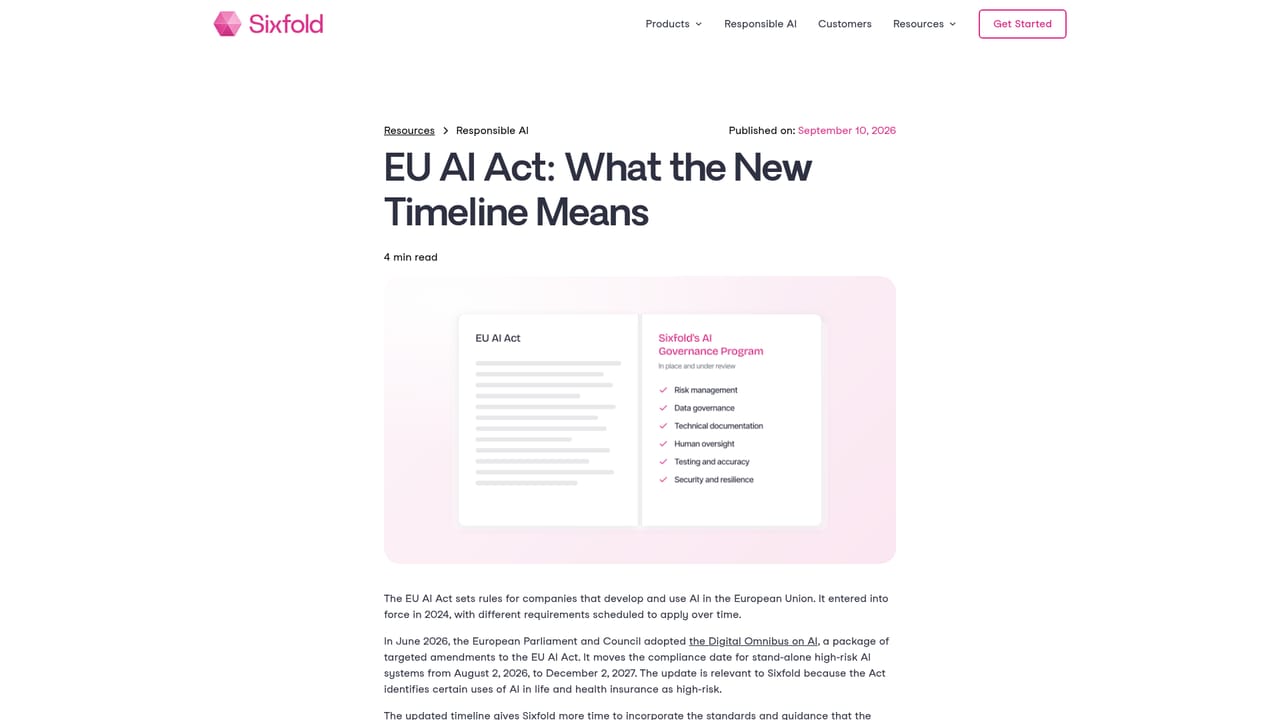
    Bring your compliance and model risk stakeholders to the follow up. The EU AI Act timeline post and the responsible AI report explain how Sixfold addresses human oversight, fairness and data governance.
    Sixfold — Validate governance and regulatory fit
  5. 5Configure appetite and pilot on live submissions
    After contracting, the implementation centers on teaching the agent your appetite and guidelines, then running a supervised pilot where underwriters review and own every recommendation before wider rollout.

Pros and cons

Pros

  • Preloaded underwriting reasoning means teams are not training a generic model from scratchAI
  • Every risk factor is cited to source documents, which supports explainable decisions and audit reviewAI
  • Covers both commercial P&C and life and health rather than a single line of businessAI
  • Appetite learning lets a carrier encode its own book strategy instead of relying on generic rulesAI
  • Public responsible AI reporting and named insurer references give buyers something concrete to evaluateAI

Cons

  • No published pricing, so cost can only be established through a sales conversationAI
  • Built for insurance carriers and MGAs, which makes it unusable for individuals or small non-insurance teamsAI
  • Homepage gives no detail on implementation timelines, data migration effort or required IT involvementAI
  • Integration specifics with policy admin and rating systems are not documented publiclyAI
  • Smaller carriers may find the enterprise sales motion and governance overhead disproportionate to their volumeAI

How much does Sixfold cost?

Features

P&C submissions are read and scored with cited, explainable signals, appetite and portfolio fit are evaluated per submission, and a next best action is recommended. Life and health cases are analyzed across prescription, lab and driving records, with impairments surfaced and rationale aligned to underwriting guidelines. Governance features include human oversight and a published responsible AI program.

Learn more

Frequently asked questions about Sixfold

  • How do you use Sixfold?
    The walkthrough on this page covers 5 steps: 1. Request a demo and scope your lines of business 2. Review the product track that matches your book 3. Read a customer case study before the technical session 4. Validate governance and regulatory fit 5. Configure appetite and pilot on live submissions.
  • What platforms does Sixfold support?
    Sixfold is available on Web App.
  • What are the limitations of Sixfold?
    No published pricing, so cost can only be established through a sales conversation. Built for insurance carriers and MGAs, which makes it unusable for individuals or small non-insurance teams. Homepage gives no detail on implementation timelines, data migration effort or required IT involvement.

Status

StatusActive
Views0
Outbound clicks0
Added10/21/2026

Platforms

Web App

Pricing

Paid