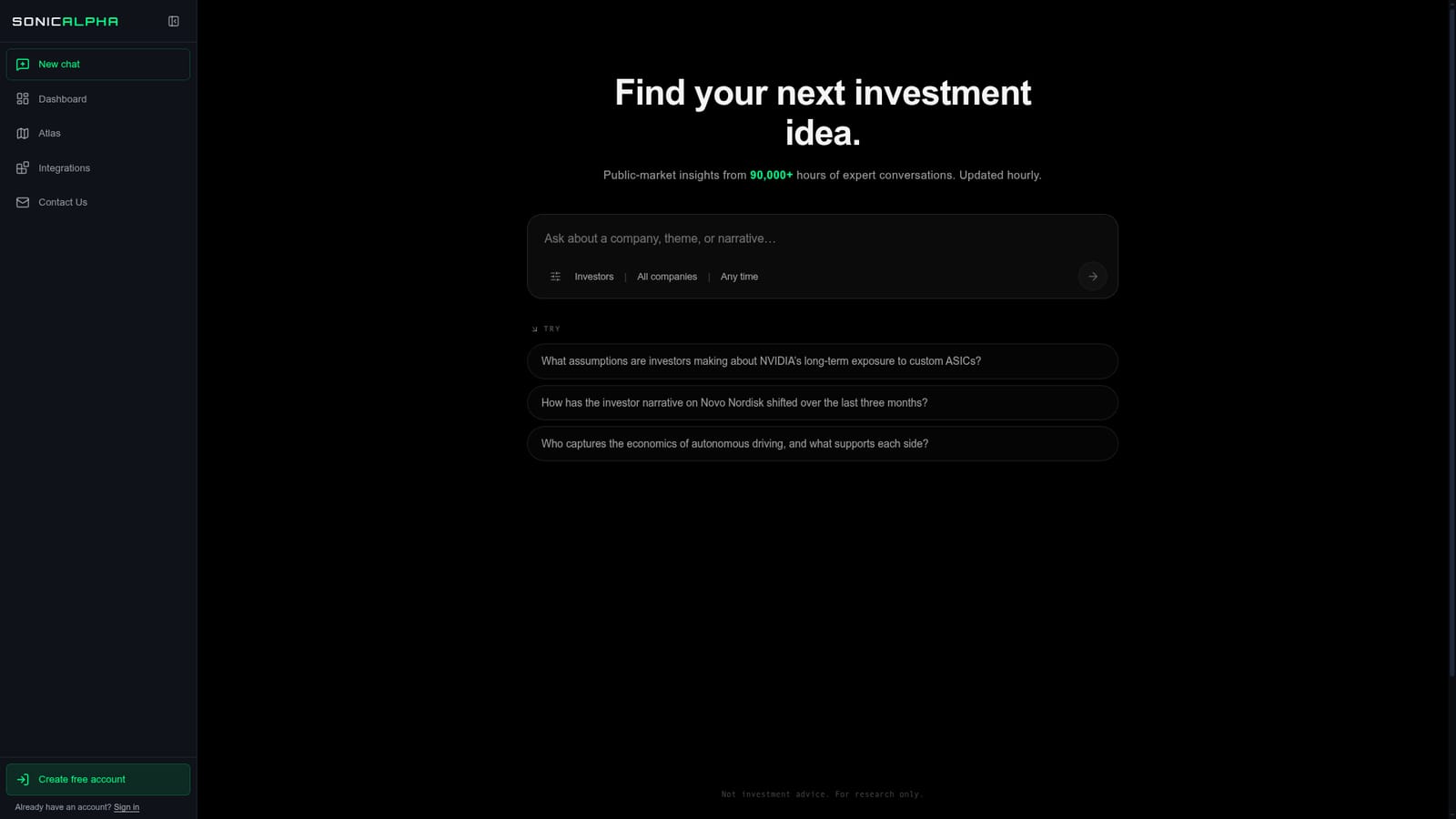
SonicAlpha is a question answering tool. SonicAlpha answers investing questions with cited briefs built from a large archive of expert podcast conversations, refreshed hourly. Filters for speaker group, company and time period help investors track narratives and generate ideas.
SonicAlpha is a research tool for public-market investors who want to see what experts are actually saying about a company, sector or theme. Its source material is a large archive of expert conversations, described as more than 90,000 hours of audio, refreshed hourly. Instead of asking users to listen to episodes or skim transcripts, it answers a typed question with a cited brief built from those podcasts.
The interface is a single search-style prompt with three selectors beside it. One chooses the speaker group (the default shown is Investors), one narrows the scope to all companies or a particular name, and one sets the time window, with "Any time" as the default. The sample questions on the homepage show the intended use: what assumptions investors hold about NVIDIA's long-term exposure to custom ASICs, how the narrative around Novo Nordisk has shifted over three months, and who captures the economics of autonomous driving and what evidence backs each side. These are questions about sentiment, debate and changing opinion rather than price quotes or raw financial data.
In practice the tool suits analysts, portfolio managers, retail investors and students who use qualitative research to generate ideas or test a thesis. The time filter makes it possible to track how a narrative moves, and the citations let a reader return to the original conversation to check context before relying on a point. The homepage states plainly that output is not investment advice and is meant for research only.
Among alternatives, SonicAlpha sits between general AI chat assistants, which lack a curated and current expert-audio corpus, and traditional terminals or news aggregators, which centre on headlines, filings and numbers. Its narrow focus on podcast commentary is both its distinguishing feature and its boundary: it complements quantitative screeners and filings analysis rather than replacing them. An account is available through the sign-in link, though the homepage gives no detail on plans or pricing.