Switch

An AI teammate that knows the where and the when of your fleet

Intermediate API
Screenshot of Switch, An AI teammate that knows the where and the when of your fleet

What is Switch?

Switch builds Myles, an agentic AI teammate for fleet and logistics operators. It answers operational questions in plain language, forecasts with stated confidence, and then acts: rebalancing, routing and planning on your city's real data. Covers 3,800+ cities and 350M trips per month.

Switch is the company behind Myles, an agentic AI teammate built for fleet and logistics operators in urban mobility. Rather than bolting a chatbot onto a dashboard, Myles is designed to answer operational questions in plain language and then carry out the resulting actions, either on demand or on a recurring schedule. The product is aimed at ops leads, planners and analysts running shared fleets, micromobility schemes or logistics operations who need fast answers without writing a query or building a report. The core of the product rests on two ideas the vendor calls the where and the when. On the where side, Myles carries the structure of a city: zones, depots, service areas, access windows and infrastructure constraints. On the when side, it holds weekly rhythms, seasonal shifts and weather correlations drawn from operational history. The site cites coverage of more than 3,800 cities and 350 million trips modelled per month, with over 500 live data feeds ingested and a claimed 30 seconds or less from question to answer. Myles grades its own certainty on forecasts and states that confidence alongside the number. In practice the workflow runs in four stages. Operators connect their feeds or start on sample city data, ask a question the way they would ask a sharp colleague, receive both an answer and a proposed next move, then let Myles execute or schedule the work every morning or shift. The stated job families are analytics (idle time, utilisation, shortages, trends), forecasting, operations (rebalancing, routing, pickup priorities) and planning (fleet sizing, breakeven, CO2 and station placement simulated on the operator's own city). Switch positions Myles against general assistants such as ChatGPT, Gemini, Claude and Grok, arguing that a general model has read about mobility but has never been on the road. The pitch is specificity: your city's topology and your fleet's history instead of a generic answer. That makes it a niche tool for mobility and logistics teams rather than a general productivity assistant, and it is still being onboarded through a waitlist.

How do you use Switch?

  1. 1Join the waitlist
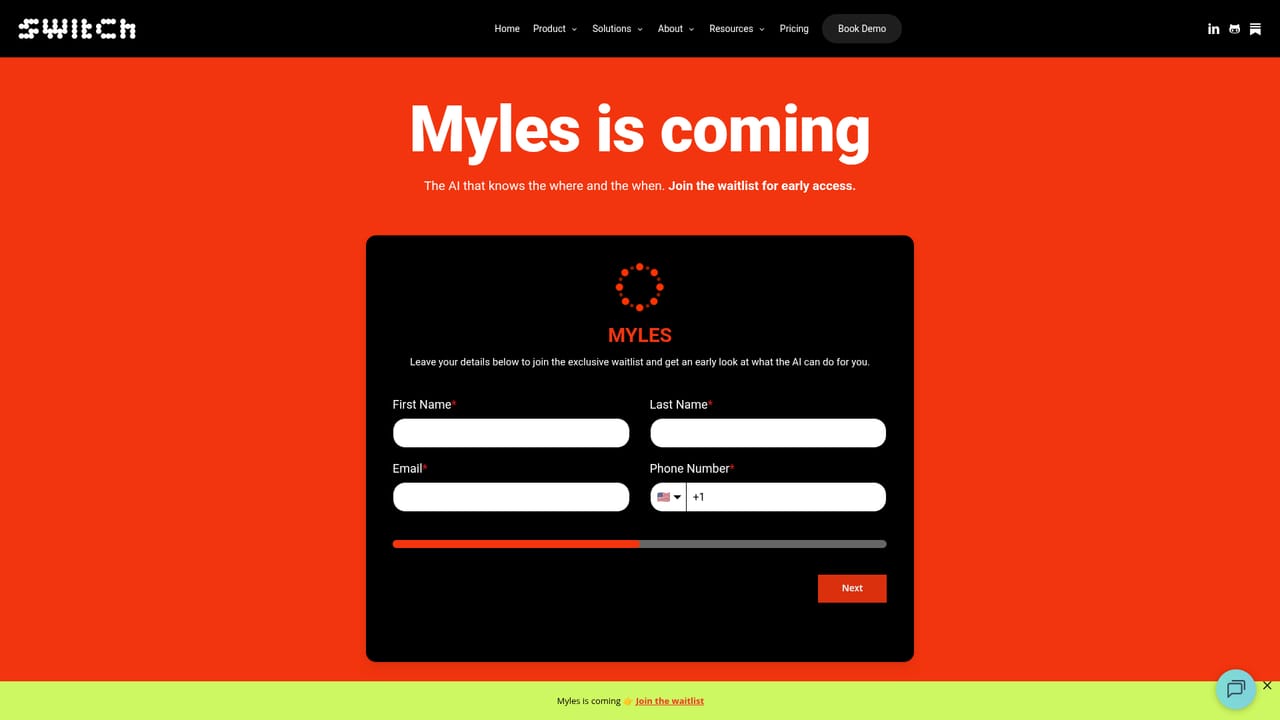
    Myles is onboarding through a waitlist. Submit your details to register interest and get access to the agent.
    Switch — Join the waitlist
  2. 2Book a demo
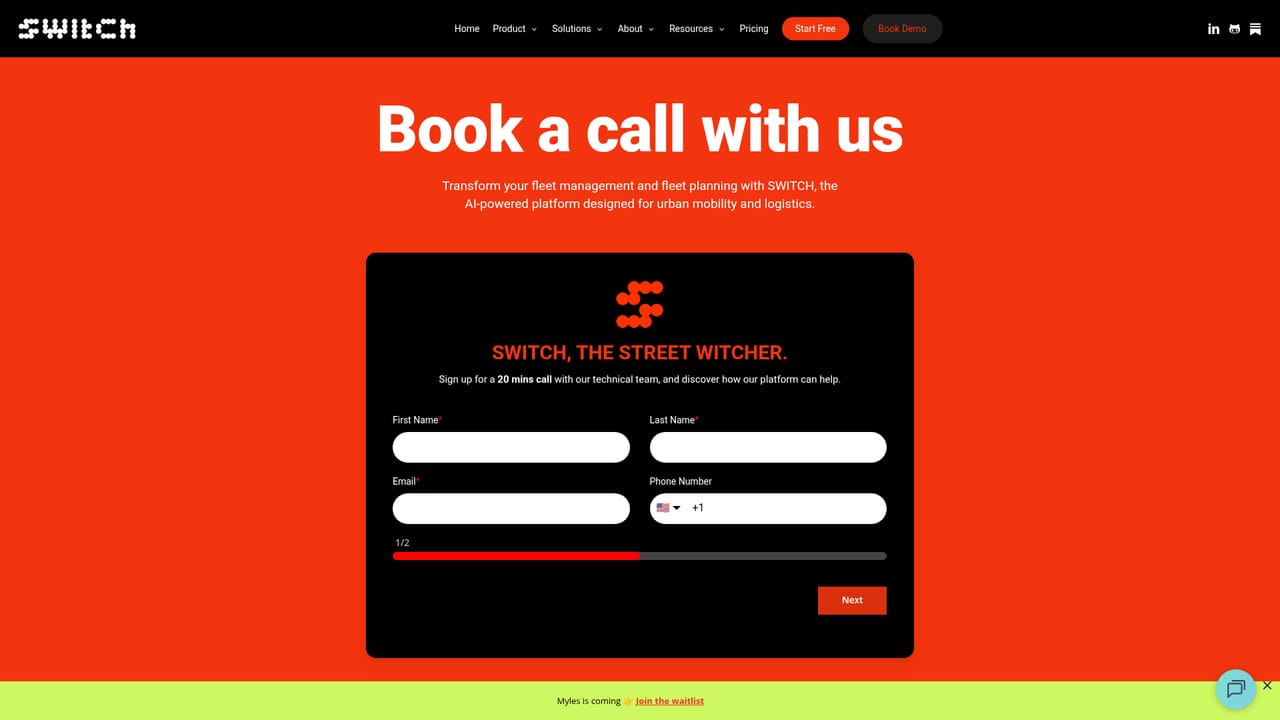
    If you would rather see the platform against your own operation first, book a walkthrough with the Switch team.
    Switch — Book a demo
  3. 3Connect your feeds or use sample data
    Once inside, plug in your operational feeds or start on sample data drawn from 3,800+ cities. The vendor says this takes minutes, not an integration project.
  4. 4Ask your first question
    Type a question the way you would ask an ops lead, for example about idle time or vehicle shortages. No query language is involved.
  5. 5Review the answer and the proposed action
    Myles returns the answer with a chart where relevant, plus a recommended next move such as a rebalancing or routing plan.
  6. 6Schedule it to run
    Set Myles to repeat the job every morning or shift, and let it build skills around your operation over time.

Pros and cons

Pros

  • Answers operational questions in plain language with no query language or dashboard build requiredAI
  • Acts on its answers rather than stopping at insight, and can run scheduled jobs each morning or shiftAI
  • Carries city-level context (zones, depots, access windows) plus historical and weather patterns instead of generic model outputAI
  • Forecasts declare their own confidence level, which makes results easier to challenge before actingAI
  • Onboarding can start on sample data from 3,800+ cities, so no integration project is needed to evaluate itAI

Cons

  • Product is gated behind a waitlist, so availability and time to access are not guaranteedAI
  • Entry Pro tier is capped at 50+ cities and 25 airports, and full city coverage plus API access sits in custom Enterprise pricingAI
  • No published details on data residency, model training practices or how customer operational data is handledAI
  • Value depends heavily on the quality and completeness of the feeds you connect, and no connector list is publishedAI
  • Pricing for Enterprise is quote-only, which makes budget comparison against established fleet platforms difficultAI

How much does Switch cost?

Pricing

Two tiers are listed. Pro costs $29 per month self-serve and includes all four job families plus autonomy, unlimited questions and vehicles, 50+ cities, 25 airports and credit top-ups. Enterprise is custom priced and adds full integrations, custom models, optimisation and simulation, the full 3,800+ cities, API access, white-glove onboarding, SSO and an SLA.

Learn more

Support

Enterprise includes white-glove onboarding and an SLA. Pro is self-serve. General contact is available by email, and the company also publishes on LinkedIn, GitHub and Substack.

Integrations

Full integrations are listed only on the Enterprise tier. The homepage states that no integration is needed to start, since operators can begin on sample city data before connecting their own feeds. No named third party connectors are published.

Features

Four stated job families: analytics (idle time, utilisation, shortages and trends, returned with charts already drawn), forecasting with self-graded confidence, operations (rebalancing, routing and pickup priorities turned into plans Myles can execute) and planning (fleet sizing, breakeven, CO2 and station placement simulated on your city). Sits on 3,800+ cities of operational context, 500+ live data feeds and 350M trips modelled per month, with scheduled autonomous runs.

Learn more

Frequently asked questions about Switch

  • How much does Switch cost?
    Two tiers are listed. Pro costs $29 per month self-serve and includes all four job families plus autonomy, unlimited questions and vehicles, 50+ cities, 25 airports and credit top-ups. Enterprise is custom priced and adds full integrations, custom models, optimisation and simulation, the full 3,800+ cities, API access, white-glove onboarding, SSO and an SLA.
  • Does Switch have an API?
    Yes, Switch offers an API.
  • How do you use Switch?
    The walkthrough on this page covers 6 steps: 1. Join the waitlist 2. Book a demo 3. Connect your feeds or use sample data 4. Ask your first question 5. Review the answer and the proposed action 6. Schedule it to run.
  • What platforms does Switch support?
    Switch is available on Web App.
  • What does Switch integrate with?
    Full integrations are listed only on the Enterprise tier. The homepage states that no integration is needed to start, since operators can begin on sample city data before connecting their own feeds. No named third party connectors are published.
  • What are the limitations of Switch?
    Product is gated behind a waitlist, so availability and time to access are not guaranteed. Entry Pro tier is capped at 50+ cities and 25 airports, and full city coverage plus API access sits in custom Enterprise pricing. No published details on data residency, model training practices or how customer operational data is handled.

Status

StatusActive
Views0
Outbound clicks0
Added10/21/2026

Platforms

Web App

Pricing

FreemiumSubscriptionPaid