Integrations
Connects commerce, pricing and promotions, inventory and supply chain, CRM, marketing, finance and ERP systems, plus external data such as market trends, weather and events, into one model.
Learn moreCommercial intelligence for enterprise retail pricing, promotions and stock
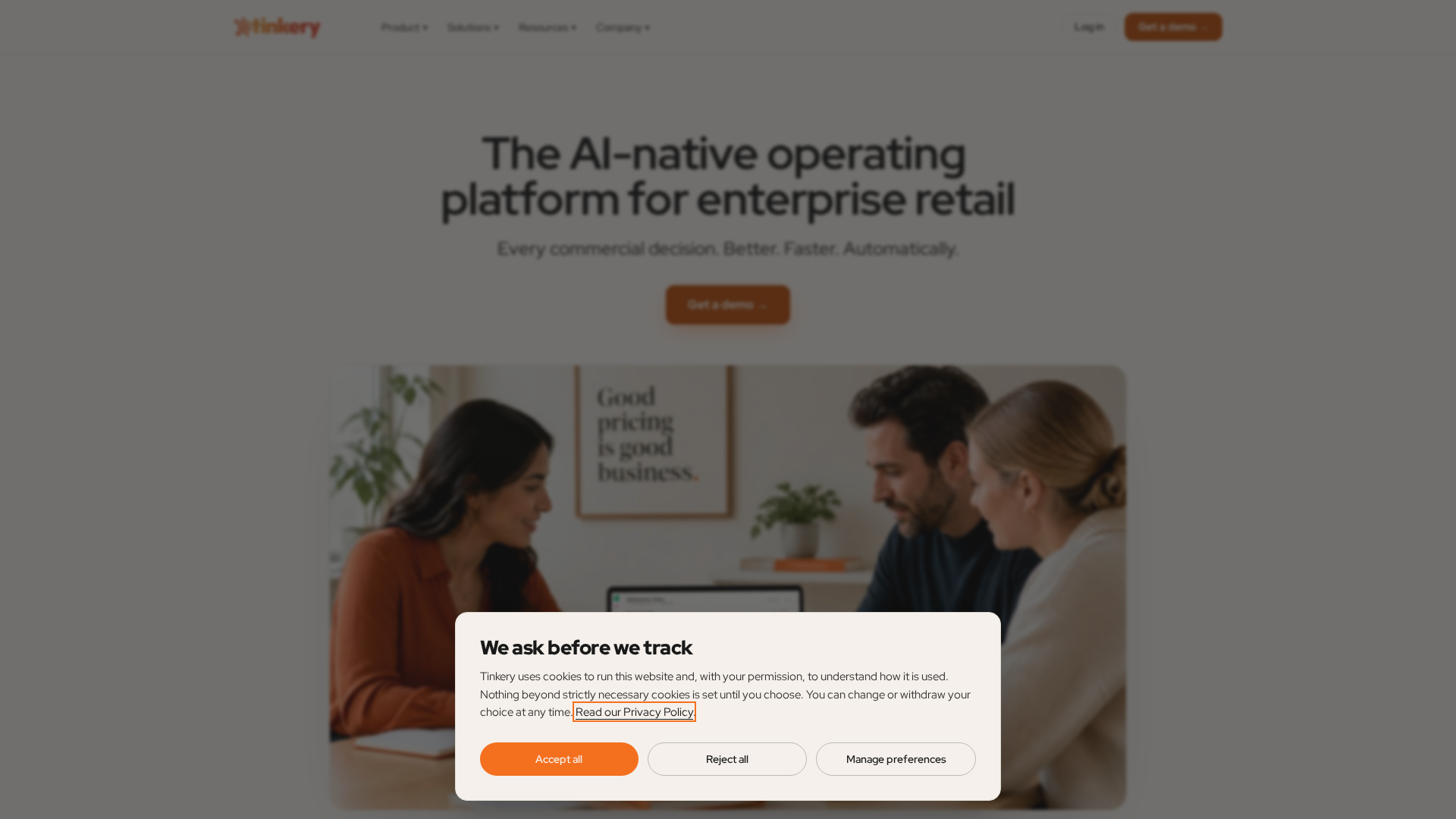
Tinkery is an AI platform for enterprise retail that unifies commercial data, recommends pricing, promotion and inventory actions with quantified impact, and executes approved decisions with humans in control.
Tinkery is a commercial intelligence platform aimed at enterprise retailers that need to make pricing, promotion and inventory decisions faster and with less manual analysis. Rather than presenting another reporting dashboard, it builds a single model of the business from ERP, commerce, CRM, marketing, inventory and finance data, then uses that model to find problems, quantify them and propose a specific action. The homepage walks through a worked example that shows the intended loop. The platform flags slow-moving SKUs by urgency and shows the capital they tie up, along with the cost of inertia (COI). It then diagnoses one product against its category's sales velocity and compares discount scenarios (conservative, recommended and aggressive) by units sold, COI avoided and net benefit. Once a discount is approved and applied, it tracks units sold against target and reports the final impact on freed working capital and margin. The product is organized in three layers: Commercial Context, which reconciles data into one model; Decision Intelligence, which recommends the next best action with reasoning; and Agentic Orchestration, which coordinates execution across pricing, promotions and inventory. Approvals stay human-in-the-loop, and the system learns from the outcome of each cycle. Use cases cover promotion performance (separating true lift from cannibalization and pull-forward), pricing intelligence (elasticity, competitive posture and guardrails) and inventory performance (risk cohorts, markdown timing and sell-through). Dedicated pages target chief commercial officers, merchandising, pricing, inventory and ecommerce directors. The company cites margin gains of 3 to 5 percent, promotion ROI up 20 percent and 90 percent less reporting effort, though these are vendor claims rather than independent results. Among alternatives, it sits between traditional retail analytics suites and standalone price optimization or promotion planning tools, positioning itself as a connected system that also executes decisions. Access starts with a sales-led demo on the buyer's own categories and systems.
Connects commerce, pricing and promotions, inventory and supply chain, CRM, marketing, finance and ERP systems, plus external data such as market trends, weather and events, into one model.
Learn moreUnified commercial model, continuous opportunity detection, quantified action recommendations, human approval workflows, autonomous execution across pricing, promotions and inventory, scenario comparison, live tracking against targets, and outcome learning.
Learn more AI Angels400+ customizable AI girlfriends for NSFW chat, voice calls, and roleplay
 Candy AIExperience the future of companionship with AI friends who chat, role-play, and connect with you on a human level.
 ourdream.aiA vast AI roleplay platform with millions of characters for chat, images, video and voiceAI Angels400+ customizable AI girlfriends for NSFW chat, voice calls, and roleplayCandy AIExperience the future of companionship with AI friends who chat, role-play, and connect with you on a human level.ourdream.aiA vast AI roleplay platform with millions of characters for chat, images, video and voice