Pricing
Plans start at $19 per year and the AI Blogger is included with every plan. Monthly AI credits come with the subscription and can be topped up at any time. Cancellation is permitted at any point.
Learn moreAn AI travel writer that refuses to invent your trip

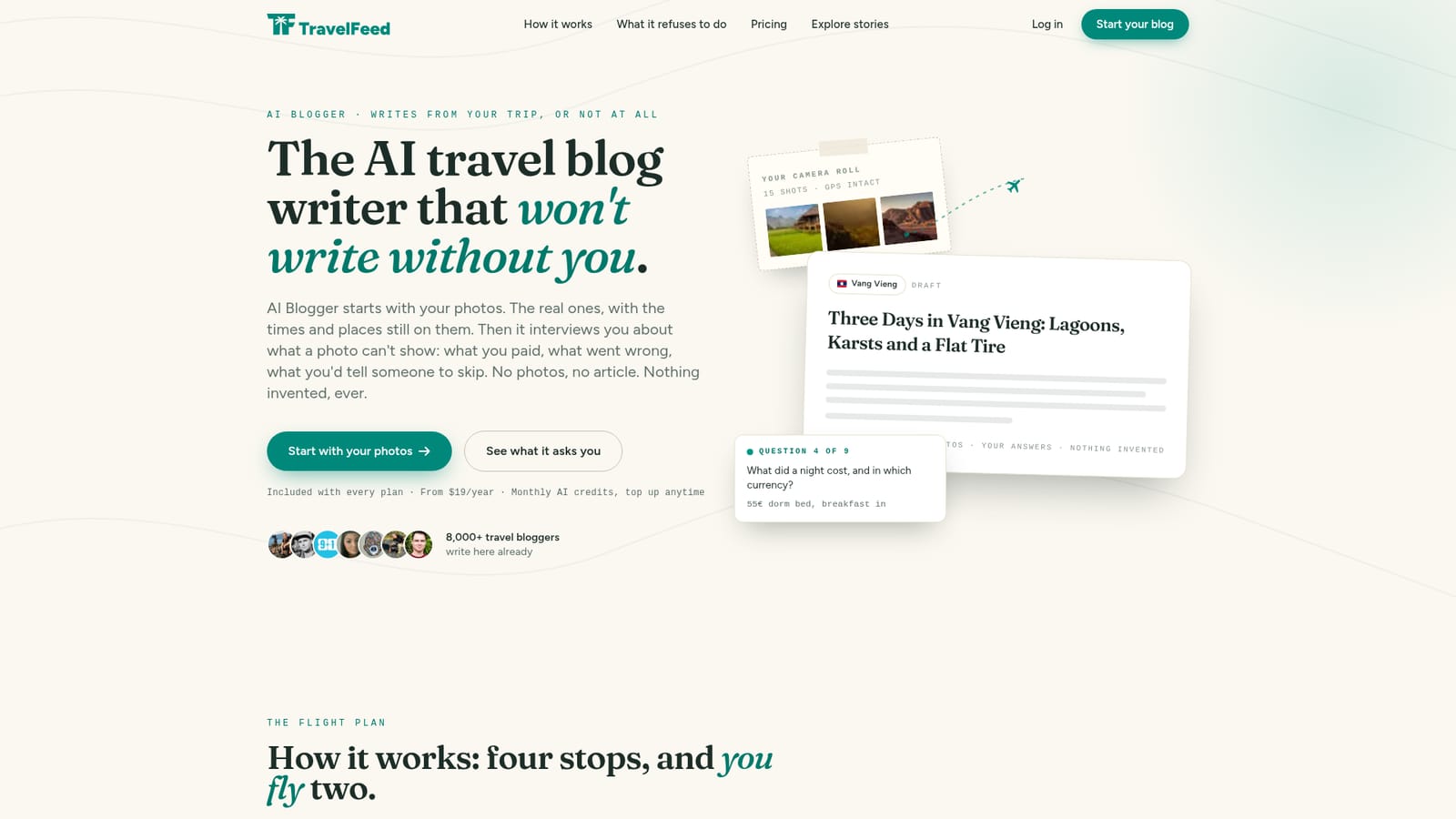
TravelFeed is an autoblogger tool. An AI travel blog writer that builds articles from your own geotagged photos plus a nine question interview about prices, mistakes and skips. It refuses to write from a destination name alone, flags missing facts instead of inventing them, and structures drafts for search with headings, FAQs and placed captions.
TravelFeed's AI Blogger is a writing tool built around a single constraint: it will not produce an article without your photographs. Upload shots straight from a phone or camera, GPS and timestamps intact, and the system reconstructs the sequence of the trip from that metadata. Feed it a bare destination name and it declines. The premise is that travel content earns trust through specifics (what a room cost, which route was a dead end, what deserved skipping), and a language model cannot supply those from memory without fabricating them. After reading the photos, the tool runs a structured interview of roughly nine questions about the things a picture cannot capture. It asks about nightly rates and currency, mistakes worth warning others about, and places that were not worth the time or money. Anyone who kept a trip diary can paste it and have most answers populated automatically. The whole intake is presented as a fifteen minute job, with a five photo minimum and fifteen recommended for a substantial piece. From there the user selects an angle from several candidate article concepts, each tied to a search intent the uploaded material can actually support. Sections can be reordered or removed before drafting. The output arrives in an editor with photos placed and captioned, headings shaped around search queries, a table of contents, an FAQ block, galleries and internal links. Gaps in the record show up as flags rather than guesses, and any detail verified on the web comes back as a sourced proposal the writer accepts or rejects individually. The draft also mimics the cadence of the user's two most recent posts, and nothing publishes without explicit approval. The tool suits working travel bloggers and photographers who already produce trip content and want to cut drafting time without publishing generic filler. It is a poor fit for anyone hoping to generate destination guides from a keyword alone, since that use case is deliberately blocked. Magic Maps, a secondary feature in the same tab, turns a list of visited places into a route map for embedding. TravelFeed itself has hosted travel blogs since 2018 and reports more than 8,000 writers on the platform.
Plans start at $19 per year and the AI Blogger is included with every plan. Monthly AI credits come with the subscription and can be topped up at any time. Cancellation is permitted at any point.
Learn morePhoto driven article generation using GPS and timestamps, a nine question interview about costs and mistakes, selectable article angles tied to search intent, and drafts with placed captions, FAQ blocks, tables of contents and internal links. Missing facts appear as flags, web checked details arrive with sources, and voice matching follows your two most recent posts. Magic Maps builds route maps from a list of places.
 AI Angels400+ customizable AI girlfriends for NSFW chat, voice calls, and roleplay
 Candy AIExperience the future of companionship with AI friends who chat, role-play, and connect with you on a human level.
 ourdream.aiA vast AI roleplay platform with millions of characters for chat, images, video and voiceAI Angels400+ customizable AI girlfriends for NSFW chat, voice calls, and roleplayCandy AIExperience the future of companionship with AI friends who chat, role-play, and connect with you on a human level.ourdream.aiA vast AI roleplay platform with millions of characters for chat, images, video and voice


