Vocabulift

Broadcast video analysis: speech, screen and music rights on one timeline

Advanced API
Screenshot of Vocabulift, Broadcast video analysis: speech, screen and music rights on one timeline

What is Vocabulift?

Vocabulift is a language learning tool. Strata by Vocabulift analyses broadcast and archive video on one millisecond timeline: word-timed transcripts in 43 languages, speaker separation, translation into 35 languages, shot and logo detection, on-screen text, and music rights matching with cue sheet export.

Vocabulift is listed as a language learning tool, and its own site notes that a related product has been on the market since 2023 by Webinson, the Košice software company behind it. The homepage supplied here describes Strata, a media intelligence service from the same team that reads a programme on a single millisecond timeline: what was said and by whom, in which language, what the picture showed, and which music played along with the rights data behind it. The speech layer is the most developed. Transcripts are timed word by word with a confidence value per word, speakers are separated without prior enrolment, and the language of each sentence is tagged so bulletins that switch languages remain readable. Lexicons supplied by the user feed corrections and entities, the model adds people, organisations, places, events, works, products and dates, and topics follow a taxonomy the customer defines. Translation covers 35 languages, with 43 recognised for input, Slovak and English among them. The vision layer describes shots and scene boundaries, classifies shot types (presenter, interview, report, control room), and detects logos, objects, people and actions through a self-hosted vision-language model, each with a probability. On-screen text such as captions, tickers and credits is captured for as long as it stays visible. The rights layer links detected music to recordings, works and parties, validates ISRC, ISWC and IPI check digits, proposes recording-to-work matches with evidence, flags conflicts for human confirmation and produces cue sheets that are exported as CSV, JSON, Excel or XML. It is aimed at broadcasters, archives, media monitoring services and rights societies rather than individual learners. Delivery is self-hosted: the software runs on the vendor's servers in Nuremberg, Germany, under NixOS, or inside the customer's own environment, and no media is sent to an outside AI provider. Everything is reachable through an OpenAPI 3.1 interface with 75 operations, signed webhooks and live progress over server-sent events. Engagement starts with a pilot measured on the customer's own recordings, followed by a licence or a joint development agreement, so neither pricing nor a free tier is published.

How do you use Vocabulift?

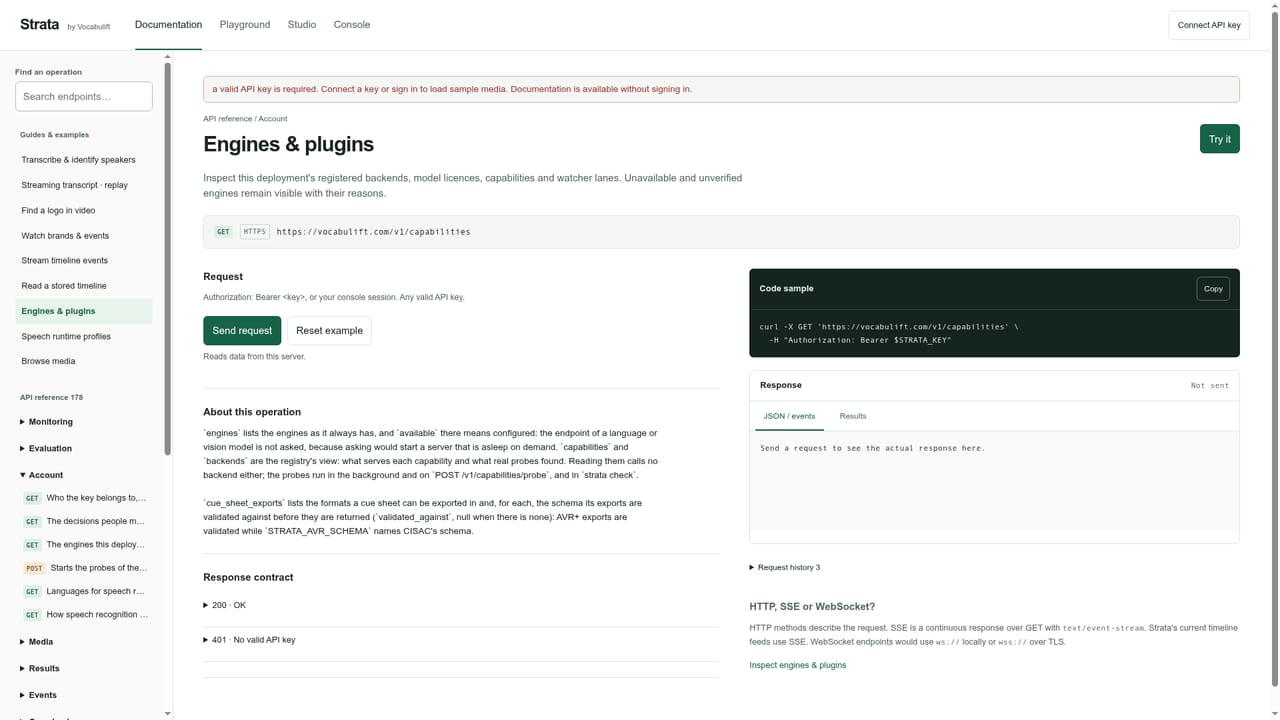
  1. 1Read the API reference
    Start with the documentation to see the 75 operations, the layer model and how errors are reported as RFC 9457 problems.
    Vocabulift — Read the API reference
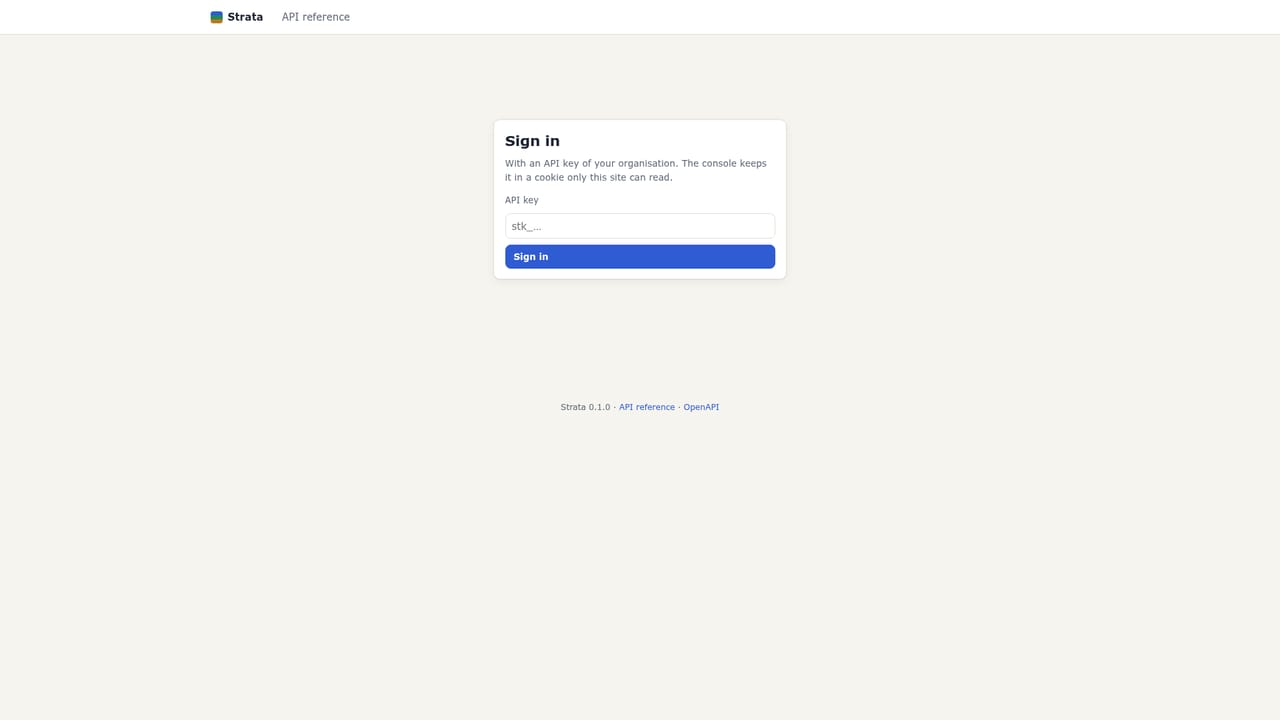
  2. 2Sign in to the console with a key
    The console shows the same media, rights data and cue sheets to people; signing in requires an API key with the right scopes.
    Vocabulift — Sign in to the console with a key
  3. 3Upload a programme
    Send the file as a multipart upload or pass a URL; Strata fetches it, probes it and retries safely when an Idempotency-Key is supplied.
  4. 4Queue an analysis job
    Choose a stored profile or a configuration of your own, then follow the job stages live over server-sent events.
  5. 5Read the timeline and detections
    Pull the merged timeline for speech, translation, entities and topics, or the detections list for logos, objects and on-screen text.
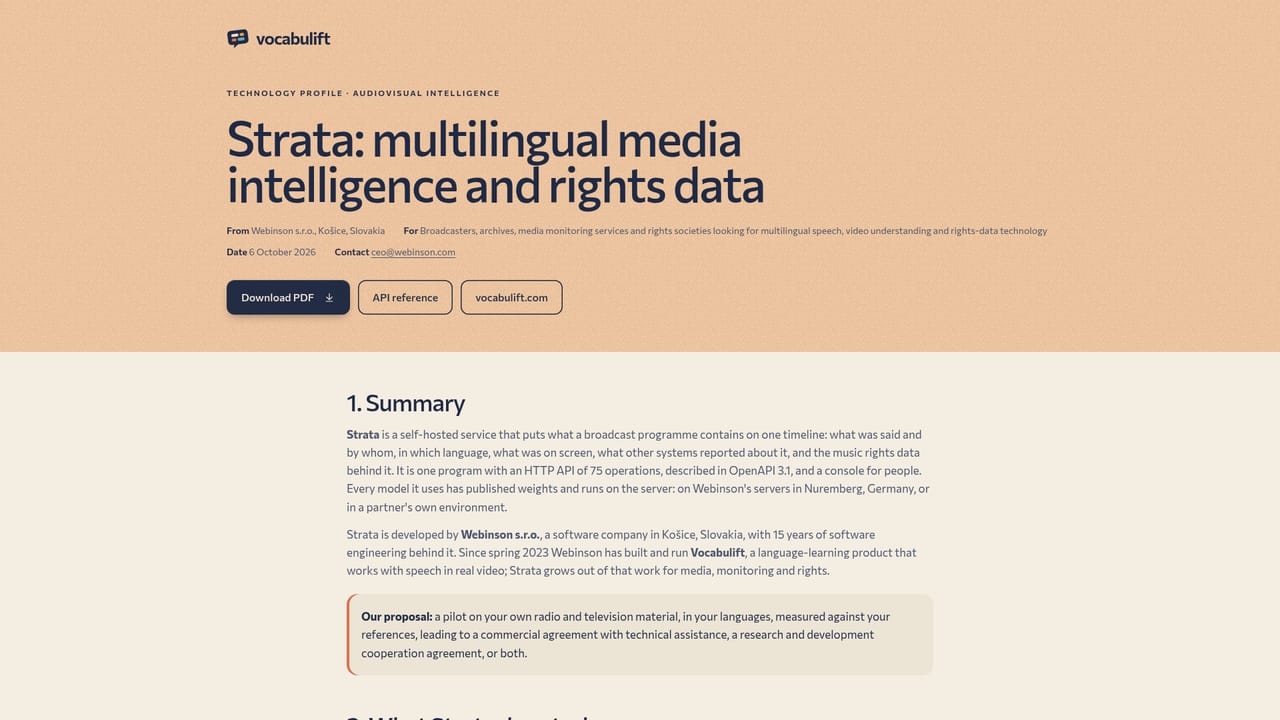
  6. 6Ask about a pilot
    For production use, contact the team through the partnership page to share sample material and get accuracy measured on your recordings.
    Vocabulift — Ask about a pilot

Pros and cons

Pros

  • One shared clock means speech, picture and rights data can be cross-checked against each other rather than stitched together afterwardsAI
  • 43 input languages and translation into 35 cover European broadcasters that switch languages mid-programmeAI
  • Self-hosted open-weight models on servers in Nuremberg, with an option to run inside your own environmentAI
  • Documented API with 75 OpenAPI 3.1 operations, idempotent uploads, SSE progress and signed webhooksAI
  • Rights layer validates ISRC, ISWC and IPI check digits and keeps an audit trail on conflictsAI

Cons

  • No published pricing and no free tier; access runs through a pilot, then a licence or joint development agreementAI
  • The vocabulary here is built for broadcast and archive workflows, so a casual language learner gets little direct use from itAI
  • Everything happens through the API or console; nothing in the material describes a mobile app or consumer study interfaceAI
  • Accuracy on your footage has to be established by measuring against your own reference transcriptsAI
  • Private deployment sizing and integration depend on the vendor's team rather than a self-serve setupAI

How much does Vocabulift cost?

Support

Support is through direct contact with Webinson (email and booking a call via the partnership page), plus a technology profile PDF, an API reference and a published error types page. No help centre or ticket system is described on the homepage.

Learn more

Integrations

An OpenAPI 3.1 HTTP interface with 75 operations, idempotent uploads, server-sent events for job progress and Standard Webhooks signed notifications with HMAC and retries. Exports cover VTT, SRT, text, CSV and JSON, with cue sheets as CSV, JSON, Excel or XML. CWR and DDEX are listed as partner work.

Learn more

Features

Word-timed transcripts with per-word confidence and speaker separation, sentence-level language tagging and translation into 35 languages. Topics from your own taxonomy, entity extraction with customer lexicons. Shot boundaries and shot types, logo, object, person and action detection with probabilities, persistent on-screen text capture. Rights data with validated ISRC, ISWC and IPI identifiers, recording-to-work matching, conflict review and cue sheet export.

Learn more

Frequently asked questions about Vocabulift

  • Does Vocabulift have an API?
    Yes, Vocabulift offers an API.
  • How do you use Vocabulift?
    The walkthrough on this page covers 6 steps: 1. Read the API reference 2. Sign in to the console with a key 3. Upload a programme 4. Queue an analysis job 5. Read the timeline and detections 6. Ask about a pilot.
  • What platforms does Vocabulift support?
    Vocabulift is available on Web App.
  • What does Vocabulift integrate with?
    An OpenAPI 3.1 HTTP interface with 75 operations, idempotent uploads, server-sent events for job progress and Standard Webhooks signed notifications with HMAC and retries. Exports cover VTT, SRT, text, CSV and JSON, with cue sheets as CSV, JSON, Excel or XML. CWR and DDEX are listed as partner work.
  • What are the limitations of Vocabulift?
    No published pricing and no free tier; access runs through a pilot, then a licence or joint development agreement. The vocabulary here is built for broadcast and archive workflows, so a casual language learner gets little direct use from it. Everything happens through the API or console; nothing in the material describes a mobile app or consumer study interface.

Status

StatusActive
Views0
Outbound clicks0
Added10/21/2026

Platforms

Web App

Pricing

Paid