Support
A live Q and A session is offered for introductory questions, bookable through a scheduling link on the AI generator page. No help centre or documentation is referenced on the homepage.
AI writing and SEO tools built into a website builder

Webondemand is a content writing tool. An AI content generator built into the Webondemand website builder, covering blog idea generation, automatic post drafting, keyword and meta description suggestions from a page title, and e-commerce product descriptions. Aimed at small businesses, freelancers and agencies that want writing and SEO handled where the site is edited.
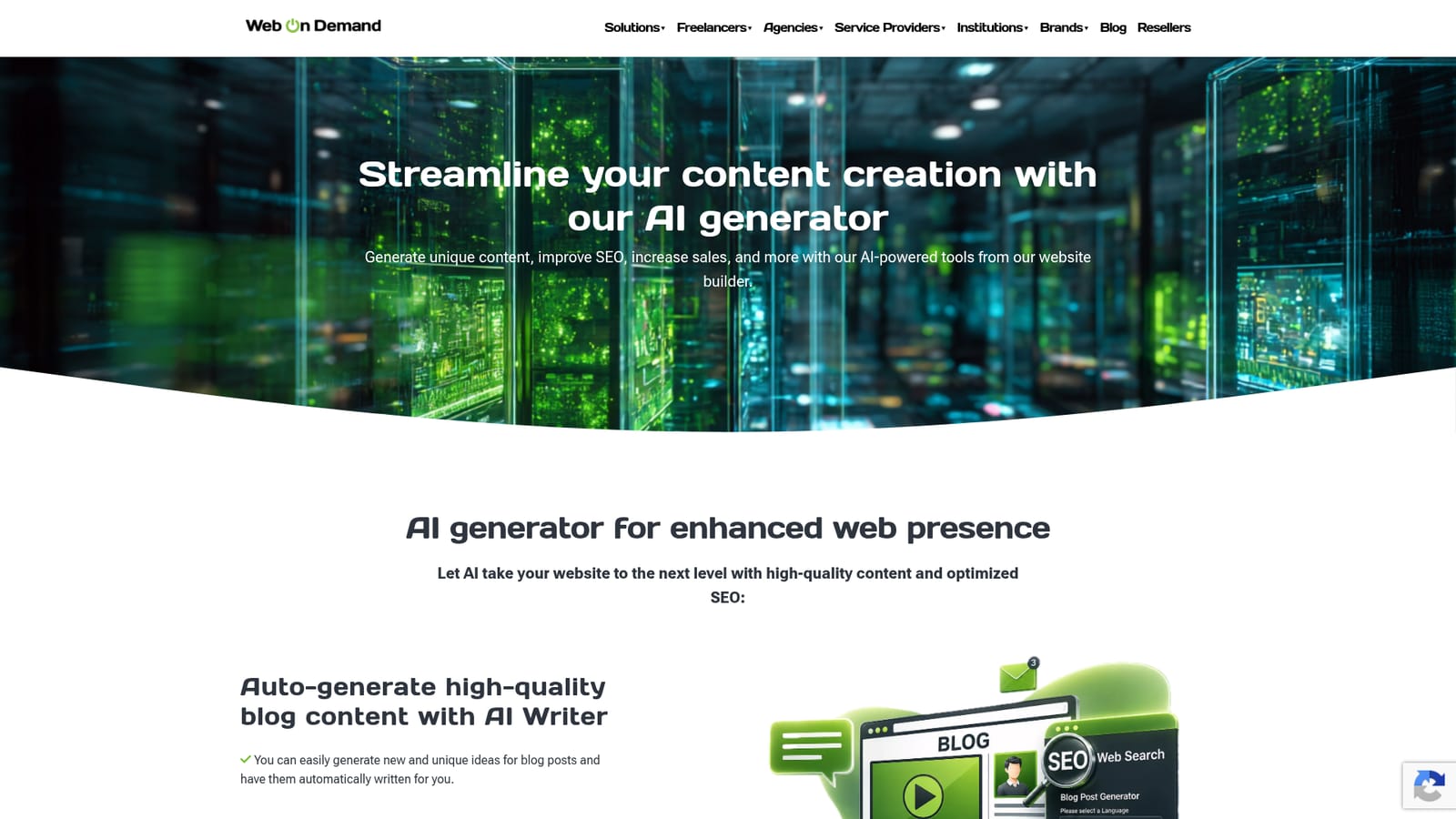
Webondemand bundles an AI content generator into its website builder, aiming at the people who actually maintain small business sites: owners, freelancers and agencies managing client pages. Rather than selling a standalone writing assistant, it treats content as part of the build and maintenance workflow, so blog posts, meta data and product copy can be produced wherever the site itself is edited. The AI Writer is the core piece. A user supplies a short description or prompt, and the system returns a list of candidate blog ideas. After one idea is selected, the generator drafts the full post using natural language processing, which keeps a single prompt from turning straight into a long article the user never chose. The SEO feature works differently: it takes a page title as input and returns suggested keywords and a meta description, a lightweight alternative to dedicated keyword research suites. For e-commerce, the generator produces product descriptions, with the site claiming benefits around search friendliness, uniqueness and conversion. This is where the tool is most practical, since catalog pages often need many short pieces of copy rather than a few long articles. Agencies get the clearest use case: the same account can produce SEO copy for multiple client sites without moving between a builder and a separate AI subscription. The obvious comparison is to standalone AI writers such as Jasper or Copy.ai, or to the AI features that larger site builders have added. Webondemand's advantage is that the writing sits next to publishing, so nothing has to be pasted between tools. The tradeoff is scope: the homepage describes blog ideas, blog drafting, keyword and meta description suggestions, and product descriptions, and nothing beyond that. Teams wanting long form editing, brand voice controls, or bulk generation at scale will likely find the feature set thin compared with dedicated platforms.
A live Q and A session is offered for introductory questions, bookable through a scheduling link on the AI generator page. No help centre or documentation is referenced on the homepage.
Documented features cover an AI Writer that proposes blog ideas from a prompt and then drafts the selected post, an SEO assistant that derives keywords and meta descriptions from a page title, and a generator for e-commerce product descriptions. The homepage also mentions improving conversions and user experience through that copy.
 AI Angels400+ customizable AI girlfriends for NSFW chat, voice calls, and roleplay
 Candy AIExperience the future of companionship with AI friends who chat, role-play, and connect with you on a human level.
 ourdream.aiA vast AI roleplay platform with millions of characters for chat, images, video and voiceAI Angels400+ customizable AI girlfriends for NSFW chat, voice calls, and roleplayCandy AIExperience the future of companionship with AI friends who chat, role-play, and connect with you on a human level.ourdream.aiA vast AI roleplay platform with millions of characters for chat, images, video and voice


