Barie AI

A sovereign AI agent that runs inside your own walls and keeps data egress at zero

Advanced
Screenshot of Barie AI, A sovereign AI agent that runs inside your own walls and keeps data egress at zero

What is Barie AI?

Barie AI is a self-hosted enterprise agent that executes multi-step tasks across your own tools while keeping all customer data inside your infrastructure. It combines a large connector library, model routing, RBAC and single sign-on, and an immutable audit log, aimed at regulated sectors that cannot send data to the cloud.

Barie AI is a general-purpose enterprise agent built around a single premise: the AI comes to your data, and the data never leaves. Instead of subscribing to a dozen separate copilots that each see a fraction of your systems, teams deploy Barie on bare metal, in their own private cloud or virtual private cloud, or on a fully isolated network. From there one agent reasons across every connected system, plans a multi-step task, and carries it out end to end, from pulling Q2 revenue figures out of Google Drive to posting a recap in Slack. The architecture is the product. Every run is scoped by the organization's role-based access controls, authenticated through its single sign-on, and written to an immutable audit log. The vendor states that customer data egress is zero by design, not by policy, and reports that its agent scored 92% on the hardest tier of the GAIA benchmark in the configuration it ships. The platform advertises a connector library of 100,000+ sources spanning SAP, Oracle, Salesforce, Snowflake, ServiceNow, Databricks, Microsoft 365, SharePoint, Workday and Splunk, plus in-house and legacy systems, with access rights inherited from the employee who invoked the task. Internally, a model router sends each subtask to the model that fits it: small fast models for invoice summarization and classification, frontier reasoning models for hard drafting, and a private fine-tune where one exists. A persistent knowledge lake on the customer's own hardware accumulates what each run learns, so the organization builds a private company brain that a competitor cannot copy. Barie targets regulated and high-stakes sectors first: government and defense, legal, finance, healthcare, semiconductors and deep tech, energy, and central banking. It competes less with consumer chat assistants than with suite copilots and cloud agents, and its pitch rests on refusing the usual trade of control for capability. Pricing is not published, and access currently runs through a demo request and waitlist.

How do you use Barie AI?

  1. 1Request a demo and discuss deployment
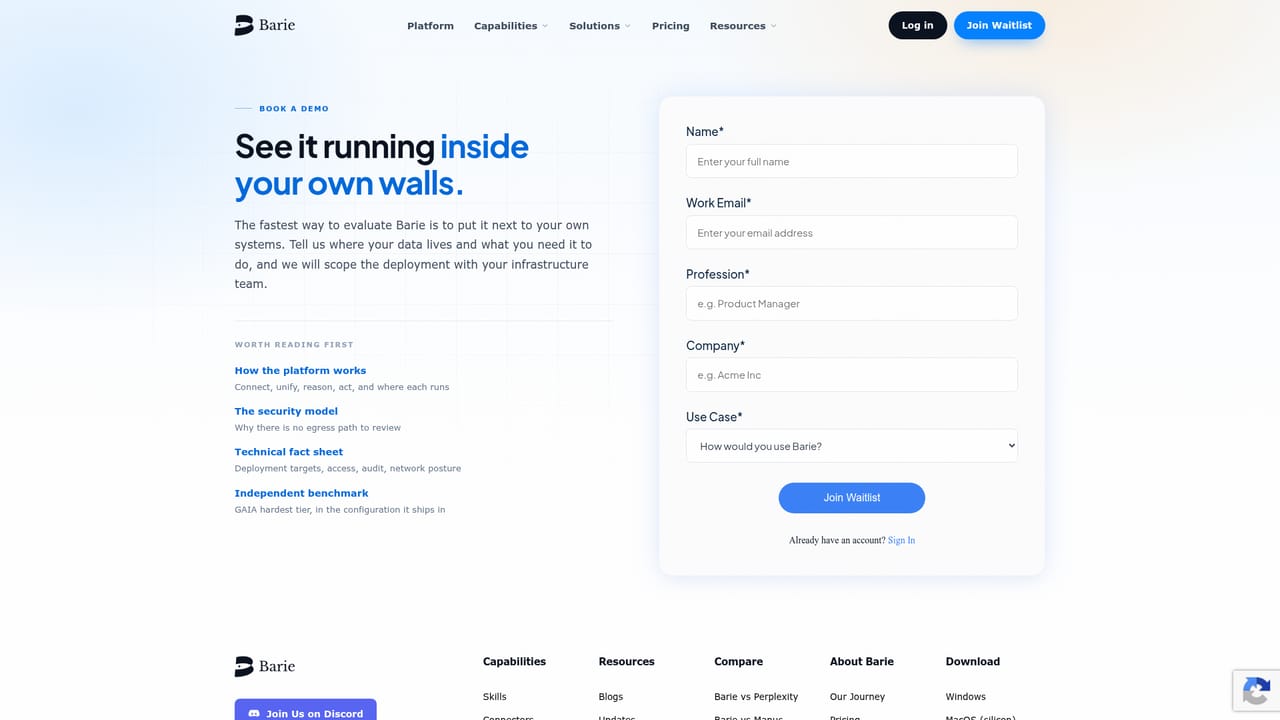
    Start on the waitlist page and book a demo. The conversation covers where Barie would run: your bare metal, your private cloud, your VPC or an isolated network.
    Barie AI — Request a demo and discuss deployment
  2. 2Review the platform architecture
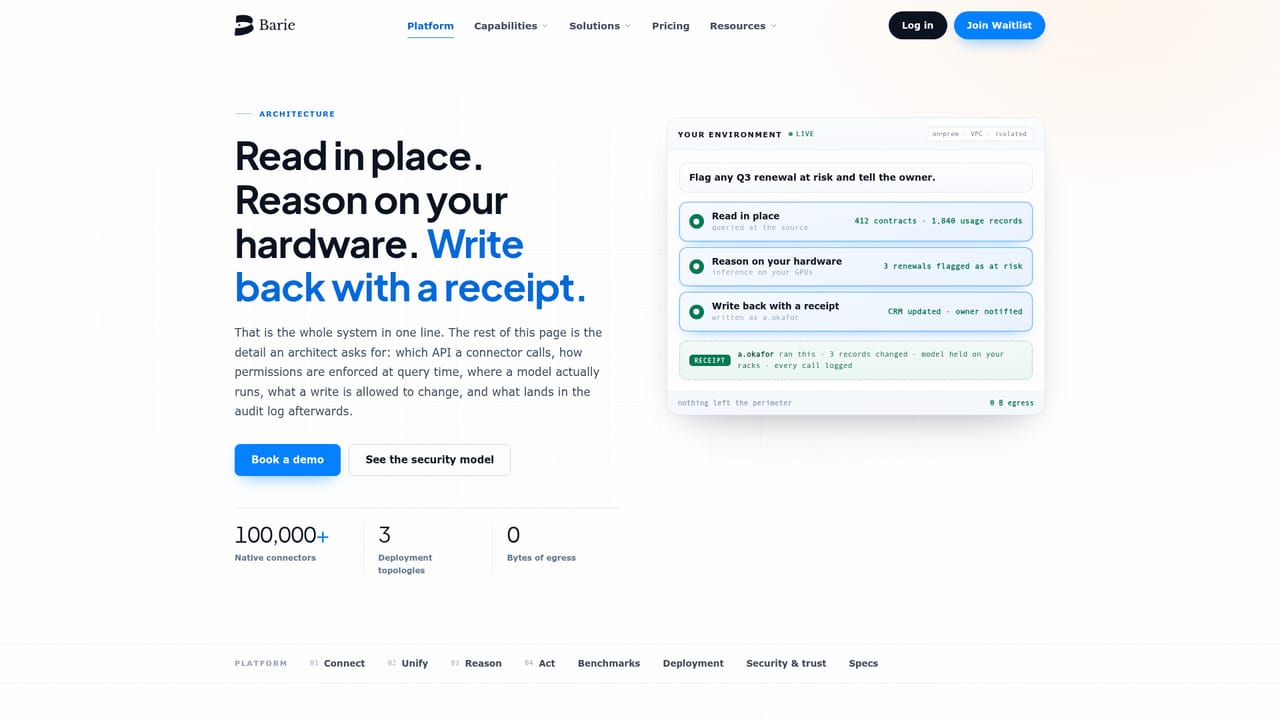
    Read the platform page to understand how the model router, connectors and company brain fit together before committing to an infrastructure plan.
    Barie AI — Review the platform architecture
  3. 3Check the sector example closest to yours
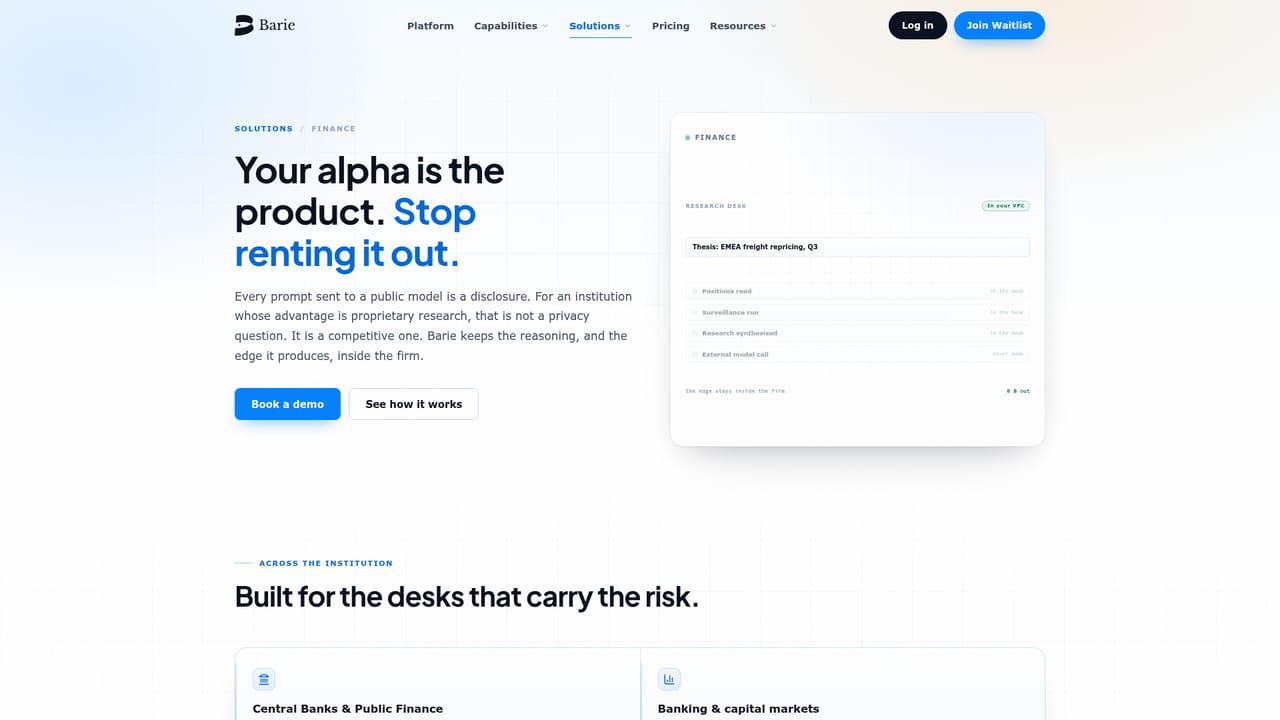
    Each solutions page walks through one industry challenge and how the architecture answers it. Pick the one matching your compliance constraints.
    Barie AI — Check the sector example closest to yours
  4. 4Deploy and connect your tools
    Once deployed, connect the systems you already use through the connector library. Access is inherited from existing employee permissions rather than granted separately.
  5. 5Issue an instruction and audit the run
    Give Barie one plain-language instruction, watch it work through the connected tools step by step, then inspect the immutable audit log for that run.

Pros and cons

Pros

  • Zero customer data egress is enforced by deployment inside your own VPC, private cloud or isolated networkAI
  • One agent reaches across 100,000+ advertised connectors, including SAP, Oracle, Snowflake and legacy mainframesAI
  • Model router assigns routine work to cheap models and reserves frontier reasoning for hard tasksAI
  • Agent permissions inherit employee access rights, so it cannot open what the user could notAI
  • Immutable audit trail and SSO authentication give compliance teams something concrete to reviewAI

Cons

  • No public pricing; every engagement starts with a demo request, which slows evaluationAI
  • Self-hosting on bare metal or a sovereign cloud demands real infrastructure and platform engineering effortAI
  • GAIA score and connector counts come from vendor-reported material with no independent third-party verificationAI
  • Product is positioned around large enterprises, so small teams will find it heavy and likely expensiveAI
  • No API details, trial terms or support tiers are documented on the public siteAI

How much does Barie AI cost?

Pricing

Pricing is not published. The site argues against per-seat subscriptions and describes Barie as one licence covering every seat, with no monthly per-user line at any headcount, running on hardware the customer already owns. Prospective buyers must book a demo for commercial terms.

Learn more

Integrations

The platform advertises 100,000+ connectors, listing Slack, Gmail, Notion, Google Drive, HubSpot, Stripe, Zendesk, Dropbox, Asana, GitHub, Airtable, Zoom and Jira alongside enterprise systems such as SAP, Oracle, Salesforce, Snowflake, ServiceNow, Databricks and Workday.

Learn more

Features

Barie plans and executes multi-step tasks across connected tools from a single instruction. A model router sends each subtask to the cheapest suitable model or a private fine-tune. A persistent on-premises knowledge lake compounds into a private company brain, and every run is governed by RBAC, SSO and an immutable audit log with zero customer data egress.

Learn more

Frequently asked questions about Barie AI

  • How much does Barie AI cost?
    Pricing is not published. The site argues against per-seat subscriptions and describes Barie as one licence covering every seat, with no monthly per-user line at any headcount, running on hardware the customer already owns. Prospective buyers must book a demo for commercial terms.
  • How do you use Barie AI?
    The walkthrough on this page covers 5 steps: 1. Request a demo and discuss deployment 2. Review the platform architecture 3. Check the sector example closest to yours 4. Deploy and connect your tools 5. Issue an instruction and audit the run.
  • What platforms does Barie AI support?
    Barie AI is available on Web App.
  • What does Barie AI integrate with?
    The platform advertises 100,000+ connectors, listing Slack, Gmail, Notion, Google Drive, HubSpot, Stripe, Zendesk, Dropbox, Asana, GitHub, Airtable, Zoom and Jira alongside enterprise systems such as SAP, Oracle, Salesforce, Snowflake, ServiceNow, Databricks and Workday.
  • What are the limitations of Barie AI?
    No public pricing; every engagement starts with a demo request, which slows evaluation. Self-hosting on bare metal or a sovereign cloud demands real infrastructure and platform engineering effort. GAIA score and connector counts come from vendor-reported material with no independent third-party verification.

Status

StatusActive
Views0
Outbound clicks0
Added10/21/2026

Platforms

Web App

Pricing

Paid