Free trial
A 14 day free trial is offered from the homepage, giving access to the summary library before committing to a paid plan. Card requirements and what happens when the trial ends are not stated on the homepage.
Learn moreConcise AI summaries of 10,000+ nonfiction books, in audio, PDF and EPUB

Bookshelf AI is an AI book generator tool. Bookshelf AI distils over 10,000 nonfiction books, podcasts and articles into short analytical summaries, downloadable as audio, PDF or EPUB. Aimed at busy professionals who want to cover more titles, it covers leadership, investing, psychology and philosophy, with author pages and community ratings.
Bookshelf AI is a subscription reading service built around condensed nonfiction. The library covers more than 10,000 titles across books, podcasts and articles, and each entry is rewritten into a short analytical summary rather than a chapter by chapter abstract. The stated editorial approach rests on three ideas: translating dense academic material into plain language, connecting ideas across disciplines, and keeping the prose tight so that every paragraph carries an argument. In practice a reader searches for a title, opens the summary, and reads a distillation that foregrounds the book's central claims. What distinguishes the product from a plain text digest is the delivery format. Summaries can be downloaded as audio, PDF or EPUB, so the same content works on a commute, in a note taking app, or on an e-reader. That flexibility is the main reason the service targets busy professionals, students and managers who want to sample a business or social science title before committing to the full book. The catalogue leans heavily toward nonfiction: leadership, investing (Buffett's Early Investments), workplace culture, psychology, philosophy and memoir. Individual book pages show cover art, subtitle, author and a community star rating, and author pages collect everything by a given writer. It sits in the same market as short form reading apps and classic summary subscription services. Its positioning is closer to an intellectual digest than to a study aid or a note taking tool: there is no workspace, no highlighting layer described on the homepage, and no claim to replace the source text. The editorial framing is aimed at readers who already read nonfiction and want to cover more ground, not at students cramming for an exam. The service claims more than one million customers and shows a 4.2 out of 5 rating from roughly 45,000 reviews, alongside endorsements from finance and productivity personalities. If the goal is to triage a long reading list quickly and keep the audio version for later, Bookshelf AI is a reasonable fit. Readers who want deep annotation tools or a full text library should look elsewhere.
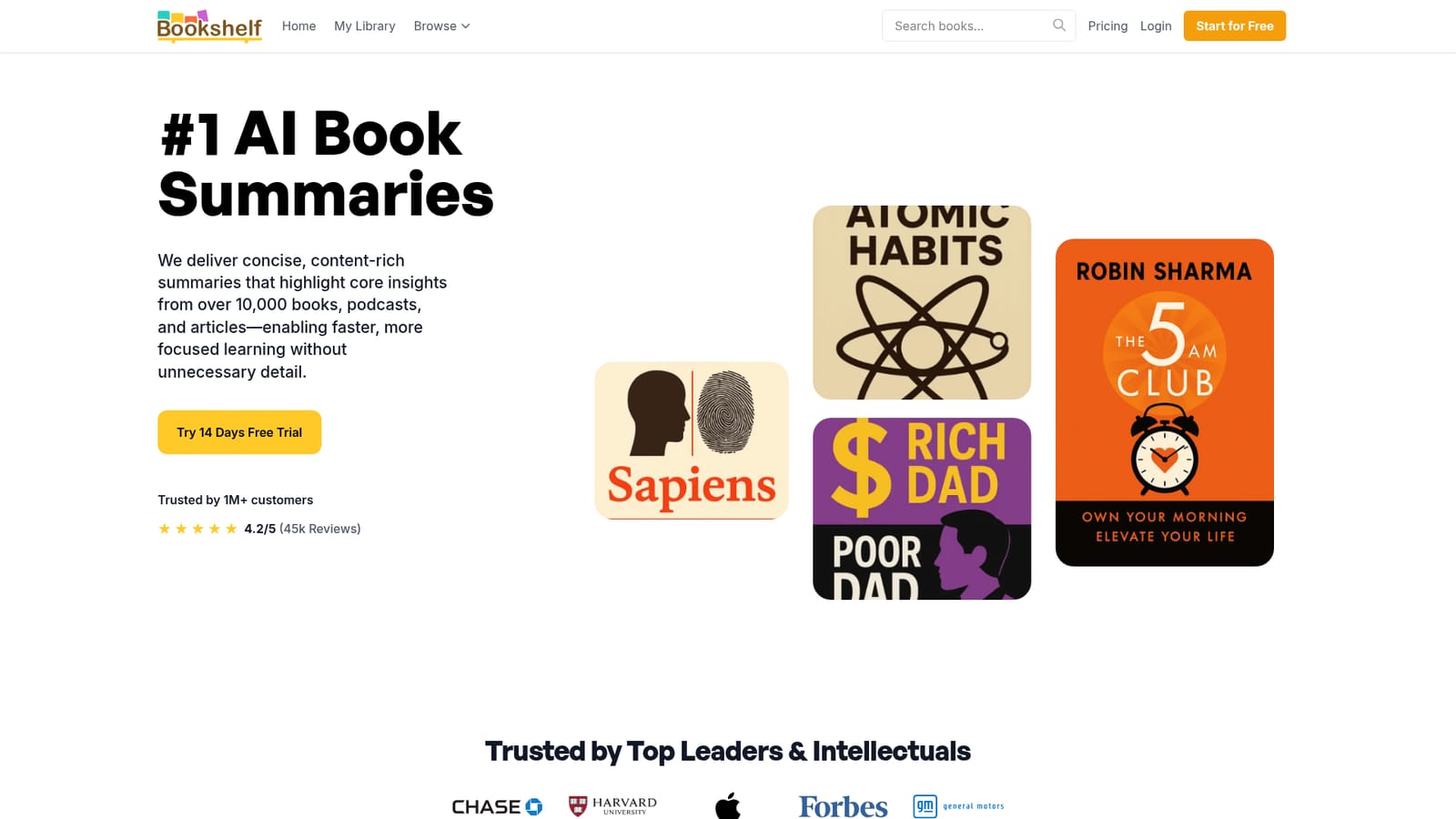
A 14 day free trial is offered from the homepage, giving access to the summary library before committing to a paid plan. Card requirements and what happens when the trial ends are not stated on the homepage.
Learn moreSummaries of more than 10,000 books, podcasts and articles, written as concise analytical overviews. Each title is available as audio, PDF and EPUB. Book pages show cover art, subtitle, author and community ratings, and author pages group titles by writer. The editorial approach emphasises plain language explanations of dense scholarship, cross disciplinary synthesis and brevity.
 AI Angels400+ customizable AI girlfriends for NSFW chat, voice calls, and roleplay
 Candy AIExperience the future of companionship with AI friends who chat, role-play, and connect with you on a human level.
 ourdream.aiA vast AI roleplay platform with millions of characters for chat, images, video and voiceAI Angels400+ customizable AI girlfriends for NSFW chat, voice calls, and roleplayCandy AIExperience the future of companionship with AI friends who chat, role-play, and connect with you on a human level.ourdream.aiA vast AI roleplay platform with millions of characters for chat, images, video and voice


