CataSEO

AI visibility engine that rewrites eCommerce product pages for Google and AI search.

Beginner
Screenshot of CataSEO, AI visibility engine that rewrites eCommerce product pages for Google and AI search

What is CataSEO?

CataSEO is an AI visibility engine for eCommerce stores. It analyzes your catalog and top competitors, then generates product descriptions, metadata, Open Graph, structured data and alt tags inside Shopify, BigCommerce, Wix or WooCommerce, with review and rollback on every change.

CataSEO is an AI visibility engine built for eCommerce catalogs. Rather than producing one-off product descriptions, it works through your existing store data: it reads your catalog, analyzes your top 10 competitors through Moz, and identifies which factors are driving their rankings. From that analysis it generates distinct product copy, metadata, Open Graph tags, social copy, image alt tags and structured data, all in a single pass per item. The workflow is built for merchants managing large SKU counts. You connect the store you already use (Shopify, BigCommerce, Wix or WooCommerce) and upload your catalog. CataSEO models your brand voice using 7 writing tones that can be customized, then fills in every field on every product. Nothing goes live without approval: each change is reviewed and editable, and any product can be rolled back to its prior version in one click. Optimization can run one product at a time or in batches, and can be scoped to entire categories and brands through Express Tokens, which the company treats as the same unit as a single product. Pricing runs on tokens, where one token equals one product, category or brand optimized. Express Tokens cost $0.75 each with a 10 token minimum and suit new products or quick updates. Batch Tokens are monthly plans: $25 for 50 products, $50 for 100 and $125 for 250, aimed at steady catalog work. CataSEO recommends refreshing roughly 10 percent of a catalog each month and cites a customer case where a one-time AI refresh produced a ranking spike that decayed within weeks, while weekly optimization produced a sustained 32 percent keyword gain. The tool suits mid-market and larger merchants, channel managers and SEO leads who cannot assign a writer to every SKU. It is narrower than a general AI writing assistant: the value comes from catalog scale, competitor benchmarking and the schema and metadata fields that general chatbots tend to skip. Enterprise plans exist for very large catalogs.

How do you use CataSEO?

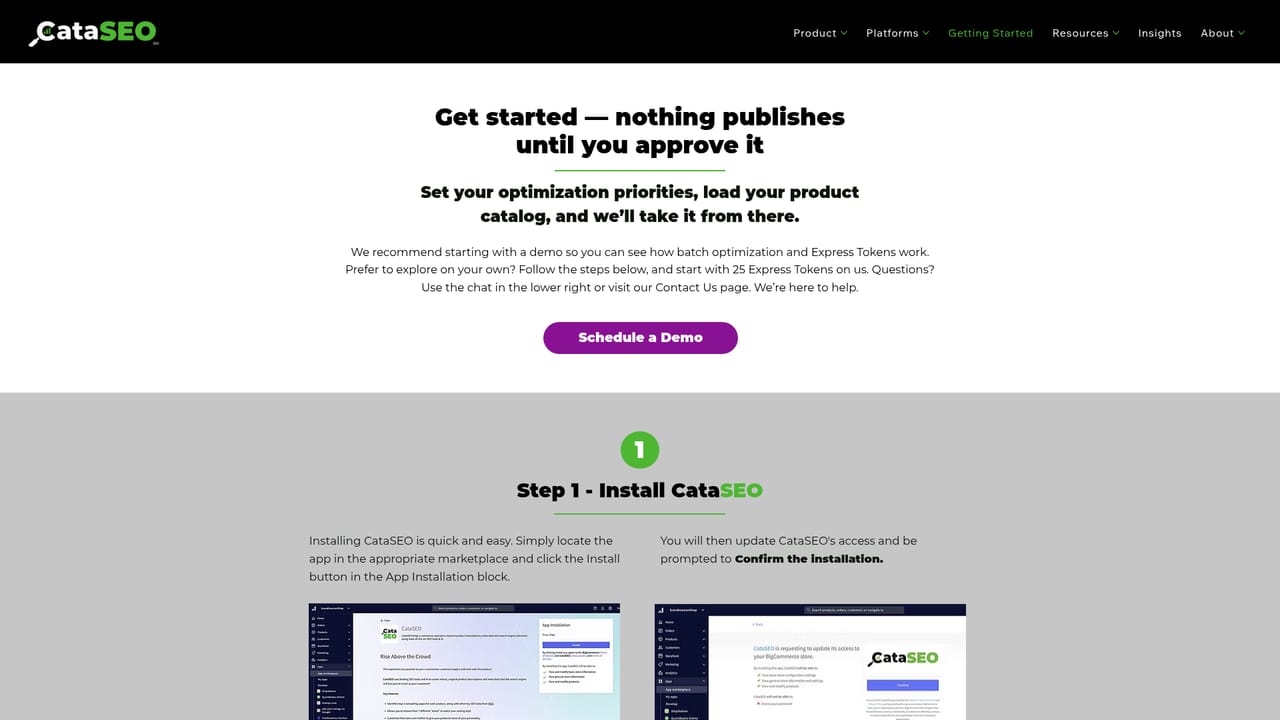
  1. 1Request access and connect your store
    Start from the getting started page to sign up for CataSEO, then connect the store you already use. Shopify, BigCommerce, Wix and WooCommerce are the supported platforms.
    CataSEO — Request access and connect your store
  2. 2Upload your product catalog
    Once connected, upload the catalog you want optimized. CataSEO then pulls your product data, competitor rankings and search signals to understand what is working and why.
  3. 3Set your brand voice
    Pick one of 7 writing tones and customize it so generated copy reflects your brand rather than generic catalog text. This setting governs every product the engine writes.
  4. 4Choose products and run optimization
    Prioritize by best sellers, inventory levels or newest products. Optimize a single item with Express Tokens or schedule batches, and include whole categories and brands where relevant.
  5. 5Review, approve and roll back
    Every generated description, meta tag, social snippet and alt tag is presented for review and editing before it goes live. Any product can be reverted to its previous version in one click.
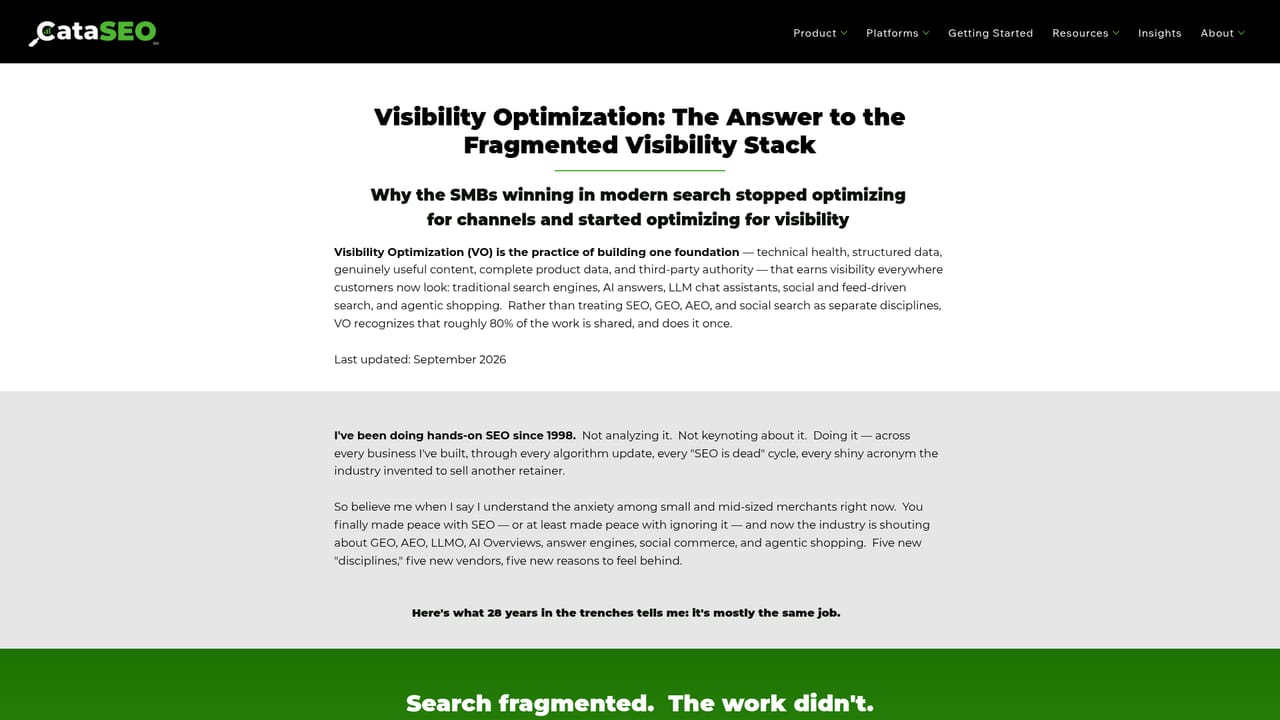
  6. 6Track visibility and keep going
    SEO gains decay after one-time refreshes, so keep a monthly cadence, roughly 10 percent of the catalog each month. Details on the continuous approach are on the visibility optimization page.
    CataSEO — Track visibility and keep going

Pros and cons

Pros

  • Covers the full page, not just descriptions: metadata, Open Graph, structured data and image alt tags are produced togetherAI
  • Works inside Shopify, BigCommerce, Wix and WooCommerce, so output lands in the store you already runAI
  • Competitor benchmarking through Moz on your top 10 rivals gives the copy a specific ranking targetAI
  • Every change is reviewable, editable and reversible to the prior version with one clickAI
  • Token model scales from single product updates to whole categories and brandsAI

Cons

  • Token pricing is metered, so cost rises with catalog size and refresh frequency rather than being a flat feeAI
  • The homepage does not state a free trial or free tier, so budget must be committed before testing output qualityAI
  • No native platform for users outside the four supported eCommerce systemsAI
  • Continuous optimization is effectively required for lasting results, which makes this an ongoing line itemAI

How much does CataSEO cost?

Pricing

Tokens map to products optimized (one product, category or brand equals one token). Express Tokens cost $0.75 each with a 10 token minimum. Batch Tokens run $25 per month for 50 products, $50 for 100 and $125 for 250. Custom enterprise plans cover very large catalogs; pricing is available via chat or contact form.

Learn more

Support

Support is reachable by email at info@cataseo.ai, by phone on the listed US numbers, and through a contact form on the contacting CataSEO page. The site also offers a newsletter for feature updates and a chat option for enterprise enquiries.

Learn more

Integrations

Runs inside Shopify, BigCommerce, Wix and WooCommerce. Competitor ranking analysis draws on Moz data, and CataSEO is listed as a Google Cloud and BigCommerce partner.

Features

Generates product descriptions alongside metadata, Open Graph tags, social copy, image alt tags and structured data in one workflow. Supports 7 customizable writing tones, competitor analysis of your top 10 rivals via Moz, prioritization by best sellers and inventory, batch or single-item optimization, category and brand level work through Express Tokens, and one-click rollback of any change.

Frequently asked questions about CataSEO

  • How much does CataSEO cost?
    Tokens map to products optimized (one product, category or brand equals one token). Express Tokens cost $0.75 each with a 10 token minimum. Batch Tokens run $25 per month for 50 products, $50 for 100 and $125 for 250. Custom enterprise plans cover very large catalogs; pricing is available via chat or contact form.
  • How do you use CataSEO?
    The walkthrough on this page covers 6 steps: 1. Request access and connect your store 2. Upload your product catalog 3. Set your brand voice 4. Choose products and run optimization 5. Review, approve and roll back 6. Track visibility and keep going.
  • What platforms does CataSEO support?
    CataSEO is available on Web App.
  • What does CataSEO integrate with?
    Runs inside Shopify, BigCommerce, Wix and WooCommerce. Competitor ranking analysis draws on Moz data, and CataSEO is listed as a Google Cloud and BigCommerce partner.
  • What are the limitations of CataSEO?
    Token pricing is metered, so cost rises with catalog size and refresh frequency rather than being a flat fee. The homepage does not state a free trial or free tier, so budget must be committed before testing output quality. No native platform for users outside the four supported eCommerce systems.

Status

StatusActive
Views0
Outbound clicks0
Added10/21/2026

Platforms

Web App

Pricing

PaidSubscription